Teresa C. Kulig – författare
Visar alla böcker från författaren Teresa C. Kulig. Handla med fri frakt och snabb leverans.
4 produkter
4 produkter
Häftad, Engelska, 2022
230 kr
Skickas inom 7-10 vardagar
School violence is a significant social concern. To better understand its sources, a comprehensive meta-analysis of the school violence and victimization literature was undertaken. Across 761 studies, the relative effects of 30 different individual, school, and community level correlates were assessed (8,790 effect size estimates). Violence and victimization were conceptualized broadly to include various forms of aggression and crime at school. The results revealed that the strongest correlates of school violence perpetration were antisocial behavior, deviant peers, antisocial attitudes, victimization, and peer rejection; and that the strongest correlates of school victimization were prior/other victimization, social competence, risk avoidance, antisocial behavior, and peer rejection. Extracurricular activities and school security devices had among the weakest associations in the meta-analysis, and several traditional criminological predictors did not perform well in the school context. We conclude with recommendations for theory, future research, and policy.
E-bok
Engelska, 2022275 kr
Läs direkt efter köp
School violence is a significant social concern. To better understand its sources, a comprehensive meta-analysis of the school violence and victimization literature was undertaken. Across 761 studies, the relative effects of 30 different individual, school, and community level correlates were assessed (8,790 effect size estimates). Violence and victimization were conceptualized broadly to include various forms of aggression and crime at school. The results revealed that the strongest correlates of school violence perpetration were antisocial behavior, deviant peers, antisocial attitudes, victimization, and peer rejection; and that the strongest correlates of school victimization were prior/other victimization, social competence, risk avoidance, antisocial behavior, and peer rejection. Extracurricular activities and school security devices had among the weakest associations in the meta-analysis, and several traditional criminological predictors did not perform well in the school context. We conclude with recommendations for theory, future research, and policy.
E-bok
PDF, Engelska, 2022275 kr
Läs direkt efter köp
School violence is a significant social concern. To better understand its sources, a comprehensive meta-analysis of the school violence and victimization literature was undertaken. Across 761 studies, the relative effects of 30 different individual, school, and community level correlates were assessed (8,790 effect size estimates). Violence and victimization were conceptualized broadly to include various forms of aggression and crime at school. The results revealed that the strongest correlates of school violence perpetration were antisocial behavior, deviant peers, antisocial attitudes, victimization, and peer rejection; and that the strongest correlates of school victimization were prior/other victimization, social competence, risk avoidance, antisocial behavior, and peer rejection. Extracurricular activities and school security devices had among the weakest associations in the meta-analysis, and several traditional criminological predictors did not perform well in the school context. We conclude with recommendations for theory, future research, and policy.
Häftad, Engelska, 2025
330 kr
Skickas inom 5-8 vardagar
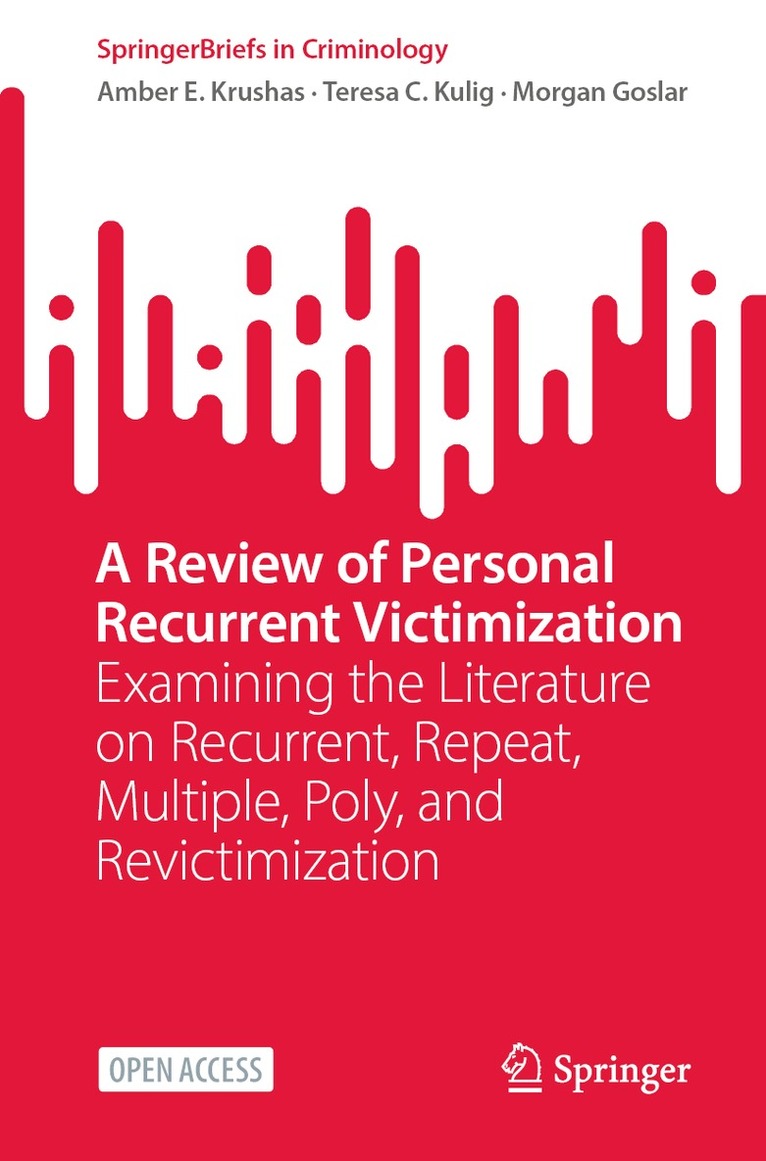
This open access brief summarizes the literature on personal recurrent victimization—broadly defined as experiencing more than one victimization. The featured research uses different categories of personal recurrent victimization to describe ways individuals can be victimized more than once, including (1) recurrent victimization, (2) repeat victimization, (3) multiple victimization, (4) poly-victimization, and (5) revictimization. Each chapter in this text reviews prior work on one of these five categories of personal recurrent victimization to provide an overview of this research in an accessible yet comprehensive way. While there is a large body of literature examining how and why some individuals experience more than one victimization, this is the first comprehensive review of research on each of these categories. As a result, this book is an excellent tool for students, researchers, and practitioners.