Tetlock - Böcker
Visar alla böcker från författaren Tetlock. Handla med fri frakt och snabb leverans.
2 produkter
2 produkter
1 893 kr
Skickas inom 3-6 vardagar
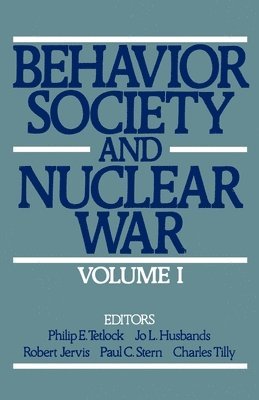
All people wish to avoid nuclear war, but this fact provides little guidance for policy. One reason is a lack of understanding of how a nuclear war might come about or how one could be prevented; much of what is offered as expert knowledge cannot be defended as more than educated opinion. Behavior, Society, and Nuclear War assesses current knowledge to create a basis for new intellectual approaches to the subject of international security that are conceptually rigorous, theoretically eclectic, and methodologically self-conscious. Leading scholars review specific behavioral and social phenomena and processes that may be critical in determining war and peace, including the behavior of decision makers during crises, the pressure of public opinion, the causes of war among great powers, and the processes of international security negotiation. This work was sponsored by the Committee on Contributions of Behavioral and Social Science to the Prevention of Nuclear War, Commission on Behavioral and Social Sciences and Education, National Research Council, National Academy of Sciences.
1 893 kr
Skickas inom 3-6 vardagar
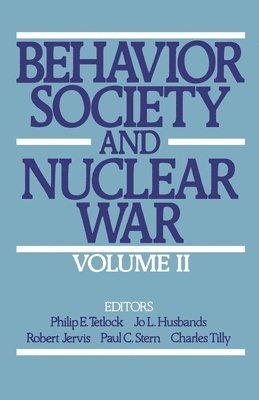
In the last year the world has witnessed changes in East-West relations that would have been unthinkable only a short time ago. The Berlin Wall has crumbled, Eastern Europe has thrown out its authoritarian leaders, and the Soviet Union itself has undergone dramatic changes in political structure and foreign policy. The U.S. public no longer regards the Eastern Bloc as the principal threat to national security. Yet even with the undeniable thaw in the Cold War many of the old scenarios for "World War III" remain as plausible as they were in the past, and new sources of instability could arise from ethnic conflicts, economic competition, or other sources. The second volume of Behavior, Society, and Nuclear War addresses the potential causes of nuclear war within the context of this changing political landscape. As in the first volume of this series, leading scholars review specific behavioral and social phenomena and processes that may be critical in determining war and peace-how foreign policy decision are made, the role of arms races, and the activities of third-party moderators.Volume Two also explores the effects of changing international conditions on the potential for the growing importance of conflicts between small powers, the possibility that techniques of reassurance can supplement deterrence, and the sources of moderation in Soviet security policy. Informed by the most up-to-date scholarship, Behavior, Society, and Nuclear War will be essential reading for anyone interested in international relations, disarmament, political science, and sociology.