Thomas F Gordon – författare
Visar alla böcker från författaren Thomas F Gordon. Handla med fri frakt och snabb leverans.
7 produkter
7 produkter
- Inbunden, Engelska, 1995
1 476 kr
Skickas inom 10-15 vardagar
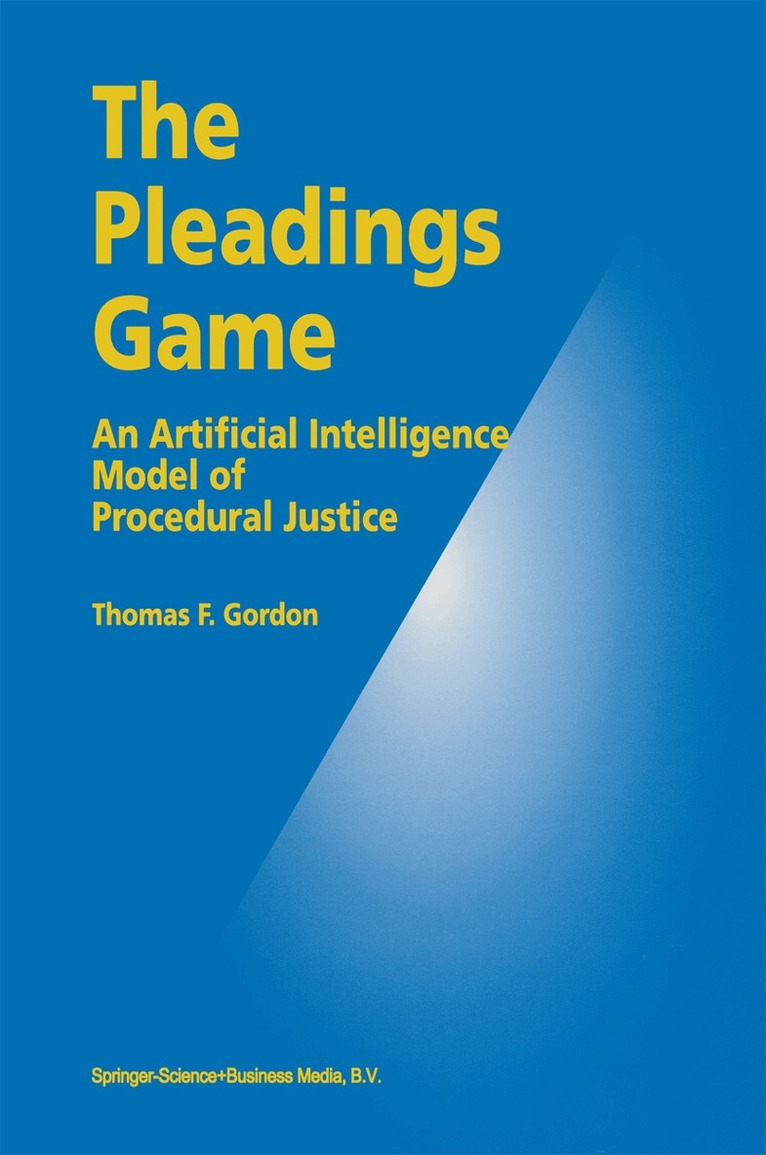
The British philosopher Stephan Toulmin, in his The Uses of Argument, made the provocative claim that "logic is generalized jurisprudence". For Toulmin, logic is the study of nonns for practical argumentation and decision making. In his view, mathematical logicians were preoccupied with fonnalizing the concepts of logical necessity, consequence and contradiction, at the expense of other equally important issues, such as how to allocate the burden of proof and make rational decisions given limited resources. He also considered it a mistake to look primarily to psychology, linguistics or the cognitive sciences for answers to these fundamentally nonnative questions. Toulmin's concerns about logic, writing in the 1950's, are equally applicable to the field of Artificial Intelligence today. The mainstream of Artificial Intelligence has focused on the analytical and empirical aspects of intelligence, without giving adequate attention to the nonnative, regulative functions of knowledge representation, problem solving and decision-making. Nonnative issues should now be of even greater interest, with the shift in perspective of AI from individual to collective intelligence, in areas such as multi-agent systems, cooperative design, distributed artificial intelligence, and computer-supported cooperative work. Networked "virtual societies" of humans and software agents would also require "virtual legal systems" to fairly balance interests, resolve conflicts, and promote security. - Inbunden, Engelska, 2022
499 kr
Skickas inom 5-8 vardagar
- Häftad, Engelska, 2022
388 kr
Skickas inom 5-8 vardagar
- Häftad, Engelska, 2013
216 kr
Skickas inom 5-8 vardagar
- Häftad, Engelska, 2010
1 433 kr
Skickas inom 10-15 vardagar
The British philosopher Stephan Toulmin, in his The Uses of Argument, made the provocative claim that "logic is generalized jurisprudence". For Toulmin, logic is the study of nonns for practical argumentation and decision making. In his view, mathematical logicians were preoccupied with fonnalizing the concepts of logical necessity, consequence and contradiction, at the expense of other equally important issues, such as how to allocate the burden of proof and make rational decisions given limited resources. He also considered it a mistake to look primarily to psychology, linguistics or the cognitive sciences for answers to these fundamentally nonnative questions. Toulmin's concerns about logic, writing in the 1950's, are equally applicable to the field of Artificial Intelligence today. The mainstream of Artificial Intelligence has focused on the analytical and empirical aspects of intelligence, without giving adequate attention to the nonnative, regulative functions of knowledge representation, problem solving and decision-making. Nonnative issues should now be of even greater interest, with the shift in perspective of AI from individual to collective intelligence, in areas such as multi-agent systems, cooperative design, distributed artificial intelligence, and computer-supported cooperative work. Networked "virtual societies" of humans and software agents would also require "virtual legal systems" to fairly balance interests, resolve conflicts, and promote security. - E-bokPDF, Engelska, 2013
1 746 kr
Läs direkt efter köp
The British philosopher Stephan Toulmin, in his The Uses of Argument, made the provocative claim that "logic is generalized jurisprudence". For Toulmin, logic is the study of nonns for practical argumentation and decision making. In his view, mathematical logicians were preoccupied with fonnalizing the concepts of logical necessity, consequence and contradiction, at the expense of other equally important issues, such as how to allocate the burden of proof and make rational decisions given limited resources. He also considered it a mistake to look primarily to psychology, linguistics or the cognitive sciences for answers to these fundamentally nonnative questions. Toulmin''s concerns about logic, writing in the 1950''s, are equally applicable to the field of Artificial Intelligence today. The mainstream of Artificial Intelligence has focused on the analytical and empirical aspects of intelligence, without giving adequate attention to the nonnative, regulative functions of knowledge representation, problem solving and decision-making. Nonnative issues should now be of even greater interest, with the shift in perspective of AI from individual to collective intelligence, in areas such as multi-agent systems, cooperative design, distributed artificial intelligence, and computer-supported cooperative work. Networked "virtual societies" of humans and software agents would also require "virtual legal systems" to fairly balance interests, resolve conflicts, and promote security.