Thomas Keijser – författare
Visar alla böcker från författaren Thomas Keijser. Handla med fri frakt och snabb leverans.
8 produkter
8 produkter
E-bok
PDF, Engelska, 20122 997 kr
Läs direkt efter köp
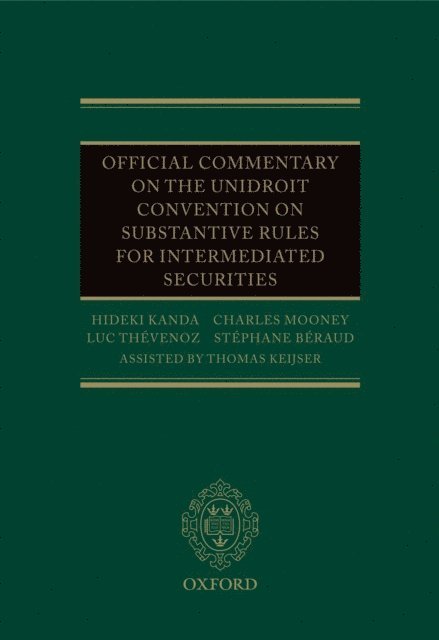
This authoritative guide to the Geneva Securities Convention is the first and only UNIDROIT backed analysis of the content of the international treaty. It streamlines the otherwise complicated and numerous transactions of intermediated securities providing easy access for practitioners and scholars in the field. The Commentary is written by participants to the negotiations and discussions which resulted in the final version of the treaty.The Geneva Securities Convention was developed as a result of the change in the way that securities are held and highlights the position of intermediated securities at the core of the international financial system. The Convention includes key provisions for governing intermediated securities designed to harmonise domestic law and clarify points of difficulty. The general introduction to the commentary sets out the reasons for developing the Convention and the principal concepts underlying its development. The main part of the commentary follows the structure of the Convention and is arranged on an article-by-article basis. The treatment of each article is subdivided into three main parts: An introduction explaining the main goal of that article; a section setting out the genesis of the provision during intergovernmental negotiation; and a part discussing in depth the application of the provision with reference to practical examples.The Convention is a highly complex instrument and the commentary provides much-needed guidance to the application and interpretation of its provisions. This is a must-have reference for lawyers and scholars interested in financial law, as well as securities intermediaries, clearing houses, banks and government officials.
E-bok
Engelska, 20122 089 kr
Läs direkt efter köp
This authoritative guide to the Geneva Securities Convention is the first and only UNIDROIT backed analysis of the content of the international treaty. It streamlines the otherwise complicated and numerous transactions of intermediated securities providing easy access for practitioners and scholars in the field. The Commentary is written by participants to the negotiations and discussions which resulted in the final version of the treaty.The Geneva Securities Convention was developed as a result of the change in the way that securities are held and highlights the position of intermediated securities at the core of the international financial system. The Convention includes key provisions for governing intermediated securities designed to harmonise domestic law and clarify points of difficulty. The general introduction to the commentary sets out the reasons for developing the Convention and the principal concepts underlying its development. The main part of the commentary follows the structure of the Convention and is arranged on an article-by-article basis. The treatment of each article is subdivided into three main parts: An introduction explaining the main goal of that article; a section setting out the genesis of the provision during intergovernmental negotiation; and a part discussing in depth the application of the provision with reference to practical examples.The Convention is a highly complex instrument and the commentary provides much-needed guidance to the application and interpretation of its provisions. This is a must-have reference for lawyers and scholars interested in financial law, as well as securities intermediaries, clearing houses, banks and government officials.
E-bok
PDF, Engelska, 20141 674 kr
Läs direkt efter köp
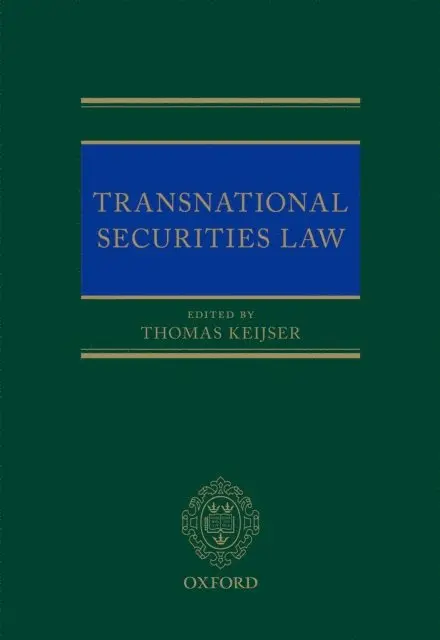
Bringing together a team of globally renowned academics and expert practitioners in the field, this new work presents the first comprehensive analysis of the Geneva and Hague Securities Conventions and related initiatives including those of UNCITRAL and regulatory authorities. It explores the international harmonization of the law relating to securities, and identifies issues that have not yet been harmonized.The book explains the current international law on intermediated and non-intermediated securities and suggests solutions to problems where there are gaps in the legislation or where the current framework could be improved.Taking the Geneva and Hague Securities Conventions as its starting point, the book focuses on private law, including substantive and conflict-of-law issues, as well as looking at recent regulatory developments. Each chapter assesses the current state of the law, and, for issues that have not yet been harmonized, presents possible ways to reach further harmonization and identifies best standard practice solutions.The first book to provide a comprehensive analysis of securities law at the transnational level; it contributes to the wider discussion on further harmonization, while also providing best-practice solutions to practitioners in relation to non-harmonized issues.
E-bok
Engelska, 20141 659 kr
Läs direkt efter köp
Bringing together a team of globally renowned academics and expert practitioners in the field, this new work presents the first comprehensive analysis of the Geneva and Hague Securities Conventions and related initiatives including those of UNCITRAL and regulatory authorities. It explores the international harmonization of the law relating to securities, and identifies issues that have not yet been harmonized.The book explains the current international law on intermediated and non-intermediated securities and suggests solutions to problems where there are gaps in the legislation or where the current framework could be improved.Taking the Geneva and Hague Securities Conventions as its starting point, the book focuses on private law, including substantive and conflict-of-law issues, as well as looking at recent regulatory developments. Each chapter assesses the current state of the law, and, for issues that have not yet been harmonized, presents possible ways to reach further harmonization and identifies best standard practice solutions.The first book to provide a comprehensive analysis of securities law at the transnational level; it contributes to the wider discussion on further harmonization, while also providing best-practice solutions to practitioners in relation to non-harmonized issues.
E-bok
PDF, Engelska, 20222 655 kr
Läs direkt efter köp
Bringing together a team of globally renowned academics and expert practitioners in the field, Transnational Securities Law , Second Edition, presents a comprehensive analysis of the international harmonization of the law relating to securities. The book focuses on private law, insolvency law, and conflict-of-laws issues, as well as providing in-depth guidance on recent regulatory and technological developments. Each chapter assesses the current state of the law, and, for issues that have not yet been harmonized, identifies best standard practice solutions.This fully revised and updated edition considers the regulatory intervention in the wake of the global financial crisis and the impact of ground-breaking technological innovations in the securities markets, with a particular focus on blockchain and other types of distributed ledger technology, smart contracts, and crypto-securities. In so doing it addresses the paucity of attention given to issues of investor protection and custody of digital assets, and provides guidance on the development from legacy technology to a landscape in which a variety of DLT solutions are increasingly applied. It furthermore proposes an approach toward solving or ameliorating prevailing legal and regulatory problems with enhanced systems, infrastructures, regulatory approaches, and private-law doctrine.Alongside the well-established and comprehensive analysis of securities law at the transnational level, this new edition continues to provide best-practice solutions for practitioners working in the field of securities law.
E-bok
Engelska, 20222 655 kr
Läs direkt efter köp
Bringing together a team of globally renowned academics and expert practitioners in the field, Transnational Securities Law , Second Edition, presents a comprehensive analysis of the international harmonization of the law relating to securities. The book focuses on private law, insolvency law, and conflict-of-laws issues, as well as providing in-depth guidance on recent regulatory and technological developments. Each chapter assesses the current state of the law, and, for issues that have not yet been harmonized, identifies best standard practice solutions.This fully revised and updated edition considers the regulatory intervention in the wake of the global financial crisis and the impact of ground-breaking technological innovations in the securities markets, with a particular focus on blockchain and other types of distributed ledger technology, smart contracts, and crypto-securities. In so doing it addresses the paucity of attention given to issues of investor protection and custody of digital assets, and provides guidance on the development from legacy technology to a landscape in which a variety of DLT solutions are increasingly applied. It furthermore proposes an approach toward solving or ameliorating prevailing legal and regulatory problems with enhanced systems, infrastructures, regulatory approaches, and private-law doctrine.Alongside the well-established and comprehensive analysis of securities law at the transnational level, this new edition continues to provide best-practice solutions for practitioners working in the field of securities law.
Inbunden, Engelska, 2022
3 553 kr
Skickas inom 5-8 vardagar
Bringing together a team of globally renowned academics and expert practitioners in the field, Transnational Securities Law , Second Edition, presents a comprehensive analysis of the international harmonization of the law relating to securities. The book focuses on private law, insolvency law, and conflict-of-laws issues, as well as providing in-depth guidance on recent regulatory and technological developments. Each chapter assesses the current state of the law, and, for issues that have not yet been harmonized, identifies best standard practice solutions.This fully revised and updated edition considers the regulatory intervention in the wake of the global financial crisis and the impact of ground-breaking technological innovations in the securities markets, with a particular focus on blockchain and other types of distributed ledger technology, smart contracts, and crypto-securities. In so doing it addresses the paucity of attention given to issues of investor protection and custody of digital assets, and provides guidance on the development from legacy technology to a landscape in which a variety of DLT solutions are increasingly applied. It furthermore proposes an approach toward solving or ameliorating prevailing legal and regulatory problems with enhanced systems, infrastructures, regulatory approaches, and private-law doctrine.Alongside the well-established and comprehensive analysis of securities law at the transnational level, this new edition continues to provide best-practice solutions for practitioners working in the field of securities law.
Inbunden, Engelska, 2012
3 869 kr
Skickas inom 7-10 vardagar
This authoritative guide to the Geneva Securities Convention is the first and only UNIDROIT backed analysis of the content of the international treaty. It streamlines the otherwise complicated and numerous transactions of intermediated securities providing easy access for practitioners and scholars in the field. The Commentary is written by participants to the negotiations and discussions which resulted in the final version of the treaty.The Geneva Securities Convention was developed as a result of the change in the way that securities are held and highlights the position of intermediated securities at the core of the international financial system. The Convention includes key provisions for governing intermediated securities designed to harmonise domestic law and clarify points of difficulty. The general introduction to the commentary sets out the reasons for developing the Convention and the principal concepts underlying its development. The main part of the commentary follows the structure of the Convention and is arranged on an article-by-article basis. The treatment of each article is subdivided into three main parts: An introduction explaining the main goal of that article; a section setting out the genesis of the provision during intergovernmental negotiation; and a part discussing in depth the application of the provision with reference to practical examples.The Convention is a highly complex instrument and the commentary provides much-needed guidance to the application and interpretation of its provisions. This is a must-have reference for lawyers and scholars interested in financial law, as well as securities intermediaries, clearing houses, banks and government officials.