Tianyang Liu – författare
2 184 kr
Skickas inom 10-15 vardagar
658 kr
Skickas inom 10-15 vardagar
757 kr
Läs direkt efter köp
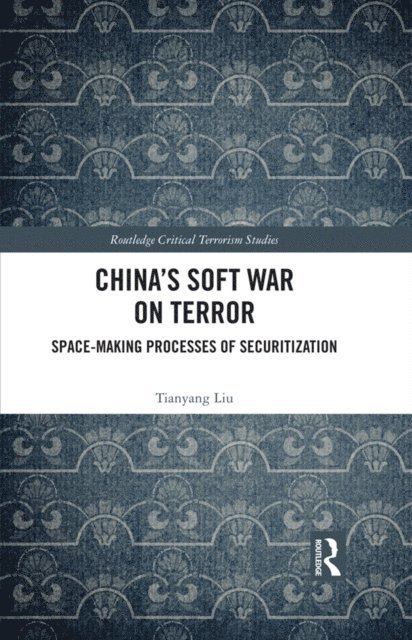
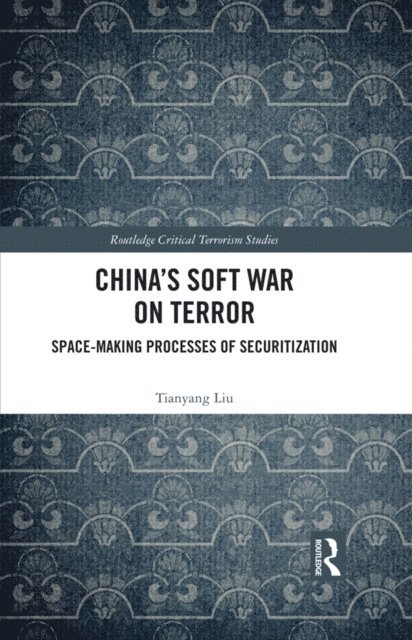
This book explores how the Chinese government reasserts its control and management of public spaces as part of its overall counter-terrorism strategy.
The work focuses primarily on the banal and alternative forms that China’s ‘war on terror’ takes: the everyday, non-military, socio-economic and spatio-material. It presents three different cases of control associated with the state’s effort to manage material, social and digital public spaces as remedies to terrorism and ethnic unrest in China: the redevelopment project of Kashgar—the ‘home’ of Uyghur culture—from 2001 to 2017; the forging of local partnerships with potential agents (i.e. the local cadres and imams in Xinjiang) as part of the process of implementing counter-terrorism policies; and an online campaign about international terrorism that appeared on Sina Weibo. Using securitization theory as a theoretical framework, the book establishes links between human geography and critical security studies and advances the understanding of non-confrontational forms of resistance in China. It also focuses attention on the binary relationship between the securitizing agency of the state and the counter-securitization agency of ‘terrorists’, while also exploring the manner in which other societal forces interact with these processes.
This book will be of interest to students of critical terrorism studies, Chinese studies, human geography, and security studies.
757 kr
Läs direkt efter köp
This book explores how the Chinese government reasserts its control and management of public spaces as part of its overall counter-terrorism strategy.
The work focuses primarily on the banal and alternative forms that China’s ‘war on terror’ takes: the everyday, non-military, socio-economic and spatio-material. It presents three different cases of control associated with the state’s effort to manage material, social and digital public spaces as remedies to terrorism and ethnic unrest in China: the redevelopment project of Kashgar—the ‘home’ of Uyghur culture—from 2001 to 2017; the forging of local partnerships with potential agents (i.e. the local cadres and imams in Xinjiang) as part of the process of implementing counter-terrorism policies; and an online campaign about international terrorism that appeared on Sina Weibo. Using securitization theory as a theoretical framework, the book establishes links between human geography and critical security studies and advances the understanding of non-confrontational forms of resistance in China. It also focuses attention on the binary relationship between the securitizing agency of the state and the counter-securitization agency of ‘terrorists’, while also exploring the manner in which other societal forces interact with these processes.
This book will be of interest to students of critical terrorism studies, Chinese studies, human geography, and security studies.
807 kr
Läs direkt efter köp
This book explores how Chinese border provinces have become actors in international relations.
Through an analysis of the international actorness – the inherent characteristics of a subnational entity as an international player – of Yunnan and two other geographically peripheral provinces, Guangdong and Guangxi, the domestic, economic, and legislative circumstances that motivated these provinces to conduct transboundary engagements are determined. The book is based on an extensive field study including interviews with those involved in the implementation of Yunnan’s foreign agenda, representatives from province-owned enterprises, universities and think tanks, and officials and experts from the countries neighboring Yunnan. Acknowledging the role of external geopolitics, the authors analyze the efforts of these border provinces to incentivize neighboring countries to cooperate with them on areas of trade, investment, and nontraditional security. Yao Song and Tianyang Liu also observe how border provinces have leveraged their paradiplomatic strengths to affect China’s foreign relations with neighboring countries.
This volume will appeal to researchers, academics, and postgraduates in political science, international relations, and diplomacy as well as geography, Southeast Asian politics, political economy, Chinese periphery diplomacy, and nonfederal paradiplomacy.
807 kr
Läs direkt efter köp
This book explores how Chinese border provinces have become actors in international relations.
Through an analysis of the international actorness – the inherent characteristics of a subnational entity as an international player – of Yunnan and two other geographically peripheral provinces, Guangdong and Guangxi, the domestic, economic, and legislative circumstances that motivated these provinces to conduct transboundary engagements are determined. The book is based on an extensive field study including interviews with those involved in the implementation of Yunnan’s foreign agenda, representatives from province-owned enterprises, universities and think tanks, and officials and experts from the countries neighboring Yunnan. Acknowledging the role of external geopolitics, the authors analyze the efforts of these border provinces to incentivize neighboring countries to cooperate with them on areas of trade, investment, and nontraditional security. Yao Song and Tianyang Liu also observe how border provinces have leveraged their paradiplomatic strengths to affect China’s foreign relations with neighboring countries.
This volume will appeal to researchers, academics, and postgraduates in political science, international relations, and diplomacy as well as geography, Southeast Asian politics, political economy, Chinese periphery diplomacy, and nonfederal paradiplomacy.
2 422 kr
Skickas inom 10-15 vardagar
681 kr
Skickas inom 10-15 vardagar
404 kr
Läs direkt efter köp
404 kr
Läs direkt efter köp
793 kr
Skickas inom 10-15 vardagar
490 kr
Skickas inom 10-15 vardagar
633 kr
Läs direkt efter köp
This book explores the geographies of (in-)security for ordinary Chinese. It advocates for a critical examination of the geography of Chinese school violence, arguing that schools are not simply containers for state policy but active channels through which spatial securitization and everyday violence converge. By analyzing the pervasive fear in schools, the analysis unravels the spatial dimensions of violence—its landscape, continuum, and social support networks. The narrative then shifts to public hospital spaces in China, arguing that local forms of hospital violence (known as Yi Nao) transforms these institutions into battlegrounds for moral and political resources. Contesting parties include patients, Yi Nao gangs, medical professionals, government agencies, and hospital administration. The final section demystifies security as applied to graves, often distanced from our daily existence, by adapting the cultural and spatial tenets of Feng Shui. It sheds light on the pursuit of Feng Shui-defined security during burial site selection and related conflicts in rural China. This study offers a compelling and vivid study of the ways that Chinese engage with their built environment, and will interest scholars of Asia, of geography and of politics.
490 kr
Skickas inom 10-15 vardagar