Tim Caro - Böcker
Visar alla böcker från författaren Tim Caro. Handla med fri frakt och snabb leverans.
8 produkter
8 produkter
2 025 kr
Skickas inom 3-6 vardagar
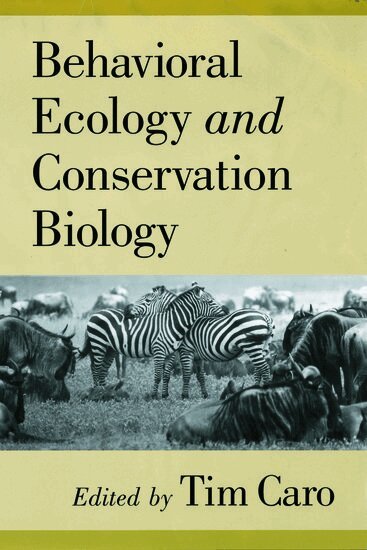
In the last few years, a handful of behavioural ecologists, increasingly concerned about species losses, have begun to address issues in conservation biology. Using data collected in the course of their fieldwork on mating systems, foraging behaviour, or habitat preferences, or simply by working on an endangered species, they have started to apply their findings to models of population growth and effective population size, hands-on management, and developing conservation strategies. This edited volume is the first attempt to link these disciplines formally.
1 801 kr
Skickas inom 5-8 vardagar
Behavioural ecologists study the strategies that individual animals use to maximize their genetic representation in future generations; conservation biologists study small populations and attempt to stem the tide of species extinctions. In the last few years, a handful of behavioural ecologists, increasingly concerned about species losses, have begun to address issues in conservation biology. Using data collected in the course of their fieldwork on mating systems, foraging behaviour, or habitat preferences, or simply by working on an endangered species, they have started to apply their findings to models of population growth and effective population size, hands-on management, and developing conservation strategies. This edited volume is the first attempt to link these disciplines formally.
423 kr
Skickas inom 7-10 vardagar
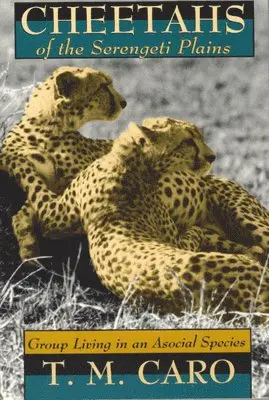
This text provides a comprehensive account of carnivore social behaviour. Synthesizing more than a decade of research in the wild, it offers a detailed account of the behaviour and ecology of cheetahs. Compared with other large cats, and other mammals, cheetahs have an unusual breeding system; whereas lions live in prides and tigers are solitary, some cheetahs live in groups while others live by themselves. Tim Caro explores group and solitary living among cheetahs and discovers that the causes of social behaviour vary dramatically, even within a single species. Why do cheetah cubs stay with their mother for a full year after weaning? Why do adolescents remain in groups? Why do adult males live in permanent associations with each other? Why do adult females live alone? Through observations on the costs and benefits of group living, Caro offers new insight into the complex behaviour of this species. For example, contrary to common belief about co-operative hunting in large carnivores, he shows that neither adolescents nor adult males benefit from hunting in groups.With many surprising findings, and through comparisons with other cat species, Caro aims to enrich our understanding of the evolution of social behaviour and offer new perspectives on conservation efforts to save this endangered carnivore.
494 kr
Skickas inom 7-10 vardagar
In nature, the ability to defend against predators is fundamental to an animal's survival. From the giraffes that rely on their spotted coats to blend into the patchy light of their woodland habitats to the South American sea lions that pile themselves in heaps to ward off the killer whales that prey on them in the shallow surf, defense strategies in the animal kingdom are seemingly innumerable. In Antipredator Defenses in Birds and Mammals, Tim Caro ambitiously synthesizes predator defenses in birds and mammals and integrates all functional and evolutionary perspectives on antipredator defenses that have developed over the last century. Structured chronologically along a hypothetical sequence of predation - Caro evokes a gazelle fawn desperate to survive a cheetah attack to illustrate the continuum of the evolution of antipredator defenses - Antipredator Defenses in Birds and Mammals considers the defenses that prey use to avoid detection by predators; the benefits of living in groups; morphological and behavioral defenses in individuals and groups; and, finally, flight and adaptations of last resort.Antipredator Defenses in Birds and Mammals will be of interest to both specialists and general readers interested in ecological issues.
384 kr
Skickas inom 7-10 vardagar
From eminent biologists like Alfred Russel Wallace and Charles Darwin to famous authors such as Rudyard Kipling in his Just So Stories, many people have asked, "Why do zebras have stripes?" There are many explanations, but until now hardly any have been seriously addressed or even tested. In Zebra Stripes, Tim Caro takes readers through a decade of painstaking fieldwork examining the significance of black-and-white striping and, after systematically dismissing every hypothesis for these markings with new data, he arrives at a surprising conclusion: zebra's markings are nature's defense against biting fly annoyance. Popular explanations for stripes range from camouflage to confusion of predators, social facilitation, and even temperature regulation. It is a challenge to test these proposals on large animals living in the wild, but using a combination of careful observations, simple field experiments, comparative information, and logic, Caro is able to weigh up, scientifically, the pros and cons of each idea.Eventually driven by experiments showing that biting flies avoid landing on striped surfaces, observations that striping is most intense where biting flies are abundant, and by his knowledge of zebras' susceptibility to biting flies and vulnerability to the diseases that flies carry Caro concludes that black-and-white stripes are an adaptation to thwart biting fly attack. Not just a tale of one scientist's quest to solve a classic mystery of biology, Zebra Stripes is also a testament to the tremendous value of longitudinal research in behavioral ecology, demonstrating how observation, experiment, and comparative research can reshape our understanding of the natural world.
2 712 kr
Kommande
A principal coloration scientist offers a comprehensive and beautifully illustrated synthesis of coloration in mammals, weaving together contemporary research on evolution, underlying genetics, visual systems, and relevance to humans. Why are giant pandas black and white, mandrills red and blue, but mice brown? How do mammalian colors and patterns develop? And why do we see in three colors, but deer do not? A cadre of evolutionary scientists, including geneticists, behavioral ecologists, visual ecologists, and anthropologists have worked for over a century to answer these and other questions about the origin and functions of mammal coloration in nature. One of them is celebrated biologist Tim Caro, who has studied animal coloration for over three decades. In this landmark book, he presents a synthesis of experimental and observational studies to explain how and why animal coloration has evolved for three primary reasons: protection against predators, communication, and to respond to environmental factors. Furthermore, Caro provides accessible descriptions of the various genetic and visual mechanisms that have shaped mammals’ extraordinarily diverse colors and patterns. Victorian naturalists were the first to recognize that coloration influences individuals’ survival and reproduction, and this led to an explosion of research on its adaptive significance a century later. Then, at the beginning of the twentieth century, biologists began to work on the genomic and developmental basis of coloration. Since then, genetic studies on model organisms, particularly mice, have led to a deep understanding of the genes regulating the production of melanin pigments and lately, pattern formation. Simultaneously, scientists have studied organisms’ color perception. However, these functional, molecular, and mechanistic approaches rarely overlap, as they historically emanate from different areas of science. In this book, Caro ties these areas of research together for the first time. Caro outlines perception and production of color; teases apart different aspects of protective coloration; discusses social and sexual signaling; explores environmental drivers of coloration in nonhuman mammals, including domesticated species; and discusses human biology and our use of color in clothing. The resulting volume offers readers both a holistic view of today’s science and an honest assessment of the remaining questions for future research.
1 031 kr
Kommande
A principal coloration scientist offers a comprehensive and beautifully illustrated synthesis of coloration in mammals, weaving together contemporary research on evolution, underlying genetics, visual systems, and relevance to humans. Why are giant pandas black and white, mandrills red and blue, but mice brown? How do mammalian colors and patterns develop? And why do we see in three colors, but deer do not? A cadre of evolutionary scientists, including geneticists, behavioral ecologists, visual ecologists, and anthropologists have worked for over a century to answer these and other questions about the origin and functions of mammal coloration in nature. One of them is celebrated biologist Tim Caro, who has studied animal coloration for over three decades. In this landmark book, he presents a synthesis of experimental and observational studies to explain how and why animal coloration has evolved for three primary reasons: protection against predators, communication, and to respond to environmental factors. Furthermore, Caro provides accessible descriptions of the various genetic and visual mechanisms that have shaped mammals’ extraordinarily diverse colors and patterns. Victorian naturalists were the first to recognize that coloration influences individuals’ survival and reproduction, and this led to an explosion of research on its adaptive significance a century later. Then, at the beginning of the twentieth century, biologists began to work on the genomic and developmental basis of coloration. Since then, genetic studies on model organisms, particularly mice, have led to a deep understanding of the genes regulating the production of melanin pigments and lately, pattern formation. Simultaneously, scientists have studied organisms’ color perception. However, these functional, molecular, and mechanistic approaches rarely overlap, as they historically emanate from different areas of science. In this book, Caro ties these areas of research together for the first time. Caro outlines perception and production of color; teases apart different aspects of protective coloration; discusses social and sexual signaling; explores environmental drivers of coloration in nonhuman mammals, including domesticated species; and discusses human biology and our use of color in clothing. The resulting volume offers readers both a holistic view of today’s science and an honest assessment of the remaining questions for future research.
Conservation by Proxy
Indicator, Umbrella, Keystone, Flagship, and Other Surrogate Species
Häftad, Engelska, 2010
739 kr
Skickas inom 5-8 vardagar
Because of the scope of conservation problems, biologists and managers often rely on 'surrogate' species to act as proxies to represent larger conservation issues. In "Conservation by Proxy", conservation biologist and field researcher Tim Caro offers systematic definitions of surrogate species concepts, explores the theories behind them, considers how surrogate species are chosen, examines evidence for and against their utility, and makes recommendations for their continued use. "Conservation by Proxy" is a benchmark reference that provides clear definitions and common understanding of the evidence and theory behind surrogate species. It is the first book to review and bring together literature on more than fifteen types of surrogate species, enabling us to assess their role in conservation and offering guidelines on how they can be used most effectively.