Timothy G. Feeman - Böcker
Visar alla böcker från författaren Timothy G. Feeman. Handla med fri frakt och snabb leverans.
5 produkter
5 produkter
562 kr
Skickas inom 7-10 vardagar
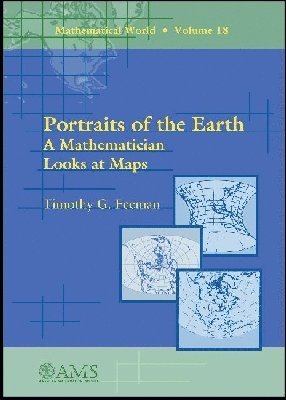
'Every map is a tool, a product of human effort and creativity, that represents some aspects of our world or universe...[This] course was powered by the belief that by exploring the mathematical ideas involved in creating and analyzing maps, students would see how mathematics could help them to understand and explain their world' - from the Preface. ""Portraits of the Earth"" exemplifies the AMS' mission to bring the power and vitality of mathematical thought to the nonexpert. It is designed to teach students to think logically and to analyze the technical information that they so readily encounter every day. Maps are exciting, visual tools that we encounter on a daily basis: from street maps to maps of the world accompanying news stories to geologic maps depicting the underground structure of the earth.This book explores the mathematical ideas involved in creating and analyzing maps, a topic that is rarely discussed in undergraduate courses. It is the first modern book to present the famous problem of mapping the earth in a style that is highly readable and mathematically accessible to most students. Feeman's writing is inviting to the novice, yet also interesting to readers with more mathematical experience. Through the visual context of maps and mapmaking, students will see how contemporary mathematics can help them to understand and explain the world. Topics explored are the shape and size of the earth, basic spherical geometry, and why one can't make a perfect flat map of the planet.The author discusses different attributes that maps can have and determines mathematically how to design maps that have the desired features. The distortions that arise in making world maps are quantitatively analyzed. There is an in-depth discussion on the design of numerous map projections - both historical and contemporary - as well as conformal and equal-area maps. Feeman looks at how basic map designs can be modified to produce maps with any center, and he indicates how to generalize methods to produce maps of arbitrary surfaces of revolution. Also included are end-of-chapter exercises and laboratory projects.Particularly interesting is a chapter that explains how to use MapleR add-on software to make maps from geographic data points. This book would make an excellent text for a basic undergraduate mathematics or geography course and would be especially appealing to the teacher who is interested in exciting visual applications in the classroom. It would also serve nicely as supplementary reading for a course in calculus, linear algebra, or differential geometry. Prerequisites include a solid grasp of trigonometry and basic calculus.
750 kr
Skickas inom 10-15 vardagar
This textbook is designed for a first course in linear algebra for undergraduate students from a wide range of quantitative and data driven fields.
538 kr
Skickas inom 10-15 vardagar
This textbook is designed for a first course in linear algebra for undergraduate students from a wide range of quantitative and data driven fields.
663 kr
Skickas inom 10-15 vardagar
The basic mathematics of computerized tomography, the CT scan, are aptly presented for an audience of undergraduates in mathematics and engineering.
663 kr
Skickas inom 10-15 vardagar
The basic mathematics of computerized tomography, the CT scan, are aptly presented for an audience of undergraduates in mathematics and engineering. Assuming no prior background in advanced mathematical analysis, topics such as the Fourier transform, sampling, and discrete approximation algorithms are introduced from scratch and are developed within the context of medical imaging. A chapter on magnetic resonance imaging focuses on manipulation of the Bloch equation, the system of differential equations that is the foundation of this important technology. Extending the ideas of the acclaimed first edition, new material has been adeed to render an even more accessible textbook for course usage. This edition includes new discussions of the Radon transform, the Dirac delta function and its role in X-ray imaging, Kacmarz’s method and least squares approximation, spectral filtering, and more. Copious examples and exercises, new computer-based exercises, and additional graphics have been added to further delineate concepts. The use of technology has been revamped throughout with the incorporation of the open source programming environment R to illustrate examples and composition of graphics. All R code is available as extra source material on SpringerLink.From the reviews of the first edition:“This book is valuable, for it addresses with care and rigor the relevance of a variety of mathematical topics to a real-world problem. …This book is well written. It serves its purpose of focusing a variety of mathematical topics onto a real-world application that is in its essence mathematics.” –The Journal of Nuclear Medicine, Vol. 51 (12), December, 2010“This new book by Timothy Feeman, truly intended to be a beginner’s guide, makes the subject accessible to undergraduates with a working knowledge of multivariable calculus and some experience with vectors and matrix methods. …author handles thematerial with clarity and grace…” –The Mathematical Association of America, February, 2010