Timothy W. Finin – författare
Visar alla böcker från författaren Timothy W. Finin. Handla med fri frakt och snabb leverans.
3 produkter
3 produkter
562 kr
Skickas inom 10-15 vardagar
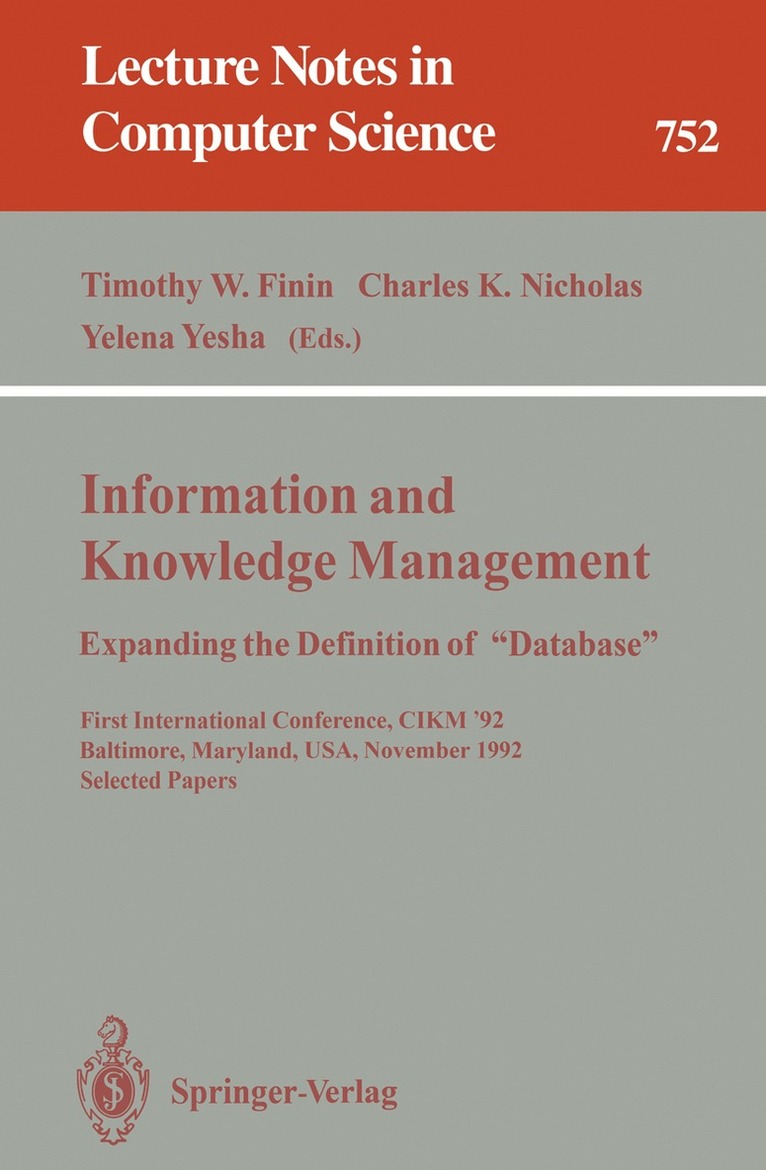
This volume contains expanded and updated versions of paperspresented at CIKM 92, the First International Conference onInformation and Knowledge Management, held in Baltimore,Maryland, in November 1992. The conference participants camefrom the fields of database management, informationretrieval, and artificial intelligence. A major theme in thevolume is how these fields are merging and enriching eachother. Theeight papers discuss: discovering context in aconceptual schema; a system for face information retrieval;queries in OODB systems; consistency checking in OODBs;integrity constraints representation in OODBs; a frameworkfor temporal object databases; inductive dependencies andapproximate databases; OODB design methodologies.
Häftad, Engelska, 2005
545 kr
Skickas inom 10-15 vardagar
There is a growing interest in the use of ontologies for multi-agent system app- cations. On the one hand, the agent paradigm is successfully employed in those applications where autonomous, loosely-coupled, heterogeneous, and distributed systems need to interoperate in order to achieve a common goal. On the other hand, ontologies have established themselves as a powerful tool to enable kno- edge sharing, and a growing number of applications have bene?ted from the use of ontologies as a means to achieve semantic interoperability among heterogeneous, distributed systems. In principle ontologies and agents are a match made in heaven, that has failed to happen. What makes a simple piece of software an agent is its ability to communicate in a ”social” environment, to make autonomous decisions, and to be proactive on behalf of its user. Communication ultimately depends on und- standing the goals, preferences, and constraints posed by the user. Autonomy is theabilitytoperformataskwithlittleornouserintervention,whileproactiveness involves acting autonomously with no need for user prompting. Communication, but also autonomy and proactiveness, depend on knowledge. The ability to c- municate depends on understanding the syntax (terms and structure) and the semantics of a language. Ontologies provide the terms used to describe a domain and the semantics associated with them. In addition, ontologies are often comp- mented by some logical rules that constrain the meaning assigned to the terms. These constraints are represented by inference rules that can be used by agents to perform the reasoning on which autonomy and proactiveness are based.
E-bok
PDF, Engelska, 2006712 kr
Läs direkt efter köp
There is a growing interest in the use of ontologies for multi-agent system app- cations. On the one hand, the agent paradigm is successfully employed in those applications where autonomous, loosely-coupled, heterogeneous, and distributed systems need to interoperate in order to achieve a common goal. On the other hand, ontologies have established themselves as a powerful tool to enable kno- edge sharing, and a growing number of applications have bene?ted from the use of ontologies as a means to achieve semantic interoperability among heterogeneous, distributed systems. In principle ontologies and agents are a match made in heaven, that has failed to happen. What makes a simple piece of software an agent is its ability to communicate in a ”social” environment, to make autonomous decisions, and to be proactive on behalf of its user. Communication ultimately depends on und- standing the goals, preferences, and constraints posed by the user. Autonomy is theabilitytoperformataskwithlittleornouserintervention,whileproactiveness involves acting autonomously with no need for user prompting. Communication, but also autonomy and proactiveness, depend on knowledge. The ability to c- municate depends on understanding the syntax (terms and structure) and the semantics of a language. Ontologies provide the terms used to describe a domain and the semantics associated with them. In addition, ontologies are often comp- mented by some logical rules that constrain the meaning assigned to the terms. These constraints are represented by inference rules that can be used by agents to perform the reasoning on which autonomy and proactiveness are based.