Tomas Petricek – författare
Visar alla böcker från författaren Tomas Petricek. Handla med fri frakt och snabb leverans.
7 produkter
7 produkter
1 298 kr
Läs direkt efter köp
Inbunden, Engelska, 2026
1 150 kr
Skickas inom 7-10 vardagar
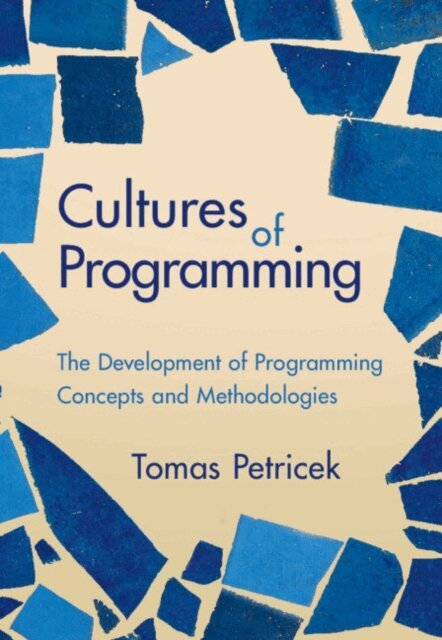
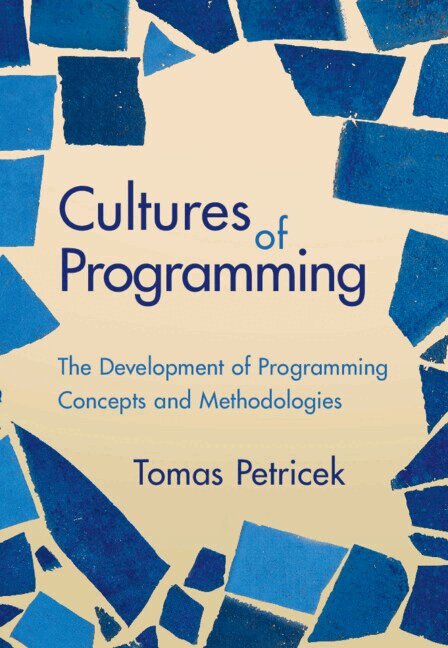
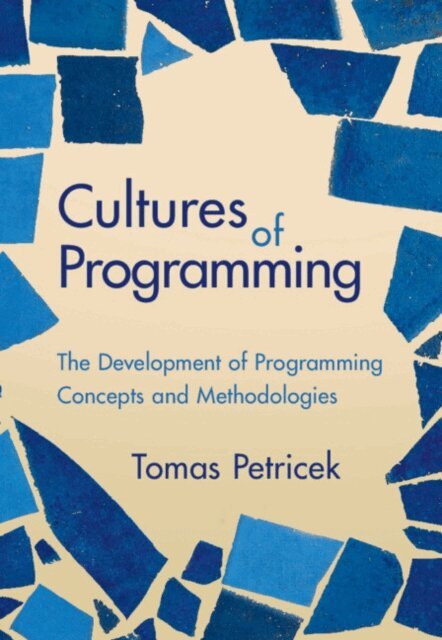
What defines a correct program? What education makes a good programmer? The answers to these questions depend on whether programs are seen as mathematical entities, engineered socio-technical systems or media for assisting human thought. Programmers have developed a wide range of concepts and methodologies to construct programs of increasing complexity. This book shows how those concepts and methodologies emerged and developed from the 1940s to the present. It follows several strands in the history of programming and interprets key historical moments as interactions between five different cultures of programming. Rooted in disciplines such as mathematics, electrical engineering, business management or psychology, the different cultures of programming have exchanged ideas and given rise to novel programming concepts and methodologies. They have also clashed about the nature of programming; those clashes remain at the core of many questions about programming today. This title is also available as Open Access on Cambridge Core.
E-bok
PDF, Engelska, 20261 298 kr
Läs direkt efter köp
E-bok
Engelska, 2014441 kr
Läs direkt efter köp
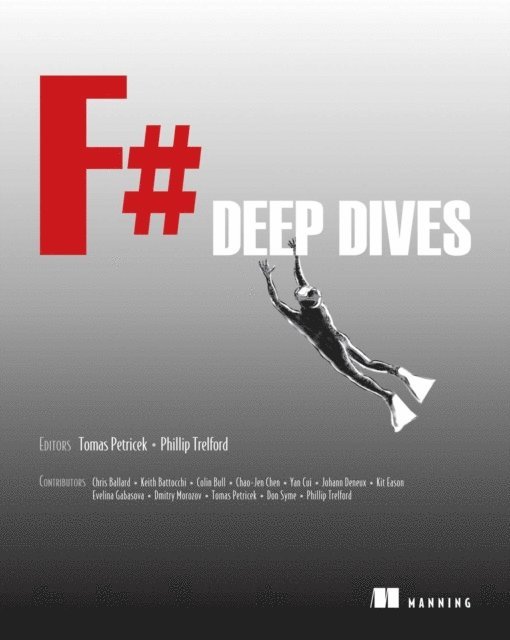
SummaryF# Deep Dives presents a collection of real-world F# techniques, each written by expert practitioners. Each chapter presents a new use case where you''ll read how the author used F# to solve a complex problem more effectively than would have been possible using a traditional approach. You''ll not only see how a specific solution works in a specific domain, you''ll also learn how F# developers approach problems, what concepts they use to solve them, and how they integrate F# into existing systems and environments.Purchase of the print book includes a free eBook in PDF, Kindle, and ePub formats from Manning Publications.About the TechnologyF# is an elegant, cross-platform, functional-first programming language. With F#, developers create consistent and predictable programs that are easier to test and reuse, simpler to parallelize, and less prone to bugs. The language, its tooling, and the functional programming style have proven effective in many application areas like secure financial engines, machine learning algorithms, scientific calculations, collaborative web applications, games, and more.About the BookF# Deep Dives is a selection of real-world F# techniques written by expert practitioners. Each chapter presents an important use case where you''ll solve a real programming challenge effectively using F# and the functional-first approach. Not only will you see how a specific solution works in a specific domain, but you''ll also learn how functional programmers think about problems, how they solve them, and how they integrate F# into existing systems and environments.Readers should have at least an introductory knowledge of the F# language.What''s InsideNumerical computingData visualizationBusiness logicDomain-specific languagesPractical solutions to real problemsInformation-rich programming, including LINQ and F# type providersCovers F# 3.1 and VS 2013About the AuthorsTomas Petricek contributed to the development of the F# language at Microsoft Research. Phil Trelford is an early adopter of F# and one of its most vocal advocates. They are joined by F# experts Chris Ballard, Keith Battocchi, Colin Bull, Chao-Jen Chen, Yan Cui, Johann Deneux, Kit Eason, Evelina Gabasova, Dmitry Morozov, and Don Syme.Table of ContentsSucceeding with functional-first languages in the industry
PART 1 INTRODUCTION
Calculating cumulative binomial distributionsParsing text-based languagesPART 2 DEVELOPING ANALYTICAL COMPONENTS
Numerical computing in the financial domainUnderstanding social networksIntegrating stock data into the F# languagePART 3 DEVELOPING COMPLETE SYSTEMS
Developing rich user interfaces using the MVC patternAsynchronous and agent-based programmingCreating games using XNABuilding social web applicationsPART 4 F# IN THE LARGER CONTEXT
F# in the enterpriseSoftware qualityE-bok
Engelska, 2009441 kr
Läs direkt efter köp
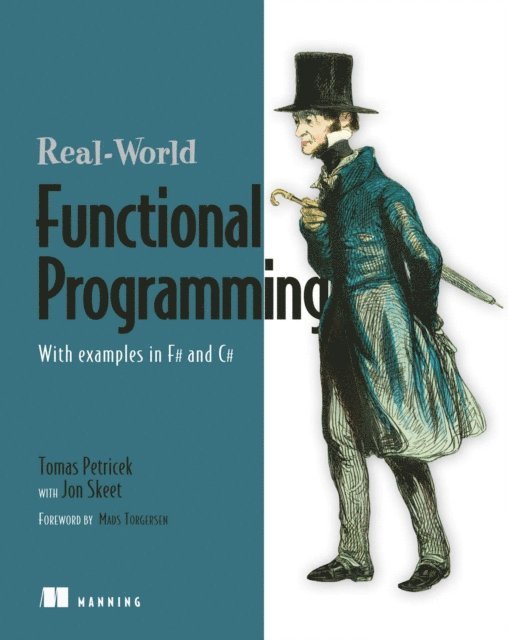
Functional programming languages like F#, Erlang, and Scala are attractingattention as an efficient way to handle the new requirements for programmingmulti-processor and high-availability applications. Microsoft''s new F# is a truefunctional language and C# uses functional language features for LINQ andother recent advances.Real-World Functional Programming is a unique tutorial that explores thefunctional programming model through the F# and C# languages. The clearlypresented ideas and examples teach readers how functional programming differsfrom other approaches. It explains how ideas look in F#-a functionallanguage-as well as how they can be successfully used to solve programmingproblems in C#. Readers build on what they know about .NET and learn wherea functional approach makes the most sense and how to apply it effectively inthose cases.The reader should have a good working knowledge of C#. No prior exposure toF# or functional programming is required. Purchase of the print book comes with an offer of a free PDF, ePub, and Kindle eBook from Manning. Also available is all code from the book.
Del 15500 - Lecture Notes in Computer Science
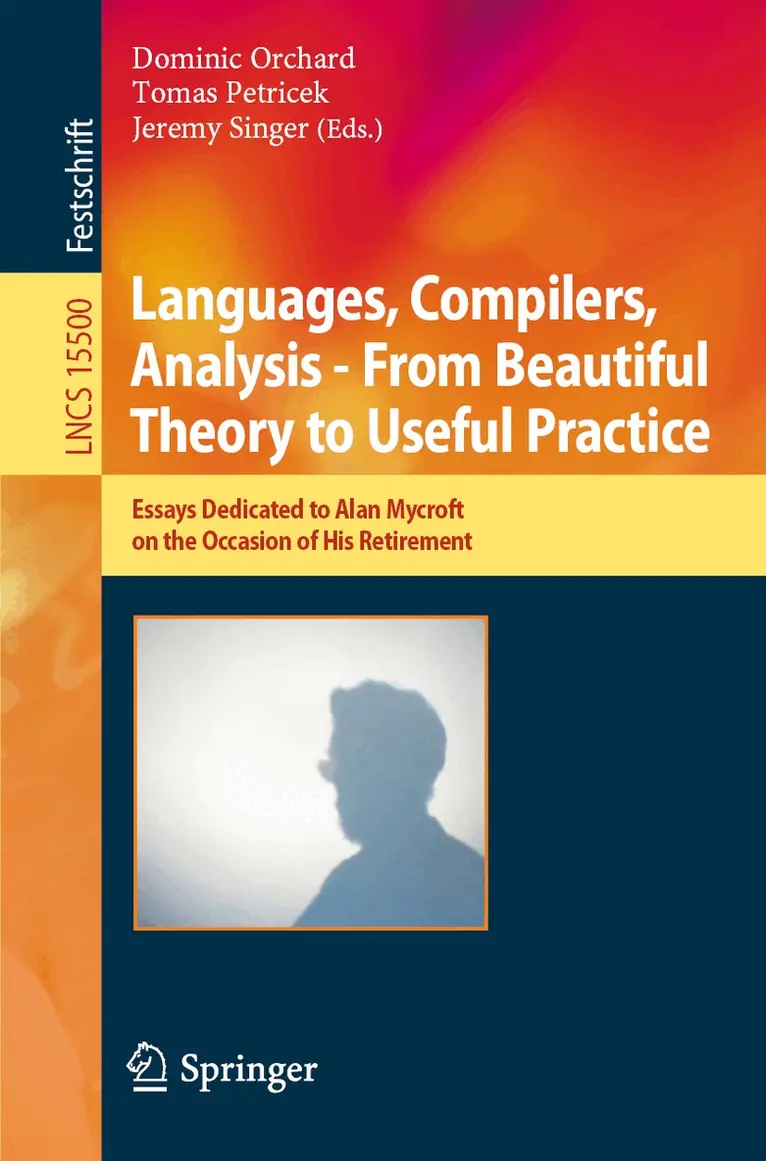
Languages, Compilers, Analysis - From Beautiful Theory to Useful Practice
Essays Dedicated to Alan Mycroft on the Occasion of His Retirement
Häftad, Engelska, 2025
1 235 kr
Skickas inom 10-15 vardagar
This Festschrift is dedicated to Alan Mycroft who formally retired from the University of Cambridge after almost 40 years. Following a BA in Mathematics from the University of Cambridge in 1977, Alan took the Diploma in Computer Science in 1978. He then completed a PhD in Edinburgh in 1981 on Abstract Interpretation and Optimising Transformations for Applicative Programs under the supervision of Rod Burstall and Robin Milner. After an EPSRC postdoctoral fellowship at Edinburgh and a research assistant position at Chalmers University, he returned to the University of Cambridge in 1984 and remained there until his retirement in 2023.Alan is well-known for pioneering contributions to programming language theory and applications, covering both design and implementation. His work ranges from compilation and optimisation techniques, through semantics, static analysis, and type systems, to parallel, concurrent, and dataflow programming. He co-created the Norcroft C compiler with Arthur Norman, he co-authored the book Java 8 in Action: Lambdas, Streams, and Functional-Style Programming, and he co-founded the Raspberry Pi Foundation, a hugely successful initiative to develop programming skills and thinking for all ages.In addition to his excellent research profile, Alan has been an inspiring teacher, mentor, and collaborator, always generous with encouragement and feedback. The impact and scope of his career is reflected in the breadth of topics in this volume, a fitting tribute to him.
E-bok
Engelska, 20251 565 kr
Läs direkt efter köp
This Festschrift is dedicated to Alan Mycroft who formally retired from the University of Cambridge after almost 40 years. Following a BA in Mathematics from the University of Cambridge in 1977, Alan took the Diploma in Computer Science in 1978. He then completed a PhD in Edinburgh in 1981 on Abstract Interpretation and Optimising Transformations for Applicative Programs under the supervision of Rod Burstall and Robin Milner. After an EPSRC postdoctoral fellowship at Edinburgh and a research assistant position at Chalmers University, he returned to the University of Cambridge in 1984 and remained there until his retirement in 2023.Alan is well-known for pioneering contributions to programming language theory and applications, covering both design and implementation. His work ranges from compilation and optimisation techniques, through semantics, static analysis, and type systems, to parallel, concurrent, and dataflow programming. He co-created the Norcroft C compiler with Arthur Norman, he co-authored the book Java 8 in Action: Lambdas, Streams, and Functional-Style Programming, and he co-founded the Raspberry Pi Foundation, a hugely successful initiative to develop programming skills and thinking for all ages.In addition to his excellent research profile, Alan has been an inspiring teacher, mentor, and collaborator, always generous with encouragement and feedback. The impact and scope of his career is reflected in the breadth of topics in this volume, a fitting tribute to him.