Toshihiro Yamada – författare
Visar alla böcker från författaren Toshihiro Yamada. Handla med fri frakt och snabb leverans.
4 produkter
4 produkter
Del 6 - ICIAM2023 Springer Series
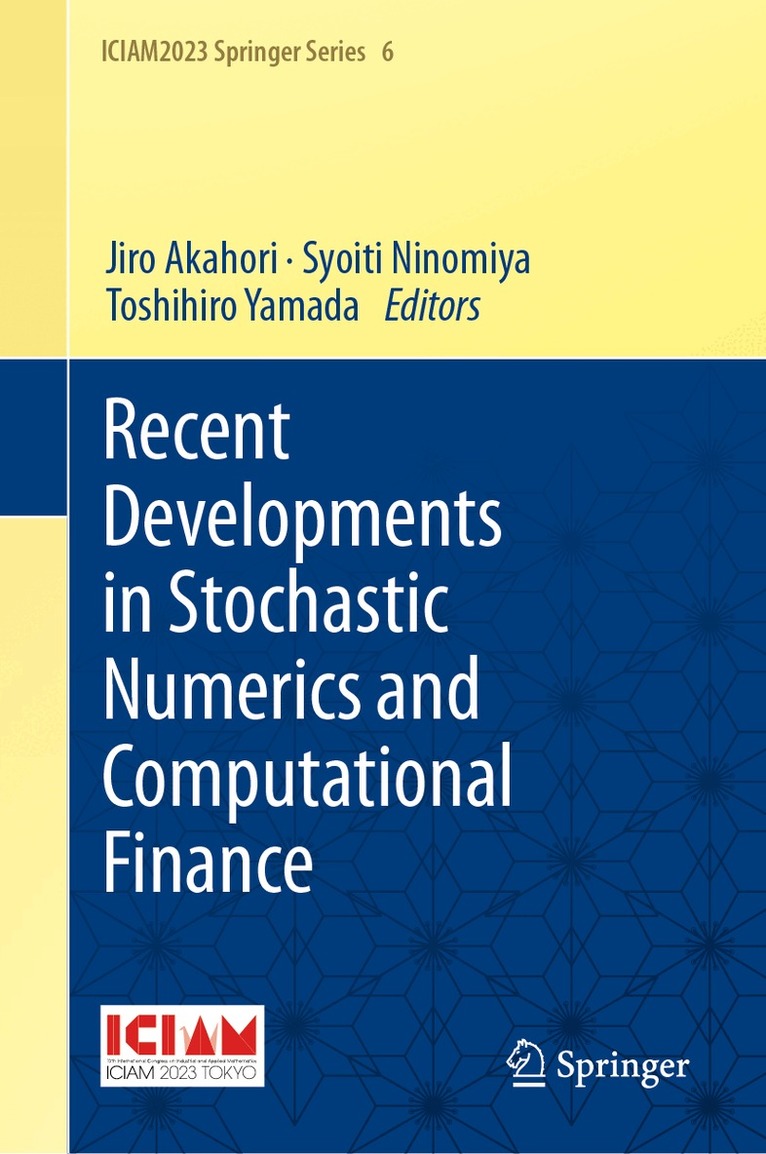
Recent Developments in Stochastic Numerics and Computational Finance
Inbunden, Engelska, 2026
2 128 kr
Skickas inom 5-8 vardagar
mso-fareast-language: EN-US;">This book presents a collection of recent advances in stochastic numerical analysis and computational finance. The volume highlights cutting-edge developments in numerical techniques for stochastic differential equations and stochastic models in finance.
E-bok
Engelska, 20262 741 kr
Läs direkt efter köp
This book presents a collection of recent advances in stochastic numerical analysis and computational finance. Stochastic numerical methods have played a pivotal role in probability theory, statistics, and applied mathematics, particularly in the rapidly evolving fields of machine learning and data science. They have also achieved significant success in computational finance. The volume highlights cutting-edge developments in numerical techniques for stochastic differential equations and stochastic models in finance. This collection offers valuable insights for researchers and practitioners seeking to deepen their understanding of stochastic modeling and its applications in finance and beyond.
Häftad, Engelska, 2025
487 kr
Skickas inom 10-15 vardagar
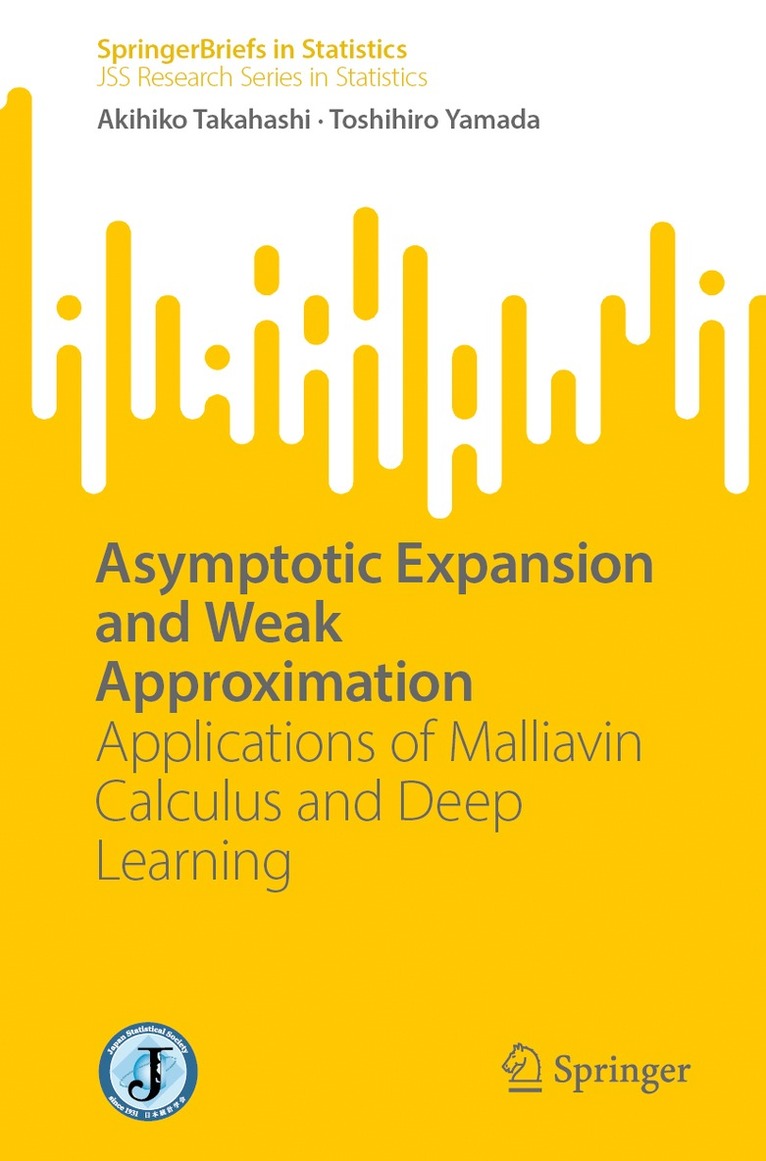
mso-bidi-language: AR-SA;">This book provides a self-contained lecture on a Malliavin calculus approach to asymptotic expansion and weak approximation of stochastic differential equations (SDEs) as well as numerical methods for computing parabolic partial differential equations (PDEs).
E-bok
Engelska, 2025611 kr
Läs direkt efter köp
This book provides a self-contained lecture on a Malliavin calculus approach to asymptotic expansion and weak approximation of stochastic differential equations (SDEs), along with numerical methods for computing parabolic partial differential equations (PDEs). Constructions of weak approximation and asymptotic expansion are given in detail using Malliavin’s integration by parts with theoretical convergence analysis. Weak approximation algorithms and Python codes are available with numerical examples. Moreover, the weak approximation scheme is effectively applied to high-dimensional nonlinear problems without suffering from the curse of dimensionality through combining with a deep learning method. Readers including graduate-level students, researchers, and practitioners can understand both theoretical and applied aspects of recent developments of asymptotic expansion and weak approximation.