T.R. Lewin – författare
Visar alla böcker från författaren T.R. Lewin. Handla med fri frakt och snabb leverans.
5 produkter
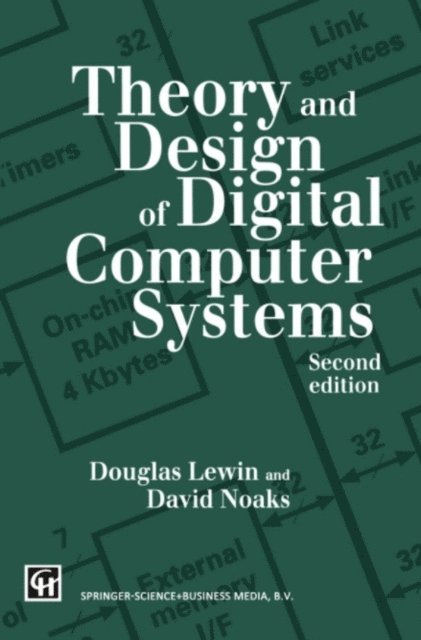
Theory and Design of Digital Computer Systems
Av T.R. Lewin, David L.G. Noakes
Häftad, 1992
1128 kr
Lägg i varukorg
Knowledge: A little light expels much darkness _ Bahya ibn Paquda, Duties of the Heart During the early 1970s digital computer techniques concentrated on the computational and interfacing aspects of digital systems and the decade began as the age of both the mainframe computer and the minicomputer. …
Computer Architecture
Proceedings of the NATO Advanced Study Institute held in St. Raphael, France, 12–24 September, 1976
Av G. Boulaye, T.R. Lewin
Inbunden, 1977
568 kr
Lägg i varukorg
This book presents as formal papers nearly all of the lectures given at the NATO advanced summer institute on Computer Architecture held at St. Raphael, France from September 12th - 24th 1976. It was not possible to include an important paper by G. Amdahl on the 470V6 System, nor papers by Mde. A. …
Computer Architecture
Proceedings of the NATO Advanced Study Institute held in St. Raphael, France, 12–24 September, 1976
Av T.R. Lewin, G. Boulaye
E-bok, 2012
755 kr
Lägg i varukorg
This book presents as formal papers nearly all of the lectures given at the NATO advanced summer institute on Computer Architecture held at St. Raphael, France from September 12th - 24th 1976. It was not possible to include an important paper by G. Amdahl on the 470V6 System, nor papers by Mde. A. …
Computer Architecture
Proceedings of the NATO Advanced Study Institute held in St. Raphael, France, 12–24 September, 1976
Av G. Boulaye, T.R. Lewin
Häftad, 2011
568 kr
Lägg i varukorg
This book presents as formal papers nearly all of the lectures given at the NATO advanced summer institute on Computer Architecture held at St. Raphael, France from September 12th - 24th 1976. It was not possible to include an important paper by G. Amdahl on the 470V6 System, nor papers by Mde. A. …
Theory and Design of Digital Computer Systems
Av David L.G. Noakes, T.R. Lewin
E-bok, 2012
1455 kr
Lägg i varukorg
Knowledge: A little light expels much darkness _ Bahya ibn Paquda, Duties of the Heart During the early 1970s digital computer techniques concentrated on the computational and interfacing aspects of digital systems and the decade began as the age of both the mainframe computer and the minicomputer. …