Tzvetan Todorov – författare
Visar alla böcker från författaren Tzvetan Todorov. Handla med fri frakt och snabb leverans.
41 produkter
Genres in Discourse
Inbunden, 1990
1551 kr
Lägg i varukorg
This is a collection in translation of recent essays by Tzvetan Todorov, one of the most eminent of today's literary critics. The essays concentrate on the idea of genre, literary or otherwise, and ask such questions as: What is literature? What is genre? Which are the major literary genres? In the …
Fantastic
A Structural Approach to a Literary Genre
Häftad, 1975
333 kr
Lägg i varukorg
"This, the first of Todorov's books to be translated into English (it was originally published in French in 1970), is brilliant.... Todorov's attempt to formulate a general theory for studying themes without subordinating literary theory to the social sciences makes this book indispensable to …
Fear of Barbarians
Beyond the Clash of Civilizations
E-bok, 2010
523 kr
Lägg i varukorg
The relationship between Western democracies and Islam, rarely entirely comfortable, has in recent years become increasingly tense. A growing immigrant population and worries about cultural and political assimilation—exacerbated by terrorist attacks in the United States, Europe, and around the …
Voices from the Gulag
Life and Death in Communist Bulgaria
Inbunden, 1999
762 kr
Lägg i varukorg
One of the most terrible legacies of our century is the concentration camp. Countless men and women have passed through camps in Nazi Germany, Communist China, and the Soviet bloc countries. In Voices from the Gulag, Tzvetan Todorov singles out the experience of one country where the concentration …
Frail Happiness
An Essay on Rousseau
Inbunden, 2001
577 kr
Lägg i varukorg
"We are all confronted, at one time or another, with choices as to what sort of life we will lead." So Tzvetan Todorov begins Frail Happiness, an important interpretation of Rousseau, one suffused with Todorov’s own moral seriousness and intellectual depth. While ranging widely through Rousseau’s …
French Literary Theory Today
A Reader
Häftad, 1982
678 kr
Lägg i varukorg
Originally published in 1982, this is an anthology of studies by French literary theorists representing the most significant contributions to the field made in France in the preceding fifteen years. The essays were published here in English for the first time and cover, among other topics, the …
Genres in Discourse
Häftad, 1990
842 kr
Lägg i varukorg
This is a collection in translation of recent essays by Tzvetan Todorov, one of the most eminent of today's literary critics. The essays concentrate on the idea of genre, literary or otherwise, and ask such questions as: What is literature? What is genre? Which are the major literary genres? In the …
Hope and Memory
Lessons from the Twentieth Century
Inbunden, 2003
821 kr
Lägg i varukorg
Examines the struggle between Totalitarianism and democracy and its effects on human life and consciousness. This book explores the history of the twentieth century not only by analyzing its spectacular political conflicts but also by offering profiles of several individuals who resisted the …
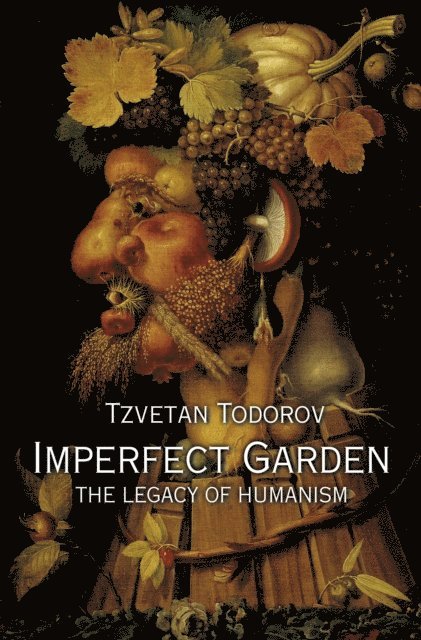
Imperfect Garden
The Legacy of Humanism
Häftad, 2014
290 kr
Lägg i varukorg
Available in English for the first time, Imperfect Garden is both an approachable intellectual history and a bracing treatise on how we should understand and experience our lives. In it, one of France's most prominent intellectuals explores the foundations, limits, and possibilities of humanist …
New World Disorder
Reflections of a European
Inbunden, 2004
637 kr
Lägg i varukorg
This illuminating analysis by one of the world's leading intellectuals addresses fundamental questions about the new world disorder exemplified by the war on terrorism, the Iraq conflict and its aftermath and the current state of transatlantic relations.In eight concise chapters, Todorov discusses …
New World Disorder
Reflections of a European
Häftad, 2004
217 kr
Lägg i varukorg
This illuminating analysis by one of the world's leading intellectuals addresses fundamental questions about the new world disorder exemplified by the war on terrorism, the Iraq conflict and its aftermath and the current state of transatlantic relations.In eight concise chapters, Todorov discusses …
Inner Enemies of Democracy
Inbunden, 2014
5,0 utav 5 stjärnor. Totalt antal röster: (1)
166 kr
Lägg i varukorg
The political history of the twentieth century can be viewed as the history of democracy’s struggle against its external enemies: fascism and communism. This struggle ended with the fall of the Berlin Wall and the collapse of the Soviet regime. Some people think that democracy now faces new …
Inner Enemies of Democracy
E-bok, 2015
208 kr
Lägg i varukorg
The political history of the twentieth century can be viewed as the history of democracy’s struggle against its external enemies: fascism and communism. This struggle ended with the fall of the Berlin Wall and the collapse of the Soviet regime. Some people think that democracy now faces new …
Theories of the Symbol
Inbunden, 1982
703 kr
Lägg i varukorg
Focusing on theories of verbal symbolism, Tzvetan Todorov here presents a history of semiotics. From an account of the semiotic doctrines embodied in the works of classical rhetoric to an exploration of representative modern concepts of the symbol found in ethnology, psychoanalysis, linguistics, …
Symbolism and Interpretation
Inbunden, 1982
661 kr
Lägg i varukorg
In Symbolism and Interpretation, Tzvetan Todorov examines two aspects of discourse: its production, which has traditionally been the domain of rhetoric, and its reception, which has always been the object of hermeneutics. He analyzes the diverse theories of symbolism and interpretation that have …
Theories of the Symbol
Häftad, 1984
487 kr
Lägg i varukorg
Focusing on theories of verbal symbolism, Tzvetan Todorov here presents a history of semiotics. From an account of the semiotic doctrines embodied in the works of classical rhetoric to an exploration of representative modern concepts of the symbol found in ethnology, psychoanalysis, linguistics, …
Symbolism and Interpretation
Häftad, 1986
463 kr
Lägg i varukorg
In Symbolism and Interpretation, Tzvetan Todorov examines two aspects of discourse: its production, which has traditionally been the domain of rhetoric, and its reception, which has always been the object of hermeneutics. He analyzes the diverse theories of symbolism and interpretation that have …
Life in Common
An Essay in General Anthropology
Häftad, 2001
275 kr
Lägg i varukorg
In Life in Common Tzvetan Todorov explores the construction of the self and offers new perspectives on current debates about otherness. Through the seventeenth century, solitude was considered the human condition in the Western philosophical tradition. The self was not dependent on others to …
Conquest of America
The Question of the Other
Häftad, 1999
4,0 utav 5 stjärnor. Totalt antal röster: (1)
290 kr
Lägg i varukorg
A classic in its field, The Conquest of America is a study of cultural confrontation in the New World, with implications far beyond sixteenth-century America. The book offers an original interpretation of both Columbus's discovery of America and the Spaniards' subsequent conquest, colonization, and …
Morals of History
Häftad, 1995
426 kr
Lägg i varukorg
The celebrated scholar Tzvetan Todorov offers a study examining the complex relationship between "ethics" and "history". Exploring such questions as "How does one measure and experience freedom in the depths of society?" and "How does one practise and measure equality among different societies?", …
Imperfect Garden
The Legacy of Humanism
E-bok, 2009
400 kr
Lägg i varukorg
Available in English for the first time, Imperfect Garden is both an approachable intellectual history and a bracing treatise on how we should understand and experience our lives. In it, one of France''s most prominent intellectuals explores the foundations, limits, and possibilities of humanist …
Torture and the War on Terror
Häftad, 2026
166 kr
Lägg i varukorg
One of the world's leading intellectuals dismantles the political and ethical justifications for institutional torture. In the aftermath of 9/11, the US government approved interrogation tactics for enemy combatant detainees that could be defined as torture, which was outlawed in Europe in the …
Hope And Memory
Reflections on the Twentieth Century
Häftad, 2005
218 kr
Lägg i varukorg
'Almost alone among contemporary critics, Tzvetan Todorov has chosen to apply his prodigious talents to the literature of twentieth-century totalitarianism. His unique gift is his ability to elucidatethe memoirs and writings of some of the century's greatest survivors, not merely discovering their …
La naissance de l'individu dans l'art
Av Tzvetan Todorov, Robert Legros
Häftad, 2018
452 kr
Lägg i varukorg