
Una StojniA‡ – författare
Visar alla böcker från författaren . Handla med fri frakt och snabb leverans.
4 produkter
4 produkter
E-bok
PDF, Engelska, 2021994 kr
Läs direkt efter köp
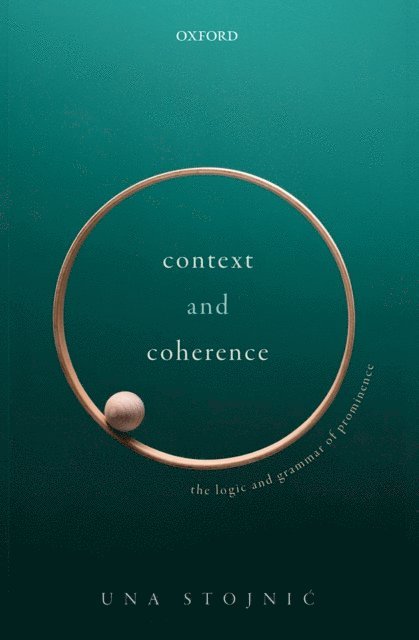
Natural languages are riddled with context-sensitivity. One and the same string of words can express many different meanings on occasion of use, and yet we understand one another effortlessly, on the fly. How do we do so? What fixes the meaning of context-sensitive expressions, and how are we able to recover the meaning so effortlessly? This book offers a novel response: we can do so because we draw on a broad array of subtle linguistic conventions that determine the interpretation of context-sensitive items. Contrary to the dominant tradition, which maintains that the meaning of context-sensitive language is underspecified by grammar and that interpretation relies on non-linguistic cues and speakers'' intentions, this book argues that meaning is determined entirely by discourse conventions, rules of language that have largely been missed and the effects of which have been mistaken for extra-linguistic effects of an utterance situation on meaning. The linguistic account of context developed here sheds a new light on the nature of linguistic content and the interaction between content and context. At the same time, it provides a novel model of context that should constrain and help evaluate debates across many subfields of philosophy where appeal to context has been common, often leading to surprising conclusions such as epistemology, ethics, value theory, metaphysics, metaethics, and logic.
E-bok
Engelska, 2021994 kr
Läs direkt efter köp
Natural languages are riddled with context-sensitivity. One and the same string of words can express many different meanings on occasion of use, and yet we understand one another effortlessly, on the fly. How do we do so? What fixes the meaning of context-sensitive expressions, and how are we able to recover the meaning so effortlessly? This book offers a novel response: we can do so because we draw on a broad array of subtle linguistic conventions that determine the interpretation of context-sensitive items. Contrary to the dominant tradition, which maintains that the meaning of context-sensitive language is underspecified by grammar and that interpretation relies on non-linguistic cues and speakers'' intentions, this book argues that meaning is determined entirely by discourse conventions, rules of language that have largely been missed and the effects of which have been mistaken for extra-linguistic effects of an utterance situation on meaning. The linguistic account of context developed here sheds a new light on the nature of linguistic content and the interaction between content and context. At the same time, it provides a novel model of context that should constrain and help evaluate debates across many subfields of philosophy where appeal to context has been common, often leading to surprising conclusions such as epistemology, ethics, value theory, metaphysics, metaethics, and logic.
E-bok
Engelska, 2025961 kr
Läs direkt efter köp
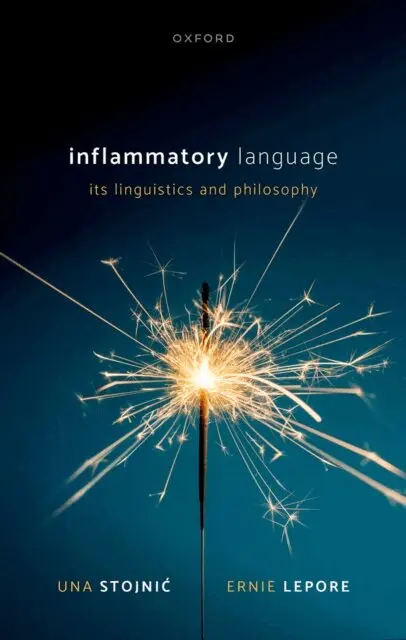
It's a platitude that words can harm. But some words are more prone to do so than others--they are pejorative by design. Among those, slurs are particularly inflammatory: these are the epithets that derogate purely on the basis of group-membership, for example, on the basis of race, ethnicity, origin, religion, gender, sexual orientation, or ideology. Inflammatory Language is in large part about pejoratives, but mainly about this subclass of particularly inflammatory words, with a characteristic offensive sting. Slurs are powerful linguistic weapons: slurring someone constitutes a transgression more severe than an insult; it is an act of bigotry, not mere rudeness, derogating the entire group at once. Moreover, the offensive effect of a slur is surprisingly sticky, as even mere mentionings of slurs carry the risk of triggering their sting, so much so that such tokenings often have a full-on taboo status, subject to media censorship, sometimes even legislation.What is the source of this characteristic offensive sting that makes slurs such powerful linguistic weapons? A natural--and predominant--assumption is that it's some aspect of their meaning, semantically encoded or pragmatically conveyed. Consequently, most efforts at understanding slurs have been attempts to characterize their meanings and how they compose with those of other expressions, in a way that generates the offensive sting. However, even those who reject this majority position trace the offensive sting down to slurring words, arguing that it is their taboo status, or offensive tone, that explains their sting. Una StojniA and Ernie Lepore argue this is a mistake. The distinctive pejorative effect of slurs, their characteristic sting, is not a matter of meaning, nor even language. Rather it is akin to the sting triggered by offensive gestures, symbols, or imagery, in that it is constituted by associations attached to and triggered by slurs' articulatory form--their typical pronunciation or spelling.
E-bok
PDF, Engelska, 2025959 kr
Läs direkt efter köp
It's a platitude that words can harm. But some words are more prone to do so than others--they are pejorative by design. Among those, slurs are particularly inflammatory: these are the epithets that derogate purely on the basis of group-membership, for example, on the basis of race, ethnicity, origin, religion, gender, sexual orientation, or ideology. Inflammatory Language is in large part about pejoratives, but mainly about this subclass of particularly inflammatory words, with a characteristic offensive sting. Slurs are powerful linguistic weapons: slurring someone constitutes a transgression more severe than an insult; it is an act of bigotry, not mere rudeness, derogating the entire group at once. Moreover, the offensive effect of a slur is surprisingly sticky, as even mere mentionings of slurs carry the risk of triggering their sting, so much so that such tokenings often have a full-on taboo status, subject to media censorship, sometimes even legislation.What is the source of this characteristic offensive sting that makes slurs such powerful linguistic weapons? A natural--and predominant--assumption is that it's some aspect of their meaning, semantically encoded or pragmatically conveyed. Consequently, most efforts at understanding slurs have been attempts to characterize their meanings and how they compose with those of other expressions, in a way that generates the offensive sting. However, even those who reject this majority position trace the offensive sting down to slurring words, arguing that it is their taboo status, or offensive tone, that explains their sting. Una StojniA and Ernie Lepore argue this is a mistake. The distinctive pejorative effect of slurs, their characteristic sting, is not a matter of meaning, nor even language. Rather it is akin to the sting triggered by offensive gestures, symbols, or imagery, in that it is constituted by associations attached to and triggered by slurs' articulatory form--their typical pronunciation or spelling.