Ursula van Rienen – författare
Visar alla böcker från författaren Ursula van Rienen. Handla med fri frakt och snabb leverans.
4 produkter
4 produkter
Häftad, Engelska, 2001
1 623 kr
Skickas inom 10-15 vardagar
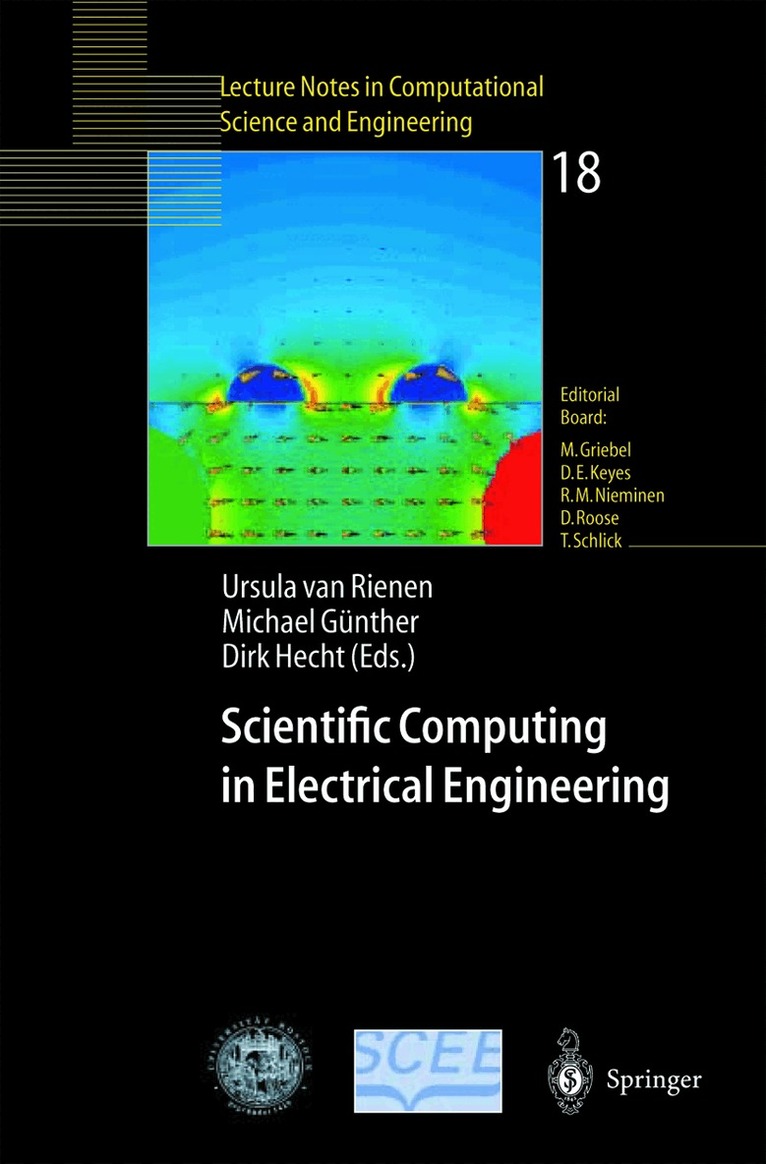
This book presents the proceedings of the 3rd International Workshop "Scientific Computing in Electrical Engineering" held in Warnemunde, Germany, August 20-23, 2000. This workshop followed two earlier workshops held in 1997 at the Darmstadt University of Technology and in 1998 at Weierstrass Institute for Applied Analysis and Stochastics under the auspices of the German Mathematical Society. The main topics of SCEE-2000 were computational electrodynamics, circuit simulation and coupled problems. The objective of the workshop, which was mainly directed at mathematicians and electrical engineers, was to bring together scientists from universities and industry with the goal of intensive discussions about modelling and numerical simulation of electronic circuits and electromagnetics fields. The book contains contributions of six invited speakers, 30 contributed speakers and 17 poster presentations.
Del 12 - Lecture Notes in Computational Science and Engineering
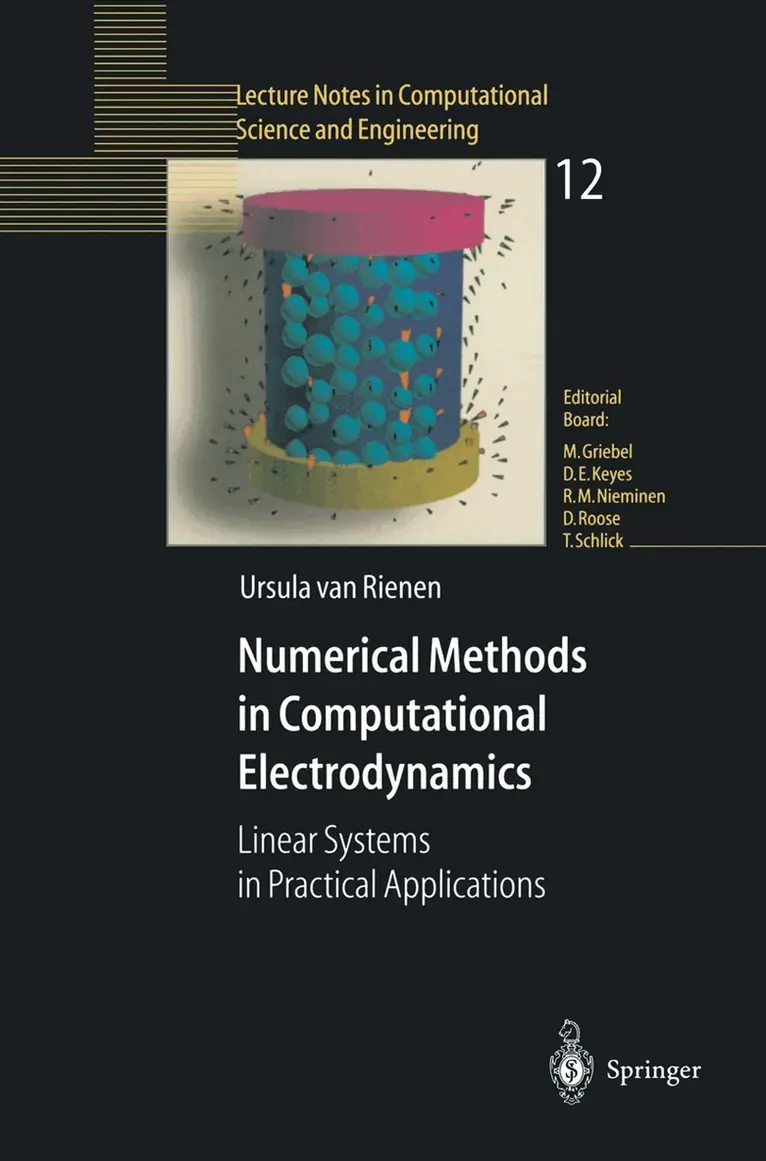
Numerical Methods in Computational Electrodynamics
Linear Systems in Practical Applications
Häftad, Engelska, 2000
1 623 kr
Skickas inom 10-15 vardagar
treated in more detail. They are just specimen of larger classes of schemes. Es sentially, we have to distinguish between semi-analytical methods, discretiza tion methods, and lumped circuit models. The semi-analytical methods and the discretization methods start directly from Maxwell's equations. Semi-analytical methods are concentrated on the analytical level: They use a computer only to evaluate expressions and to solve resulting linear algebraic problems. The best known semi-analytical methods are the mode matching method, which is described in subsection 2. 1, the method of integral equations, and the method of moments. In the method of integral equations, the given boundary value problem is transformed into an integral equation with the aid of a suitable Greens' function. In the method of moments, which includes the mode matching method as a special case, the solution function is represented by a linear combination of appropriately weighted basis func tions. The treatment of complex geometrical structures is very difficult for these methods or only possible after geometric simplifications: In the method of integral equations, the Greens function has to satisfy the boundary condi tions. In the mode matching method, it must be possible to decompose the domain into subdomains in which the problem can be solved analytically, thus allowing to find the basis functions. Nevertheless, there are some ap plications for which the semi-analytic methods are the best suited solution methods. For example, an application from accelerator physics used the mode matching technique (see subsection 5. 4).
E-bok
PDF, Engelska, 20122 049 kr
Läs direkt efter köp
rd This book presents a collection of selected contributions presented at the 3 International Workshop on Scientific Computing in Electrical Engineering, SCEE-2000, which took place in Warnemiinde, Germany, from August 20 to 23, 2000. Nearly hundred scientists and engineers from thirteen countries gathered in Warnemiinde to participate in the conference. Rostock Univer sity, the oldest university in Northern Europe founded in 1419, hosted the conference. This workshop followed two earlier workshops held 1997 at the Darmstadt University of Technology and 1998 at Weierstrass Institute for Applied Anal ysis and Stochastics in Berlin under the auspices ofthe German Mathematical Society. These workshops aimed at bringing together two scientific communi ties: applied mathematicians and electrical engineers who do research in the field of scientific computing in electrical engineering. This, of course, is a wide field, which is why it was decided to concentrate on selected major topics. The workshop in Darmstadt, which was organized by Michael Giinther from the Mathematics Department and Ursula van Rienen from the Department of Electrical Engineering and Information Technology,brought together more than hundred scientists interested in numerical methods for the simulation of circuits and electromagnetic fields. This was a great success. Voices coming from the participants suggested that it was time to bring these communities together in order to get to know each other, to discuss mutual interests and to start cooperative work. A collection of selected contributions appeared in ''Surveys on Mathematics for Industry'', Vol.8, No. 3-4 and Vol.9, No.2, 1999.
E-bok
PDF, Engelska, 20121 977 kr
Läs direkt efter köp
treated in more detail. They are just specimen of larger classes of schemes. Es sentially, we have to distinguish between semi-analytical methods, discretiza tion methods, and lumped circuit models. The semi-analytical methods and the discretization methods start directly from Maxwell''s equations. Semi-analytical methods are concentrated on the analytical level: They use a computer only to evaluate expressions and to solve resulting linear algebraic problems. The best known semi-analytical methods are the mode matching method, which is described in subsection 2. 1, the method of integral equations, and the method of moments. In the method of integral equations, the given boundary value problem is transformed into an integral equation with the aid of a suitable Greens'' function. In the method of moments, which includes the mode matching method as a special case, the solution function is represented by a linear combination of appropriately weighted basis func tions. The treatment of complex geometrical structures is very difficult for these methods or only possible after geometric simplifications: In the method of integral equations, the Greens function has to satisfy the boundary condi tions. In the mode matching method, it must be possible to decompose the domain into subdomains in which the problem can be solved analytically, thus allowing to find the basis functions. Nevertheless, there are some ap plications for which the semi-analytic methods are the best suited solution methods. For example, an application from accelerator physics used the mode matching technique (see subsection 5. 4).