V. I. Arnold – författare
Visar alla böcker från författaren V. I. Arnold. Handla med fri frakt och snabb leverans.
8 produkter
8 produkter
Del 53 - London Mathematical Society Lecture Note Series
Singularity Theory
Häftad, Engelska, 1981
916 kr
Skickas inom 7-10 vardagar
Professor Arnold is a prolific and versatile mathematician who has done striking work in differential equations and geometrical aspects of analysis. In this volume are collected seven of his survey articles from Russian Mathematical Surveys on singularity theory, the area to which he has made most contribution. These surveys contain Arnold's own analysis and synthesis of a decade's work. All those interested in singularity theory will find this an invaluable compilation. Professor C. T. C. Wall has written an introduction outlining the significance and content of the articles.
Häftad, Engelska, 2010
355 kr
Skickas inom 7-10 vardagar
V. I. Arnold reveals some unexpected connections between such apparently unrelated theories as Galois fields, dynamical systems, ergodic theory, statistics, chaos and the geometry of projective structures on finite sets. The author blends experimental results with examples and geometrical explorations to make these findings accessible to a broad range of mathematicians, from undergraduate students to experienced researchers.
Häftad, Engelska, 2014
463 kr
Skickas inom 5-8 vardagar
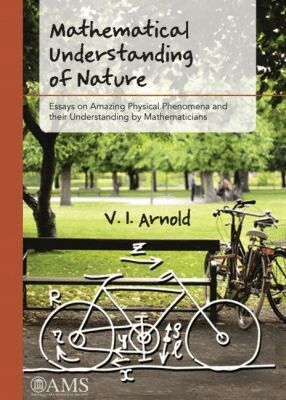
This collection of 39 short stories gives the reader a unique opportunity to take a look at the scientific philosophy of Vladimir Arnold, one of the most original contemporary researchers. Topics of the stories included range from astronomy, to mirages, to motion of glaciers, to geometry of mirrors and beyond. In each case Arnold's explanation is both deep and simple, which makes the book interesting and accessible to an extremely broad readership. Original illustrations hand drawn by the author help the reader to further understand and appreciate Arnold's view on the relationship between mathematics and science.Arnold's talent for exposition shines in this collection of short chapters on a miscellany of topics. I could not stop reading until I reached the end of the book. This book will entertain and enrich any curious person, whether a layman or a specialist”. - Mark Levi, Penn State University, USA author of The Mathematical Mechanic.“This book, which fits all mathematical ages, provides a glimpse into the “laboratory” of one of the most influential mathematicians of our time. Its genre is absolutely unique. A kaleidoscope of intriguing examples illustrating applications of mathematics to real life, intertwines with entertaining and often wildly funny mathematical anecdotes, as well as with profound insights into modern research areas. A brilliant informal exposition, complemented by artful drawings by the author, makes the book a fascinating read”. - Leonid Polterovich, Tel-Aviv University, Israel.
Häftad, Engelska, 2015
410 kr
Skickas inom 5-8 vardagar
Vladimir Arnold (1937-2010) was one of the great mathematical minds of the late 20th century. He did significant work in many areas of the field. On another level, he was keeping with a strong tradition in Russian mathematics to write for and to directly teach younger students interested in mathematics. This book contains some examples of Arnold's contributions to the genre.``Continued Fractions'' takes a common enrichment topic in high school math and pulls it in directions that only a master of mathematics could envision.``Euler Groups'' treats a similar enrichment topic, but it is rarely treated with the depth and imagination lavished on it in Arnold's text. He sets it in a mathematical context, bringing to bear numerous tools of the trade and expanding the topic way beyond its usual treatment.In ``Complex Numbers'' the context is physics, yet Arnold artfully extracts the mathematical aspects of the discussion in a way that students can understand long before they master the field of quantum mechanics.``Problems for Children 5 to 15 Years Old'' must be read as a collection of the author's favorite intellectual morsels. Many are not original, but all are worth thinking about, and each requires the solver to think out of his or her box. Dmitry Fuchs, a long-term friend and collaborator of Arnold, provided solutions to some of the problems. Readers are of course invited to select their own favorites and construct their own favorite solutions.In reading these essays, one has the sensation of walking along a path that is found to ascend a mountain peak and then being shown a vista whose existence one could never suspect from the ground.Arnold's style of exposition is unforgiving. The reader--even a professional mathematician--will find paragraphs that require hours of thought to unscramble, and he or she must have patience with the ellipses of thought and the leaps of reason. These are all part of Arnold's intent.In the interest of fostering a greater awareness and appreciation of mathematics and its connections to other disciplines and everyday life, MSRI and the AMS are publishing books in the Mathematical Circles Library series as a service to young people, their parents and teachers, and the mathematics profession.
E-bok
PDF, Engelska, 20131 100 kr
Läs direkt efter köp
Many different mathematical methods and concepts are used in classical mechanics: differential equations and phase ftows, smooth mappings and manifolds, Lie groups and Lie algebras, symplectic geometry and ergodic theory. Many modern mathematical theories arose from problems in mechanics and only later acquired that axiomatic-abstract form which makes them so hard to study. In this book we construct the mathematical apparatus of classical mechanics from the very beginning; thus, the reader is not assumed to have any previous knowledge beyond standard courses in analysis (differential and integral calculus, differential equations), geometry (vector spaces, vectors) and linear algebra (linear operators, quadratic forms). With the help of this apparatus, we examine all the basic problems in dynamics, including the theory of oscillations, the theory of rigid body motion, and the hamiltonian formalism. The author has tried to show the geometric, qualitative aspect of phenomena. In this respect the book is closer to courses in theoretical mechanics for theoretical physicists than to traditional courses in theoretical mechanics as taught by mathematicians.
Engelska, 2013
625 kr
Skickas inom 5-8 vardagar
E-bok
PDF, Engelska, 20121 100 kr
Läs direkt efter köp
Singularity theory is growing very fast and many new results have been discovered since the Russian edition appeared: for instance the relation of the icosahedron to the problem of by passing a generic obstacle. The reader can find more details about this in the articles "Singularities of ray systems" and "Singularities in the calculus of variations" listed in the bi bliography of the present edition. Moscow, September 1983 v. I. Arnold Preface to the Russian Edition "Experts discuss forecasting disasters" said a New York Times report on catastrophe theory in November 1977. The London Times declared Catastrophe Theory to be the "main intellectual movement of the century" while an article on catastrophe theory in Science was headed "The emperor has no clothes". This booklet explains what catastrophe theory is about and why it arouses such controversy. It also contains non-con troversial results from the mathematical theories of singulari ties and bifurcation. The author has tried to explain the essence of the fundamen tal results and applications to readers having minimal mathe matical background but the reader is assumed to have an in quiring mind. Moscow 1981 v. I. Arnold Contents Chapter 1. Singularities, Bifurcations, and Catastrophe Theories ............... 1 Chapter 2. Whitney''s Singularity Theory ... 3 Chapter 3. Applications of Whitney''s Theory 7 Chapter 4. A Catastrophe Machine ...... 10 Chapter 5. Bifurcations of Equilibrium States 14 Chapter 6. Loss of Stability of Equilibrium and the Generation of Auto-Oscillations . . . . . . 20 .
Inbunden, Engelska, 2010
669 kr
Tillfälligt slut
V. I. Arnold reveals some unexpected connections between such apparently unrelated theories as Galois fields, dynamical systems, ergodic theory, statistics, chaos and the geometry of projective structures on finite sets. The author blends experimental results with examples and geometrical explorations to make these findings accessible to a broad range of mathematicians, from undergraduate students to experienced researchers.