Valentin Kockel – författare
Visar alla böcker från författaren Valentin Kockel. Handla med fri frakt och snabb leverans.
4 produkter
4 produkter
Inbunden, Engelska, 2016
1 741 kr
Skickas inom 3-6 vardagar
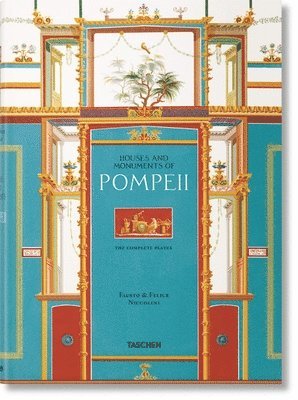
When the excavations at Pompeii were first placed on a scholarly archaeological footing in the 19th century, brothers Fausto and Felice Niccolini were close at hand and ready to respond. Making use of the newly introduced technique of color lithography, they documented the buildings, frescos, statues, as well as the most ordinary everyday objects, of the city buried in just 24 hours by the catastrophic eruption of Vesuvius and preserved for over 1,600 years under a mantle of volcanic ash.The Niccolinis’ goal was to illustrate all aspects of life in the antique city. Their publication, Le case ed i monumenti di Pompei (“The Houses and Monuments of Pompeii”), which was issued in installments between 1854 and 1896 in Naples, presented over 400 color plates providing not only views, maps, and groundplans of the city and its public buildings, but also offered unprecedented access to Pompeii’s private residences. They revealed the astonishing painted wall decorations that adorned these long-buried abodes, their intricate works of art, and the practical utensils of everyday use, conjuring up a vivid picture of each house as a real domestic space. In total, the plates illustrated more than 1,000 items, each extensively specified and located for the first time, making the publication a major reference in Pompeii research. In addition, “animated” representations visualized daily life in Pompeii’s workshops, taverns, and shops, on its public squares, and in its temples, theaters, and baths.This meticulous facsimile revives the Niccolinis’ extraordinary achievement with all color plates and two introductory essays setting the project in its contemporary context and presenting the historical protagonists of the Vesuvian excavations. In addition, we explore the remarkable influence exerted by Pompeian art—and by the haunting plaster casts made of victims of the eruption—on the visual arts. Across painting, sculpture, and interior design, we trace the Pompeii legacy in the work of Robert Adam, Anton Raphael Mengs, Angelika Kaufmann, Jean-Auguste-Dominique Ingres, Lawrence Alma-Tadema, Pablo Picasso, and Giorgio de Chirico, right through to recent masters Duane Hanson and George Segal.
Inbunden, Engelska, 2026
390 kr
Skickas inom 3-6 vardagar
When the excavations at Pompeii were first placed on a scholarly archaeological footing in the 19th century, brothers Fausto and Felice Niccolini were close at hand and ready to respond. Making use of the newly introduced technique of color lithography, they documented the buildings, frescos, statues, as well as the most ordinary everyday objects, of the city buried in just 24 hours by the catastrophic eruption of Vesuvius and preserved for over 1,600 years under a mantle of volcanic ash.The Niccolinis’ goal was to illustrate all aspects of life in the antique city. Their publication, Le case ed i monumenti di Pompei (“The Houses and Monuments of Pompeii”), which was issued in installments between 1854 and 1896 in Naples, presented over 400 color plates providing not only views, maps, and groundplans of the city and its public buildings, but also offered unprecedented access to Pompeii’s private residences. They revealed the astonishing painted wall decorations that adorned these long-buried abodes, their intricate works of art, and the practical utensils of everyday use, conjuring up a vivid picture of each house as a real domestic space. In addition, “animated” representations visualized daily life in Pompeii’s workshops, taverns, and shops, on its public squares, and in its temples, theaters, and baths.This meticulous facsimile revives the Niccolinis’ extraordinary achievement with selected color plates and two introductory essays setting the project in its contemporary context and presenting the historical protagonists of the Vesuvian excavations. In addition, we explore the remarkable influence exerted by Pompeian art—and by the haunting plaster casts made of victims of the eruption—on the visual arts. Across painting, sculpture, and interior design, we trace the Pompeii legacy in the work of Robert Adam, Anton Raphael Mengs, Angelika Kaufmann, Jean-Auguste-Dominique Ingres, Lawrence Alma-Tadema, Pablo Picasso, and Giorgio de Chirico, right through to recent masters Duane Hanson and George Segal.
Del 21 - Colloquia Augustana
Francesco Bianchini (1662-1729) Und Die Europäische Gelehrte Welt Um 1700
Inbunden, Tyska, 2005
1 061 kr
Skickas inom 5-8 vardagar
E-bok
PDF, Tyska, 20111 218 kr
Läs direkt efter köp
Francesco Bianchini gehört zu den herausragenden Gestalten der europäischen gelehrten Welt am Beginn des 18. Jahrhunderts. Sein wissenschaftliches Werk reicht von astronomischen Schriften über eine unvollendete Istoria universale bis zur aufwendigen Publikation archäologischer Ausgrabungen. Als Ehrenmitglied der königlichen Akademien in Paris und London korrespondierte er mit den führenden Gelehrten seiner Zeit, so mit Leibniz und Newton. Die weitverzweigten Forschungsinteressen Bianchinis eröffnen ein Panorama frühneuzeitlicher Bildungs-, Wissenschafts- und Institutionengeschichte. Sein Leben und Werk fügen sich in die erkenntnis-, wahrnehmungs- und wissenschaftstheoretischen Kontroversen und forschungspraktischen Errungenschaften seiner Zeit ein. Er propagierte die Überlegenheit der Bild- über die Schriftquellen sowohl im Sinne der historischen Wahrheitsfindung als auch hinsichtlich der aus der Antike abgeleiteten Gedächtnis- und Wahrnehmungstheorien. Neben der Forschung galt seine Aufmerksamkeit der Vermittlung von Wissen, bei der das Bild sowohl als eigenständiger Beleg wie als mnemotechnische Stütze von zentraler Bedeutung ist. Trotz dieses ungewöhnlich breit gefächerten Lebenswerkes, seiner weitreichenden Anerkennung zu Lebzeiten und einer hervorragenden archivalischen Überlieferung blieb Bianchini bisher in den jüngeren Forschungen zur Wissenschafts- und Kulturgeschichte des frühen 18. Jahrhunderts weitgehend ausgespart. Diese Lücke sollte ein international und überdisziplinär konzipiertes Kolloquium zumindest teilweise schließen, das im September 2003 am Institut für Europäische Kulturgeschichte in Augsburg stattfand und dessen Beiträge in dem vorgestellten Band dokumentiert werden. Mit Beiträgen von Valentin Kockel, Brigitte Sölch, Irene Favaretto, Werner Oechslin, François de Polignac, Meinrad von Engelberg, Susan Dixon, John L. Heilbron, Christopher Johns, Paolo Liverani, Petra Thomas.