Valérie Frayssé – författare
Visar alla böcker från författaren Valérie Frayssé. Handla med fri frakt och snabb leverans.
3 produkter
3 produkter
Häftad, Engelska, 1997
1 104 kr
Skickas inom 5-8 vardagar
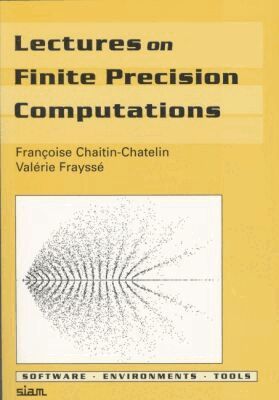
Devoted to the assessment of the quality of numerical results produced by computers, this book addresses the question: how does finite precision affect the convergence of numerical methods on the computer when convergence has been proven in exact arithmetic?Finite precision computations are at the heart of the daily activities of many engineers and researchers in all branches of applied mathematics. Written in an informal style, the book combines techniques from engineering and mathematics to describe the rigorous and novel theory of computability in finite precision. In the challenging cases of nonlinear problems, theoretical analysis is supplemented by software tools to explore the stability on the computer.Round-off errors are often considered negatively, as a severe limitation on the purity of exact computations. The authors show how the necessarily finite precision of the computer arithmetic can be turned into an asset when describing physical phenomena.Special Features:Discusses the influence of nonnormality on the reliability of algorithms and methods in relation to physics and technology.Shows rounding errors to be treatable by classical analysis due to the framework of backward error analysis.Presents a unified theory of convergence and stability by means of elementary mathematics.Illustrates how to take advantage of modern programming environments to do experimental investigation of the stability of a problem or of the reliability of an algorithm or a numerical method.Contains, for the first time in a book, a unified survey of normwise/componentwise error analysis for linear algebra (linear systems, least squares, and eigenproblems) and roots of polynomials.
E-bok
PDF, Engelska, 2003712 kr
Läs direkt efter köp
Euro-Parisaninternationalconferencededicatedtothepromotionandadvan- ment of all aspects of parallel computing. The major themes can be divided into the broad categories of hardware, software, algorithms and applications for p- allel computing. The objective of Euro-Par is to provide a forum within which to promote the development of parallel computing both as an industrial te- nique and an academic discipline, extending the frontier of both the state of the art and the state of the practice. This is particularly important at a time when parallel computing is undergoing strong and sustained development and experiencing real industrial take-up. The main audience for and participants in Euro-Parareseenasresearchersinacademicdepartments,governmentlabora- ries and industrial organisations. Euro-Par’s objective is to become the primary choice of such professionals for the presentation of new results in their specic areas. Euro-Par is also interested in applications which demonstrate the e -tiveness of the main Euro-Par themes. There is now a permanent Web site for the series http://brahms. fmi. uni-passau. de/cl/europar where the history of the conference is described. Euro-Par is now sponsored by the Association of Computer Machinery and the International Federation of Information Processing. Euro-Par’99 The format of Euro-Par’99follows that of the past four conferences and consists of a number of topics eachindividually monitored by a committee of four. There were originally 23 topics for this year’s conference. The call for papers attracted 343 submissions of which 188 were accepted. Of the papers accepted, 4 were judged as distinguished, 111 as regular and 73 as short papers.
662 kr
Skickas inom 10-15 vardagar
Euro-Parisaninternationalconferencededicatedtothepromotionandadvan- ment of all aspects of parallel computing. The major themes can be divided into the broad categories of hardware, software, algorithms and applications for p- allel computing. The objective of Euro-Par is to provide a forum within which to promote the development of parallel computing both as an industrial te- nique and an academic discipline, extending the frontier of both the state of the art and the state of the practice. This is particularly important at a time when parallel computing is undergoing strong and sustained development and experiencing real industrial take-up. The main audience for and participants in Euro-Parareseenasresearchersinacademicdepartments,governmentlabora- ries and industrial organisations. Euro-Par’s objective is to become the primary choice of such professionals for the presentation of new results in their specic areas. Euro-Par is also interested in applications which demonstrate the e -tiveness of the main Euro-Par themes. There is now a permanent Web site for the series http://brahms. fmi. uni-passau. de/cl/europar where the history of the conference is described. Euro-Par is now sponsored by the Association of Computer Machinery and the International Federation of Information Processing. Euro-Par’99 The format of Euro-Par’99follows that of the past four conferences and consists of a number of topics eachindividually monitored by a committee of four. There were originally 23 topics for this year’s conference. The call for papers attracted 343 submissions of which 188 were accepted. Of the papers accepted, 4 were judged as distinguished, 111 as regular and 73 as short papers.