Vera Gowlland-Debbas – författare
Visar alla böcker från författaren Vera Gowlland-Debbas. Handla med fri frakt och snabb leverans.
10 produkter
10 produkter
E-bok
PDF, Engelska, 20215 776 kr
Läs direkt efter köp
Georges Abi-Saab began his writing and teaching at a time when the process of decolonization, and thereafter the quest for emancipation, began to make its far-reaching impact on the international scene, producing significant changes in the international environment, both quantitatively in increasing the number of nation-States and qualitatively in changing patterns of interests and claims. This was bound to result in new pressures on the international legal system itself and in a questioning of the traditional Eurocentric content of international law. In his work and teaching Professor Abi-Saab viewed the dynamics of international law as a function of two driving forces: the emergence of the third world and the sense of injustice. In his view, the first driving force - the emergence of the third world - raised the problem of exclusion: exclusion from participation in the elaboration of international law and the decision-making process, and exclusion as beneficiaries of the resulting rules of international law. At the same time, this new force introduced diversity into the international scene, reflecting the richness of the international community in its different facets. This process remains relevant today, reflecting the contemporary problem of exclusion of new actors as well as their quest for participation. The second driving force - the sense of injustice - posed a teleological problem for him, that of defining community values in order that they capture the different facets of justice, whether formal or distributive. So long as there is no effective organic structure, international law in his view will continue to remain effectiveness-oriented, reflecting rather than impacting on the structures of power. Nevertheless, it is undeniable that there is an on-going process of development of community values and interests; as Georges Abi-Saab wrote with reference to international crimes: `law, like all social phenomena, is a continuous unfolding, a continuous process of elaboration'. He has also considered that the dynamics of the international legal process itself can be captured from the perspective of international organizations as vehicles for change in the international system. From his early writings, Georges Abi-Saab approached the United Nations Charter as a blueprint - both normative and institutional - for a certain type of international society. International institutions with all their imperfections, continue for him to be the means of realization of the law of cooperation which lies at the heart of his concept of the international system. The themes selected for this volume in honour of Professor Georges Abi-Saab are intended to reflect his unique and pioneering contribution to the field of international law. The contributors are drawn from what he has always considered to be his large `family' of former students: in his forty years of teaching, Georges Abi-Saab has acted as mentor to generations of students from all over the world who have benefited from his vision, insights, originality and creative and stimulating use of language. The contributors also include colleagues and friends who share a similar vision of the international legal system.
E-bok
PDF, Engelska, 20211 893 kr
Läs direkt efter köp
This book focuses on the impact of social change on the rules relating to the forms and procedures of treaty-making, but inevitably also comes to focus on the content of the norms themselves, where, as in human rights and the environment, they have had an impact on the form and procedure of the treaty. It is of great value to all practitioners, academics, and policy-makers involved with, or interested in, the treaty-making process.
E-bok
PDF, Engelska, 20213 331 kr
Läs direkt efter köp
The present volume highlights the new challenges of the international protection of refugees fifty years after the adoption of the 1951 Geneva Convention relating to the Status of Refugees. Focusing on the problems faced by Switzerland in the field of international protection of refugees as well as on the specificity of its asylum law and practice, this publication addresses the refugee problem from a national, European and international perspective. The Swiss experience serves to illustrate the wider problematic of on the one hand, the tensions between security, political and humanitarian concerns encountered by refugee-receiving states, and on the other, the need to preserve an international refugee protection regime which remains an essential component of international law and relations for so long as political solutions are not brought to the root causes of refugee exodus. This reflection on the international protection of refugees is organized around four main themes. The first examines Switzerland's response in the past to mass influx, in the light of historical case studies and the evolution of Swiss asylum law and practice. The second focuses on the question of access of refugees to asylum territories and refugee status determination procedures within the framework of the 1951 Convention on the Status of Refugees and the current Swiss asylum law. The third centres on the wider protection regime currently being forged in Europe to address a broader category of refugees, including solutions for temporary and subsidiary protection. The final theme revolves around return of refugees, including those under the Dayton and recent Kosovo agreements and covers reintegration of returnees, assistance and long-term development. This work is based on papers presented at a colloquium of the Graduate Institute of the International Studies in Geneva which was organised in collaboration with the Office of the United Nations High Commissioner for Refugees as a contribution to the 50th anniversaries of the UNHCR and the Geneva Convention relating to the Status of Refugees.
E-bok
PDF, Engelska, 20213 554 kr
Läs direkt efter köp
The reactivation of the Security Council at the beginning of the last decade has resulted, since the invasion of Kuwait by Iraq on August 2, l990, in increasing use of its powers under Chapter VII of the Charter and the adoption of measures against a number of state and non-state entities. The notion of a threat to the peace has now come to encompass violations of fundamental norms of international law such as human rights and humanitarian law, and the wide-ranging measures adopted have included such innovations as the establishment of the UN Compensation Commission or that of the two international criminal tribunals for Former Yugoslavia and Rwanda. These measures have not only infringed on the legal rights of the targeted state (sometimes with irreversible effects where they have remained in force over a long period of time) and its population, but also on those of implementing states and of private rights within these states. The current debate over the legitimacy and long-term effects of economic sanctions on states and their populations makes it imperative to re-evaluate this instrument and the broader peace maintenance function of the Security Council in the light of current community concerns. Part One of this book addresses the theoretical issues by focussing on: 1) The place of sanctions in the international legal system; 2) the limits to the powers of the Security Council and the question of accountability; and 3) an assessment of the alternatives to collective economic sanctions. Part Two looks at the relationship between sanctions and humanitarian issues, examining the relationship between: 1) Sanctions and human rights law; 2) sanctions, humanitarian issues and mandates; and 3) sanctions and humanitarian law. Part Three focuses on implementation by states of Security Council sanctions resolutions by examining: 1) Sanctions and private rights; and 2) special problems for implementing states. Part Four addresses the future in reassessing the place and ethics of sanctions in an international legal system which is giving increased importance to the individual.This work is based on papers presented at a colloquium of the Graduate Institute of International Studies in Geneva.
E-bok
PDF, Engelska, 20246 403 kr
Läs direkt efter köp
E-bok
PDF, Engelska, 20242 987 kr
Läs direkt efter köp
The contributions collected in the present book go beyond refugee law in its traditional sense - largely centred on questions of durable asylum and the plight of only a small tranche of the asylum-seeking population - in situating refugee law within the broader international legal system. The refugee problem is thus seen as a prism through which a host of exploding issues confront traditional international law and international relations: creation and dissolution of states, state responsibility, human rights, international jurisdiction and the United Nations mandate. These theoretical problems and their legal incidence on the refugee condition are debated against the background of UNHCR field operations in Former Yugoslavia, Africa and Eastern Europe. The contributions were originally presented at a Colloquium held in May 1994, organised by the Graduate Institute of International Studies in collaboration with the Office of the United Nations High Commissioner for Refugees. Refugee law experts, members of the UN International Law Commission and practitioners were brought together in a dialogue between scholars and practitioners on a major and exponentially growing international problem.
Del 47 - Nijhoff Law Specials
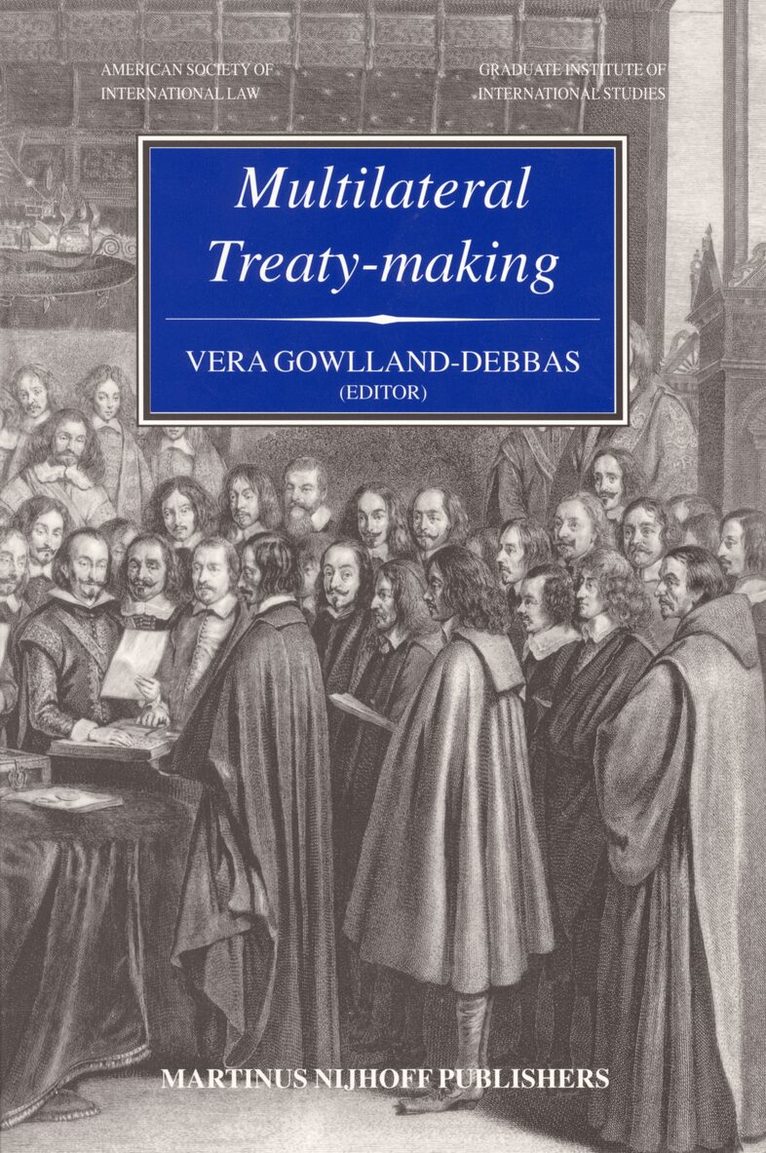
Multilateral Treaty-Making
The Current Status of Challenges to and Reforms Needed in the International Legislative Process
Häftad, Engelska, 2000
1 665 kr
Skickas inom 5-8 vardagar
This book focuses on the impact of social change on the rules relating to the forms and procedures of treaty-making, but inevitably also comes to focus on the content of the norms themselves, where, as in human rights and the environment, they have had an impact on the form and procedure of the treaty. It is of great value to all practitioners, academics, and policy-makers involved with, or interested in, the treaty-making process.
E-bok
PDF, Engelska, 20044 823 kr
Läs direkt efter köp
This work is a comparative study of domestic implementation of Security Council mandatory sanctions taken under Article 41, Chapter VII of the UN Charter, including the establishment of the two international criminal tribunals, the ICTY and ICTR, and recent resolutions on the combating of the financing of terrorism. The book examines implementation in 16 select States in Europe, America, Asia, the Middle East and Africa, underlining also the particular problems arising from sanctions implementation by the European Union, by a permanently neutral and former non-Member State - Switzerland - and by States confronted with special economic problems within the meaning of Article 50 of the UN Charter. Three interrelated themes are addressed. The first, of a theoretical nature, concerns the question of whether implementation of Security Council resolutions, particularly where perceived to be in fulfilment of community objectives, poses problems which are in some way distinct from those raised by the implementation of other conventional international law obligations, thereby shedding a different light on the traditional relationship between international and municipal law. The second concerns the effectiveness of the decisions of the Security Council viewed from the perspective of the effective mise en uvre of these decisions in national law. The third theme concerns the legitimacy of Security Council resolutions as seen from the viewpoint of domestic legal systems, that is the extent to which Security Council decisions encroach on internationally or constitutionally protected individual rights and the potential role played by domestic courts in reviewing the decisions of the Security Council. The latter has assumed particular importance in the framework of the combating of the financing of terrorism.This work, which brings together the research results of 29 academics and experts, is the second publication within the framework of a project on Security Council sanctions carried out under the auspices of the Graduate Institute of International Studies. The first, which looked at a broad set of issues, was entitled United Nations Sanctions and International Law and was published by Kluwer Law International in 2001.
Häftad, Engelska, 2000
506 kr
Skickas inom 10-15 vardagar
E-bok
PDF, Engelska, 2013632 kr
Läs direkt efter köp