Vincent Moulton - Böcker
Visar alla böcker från författaren Vincent Moulton. Handla med fri frakt och snabb leverans.
2 produkter
2 produkter
586 kr
Skickas inom 7-10 vardagar
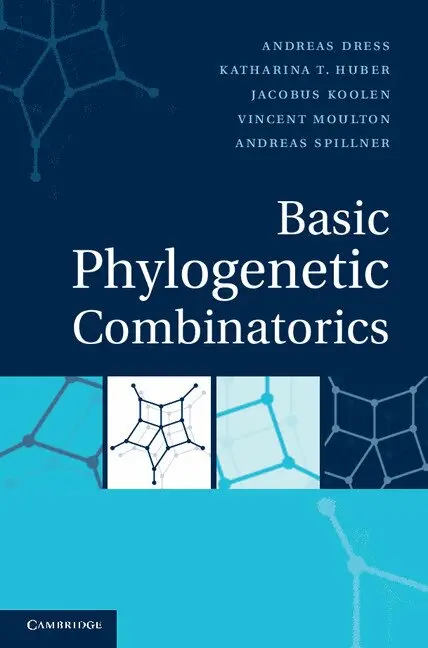
Phylogenetic combinatorics is a branch of discrete applied mathematics concerned with the combinatorial description and analysis of phylogenetic trees and related mathematical structures such as phylogenetic networks and tight spans. Based on a natural conceptual framework, the book focuses on the interrelationship between the principal options for encoding phylogenetic trees: split systems, quartet systems and metrics. Such encodings provide useful options for analyzing and manipulating phylogenetic trees and networks, and are at the basis of much of phylogenetic data processing. This book highlights how each one provides a unique perspective for viewing and perceiving the combinatorial structure of a phylogenetic tree and is, simultaneously, a rich source for combinatorial analysis and theory building. Graduate students and researchers in mathematics and computer science will enjoy exploring this fascinating new area and learn how mathematics may be used to help solve topical problems arising in evolutionary biology.
Algorithms in Bioinformatics
10th International Workshop, WABI 2010, Liverpool, UK, September 6-8, 2010, Proceedings
Häftad, Engelska, 2010
1 064 kr
Skickas inom 10-15 vardagar
We are pleased to present the proceedings of the 10th Workshop on Algorithms in Bioinformatics (WABI 2010) which took place in Liverpool, UK, Sept- ber 6-8, 2010. The WABI 2010 workshop was part of the four ALGO 2010 conference meetings, which, in addition to WABI, included ESA, ATMOS, and WAOA. WABI 2010 was hosted by the University of Liverpool Department of Computer Science, and sponsored by the European Association for Theoretical Computer Science (EATCS) and the International Society for Computational Biology(ISCB). Seehttp://algo2010.csc.liv.ac.uk/wabi/for more details. The Workshop in Algorithms in Bioinformatics highlights research in al- rithmicworkforbioinformatics,computationalbiologyandsystemsbiology.The emphasis is mainly on discrete algorithms and machine-learning methods that address important problems in molecular biology, that are founded on sound models, that are computationally e?cient, and that havebeen implemented and tested in simulations and on real datasets. The goal is to present recent research results, including signi?cant work-in-progress,and to identify and explore dir- tions of future research.