Vincent Verouden – författare
3 515 kr
Läs direkt efter köp
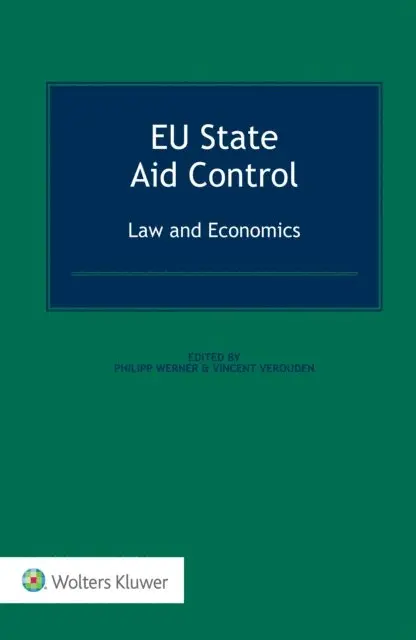
In recent years, the European Commission has conducted an almost complete overhaul of State aid control in the European Union (EU). The State Aid Modernization (SAM) initiative has engendered new secondary legislation, as well as new guidelines covering practically all areas of State aid control, including both horizontal and sector-specific rules. Notable in these developments is an increasingly refined economic approach, both in the design of the rules and in the assessment of individual cases. This book, first of a kind in its in-depth analysis of the current legal and economic principles of EU State aid control, thoroughly explores the main rationales of State aid, the main concerns and the various trade-offs that underlie the rules and the decisions ultimately taken by the Commission and the Courts.
The first part of the book covers the various elements of the notion of State aid, including the hotly disputed conditions of economic advantage and selectivity. Its second part covers the compatibility of aid measures under horizontal rules across industry sectors, including an assessment of the efficiency of the General Block Exemption Regulation and of the new rules on ex post evaluation. The third part deals with the application of State aid rules in specific sectors such as infrastructure, broadband, energy and banking.
Distinguished experts - including lawyers, economists, academics, and officials of the European Commission and of Member State authorities - share their legal and economic experience, insight, and critique of EU State aid control as it stands.
As a critical assessment of the current status of EU State aid control from both legal and economic perspectives, and as an authoritative guide through its complexities and pitfalls, this book will be of immeasurable value, now and in the coming years, to all stakeholders required to understand, interpret and apply the rules under the new regime of State aid control.
Philipp Werner is a Partner in Jones Day’s Brussels office. He has extensive experience in the area of State aid and advises public and private companies on privatization, restructuring, and investment aid. Vincent Verouden is a Director in E.CA Economics’ Brussels office and a former Deputy Chief Economist at the European Commission. In this previous capacity, he was deeply involved in the various reform proposals in the context of the SAM programme.
2 880 kr
Läs direkt efter köp
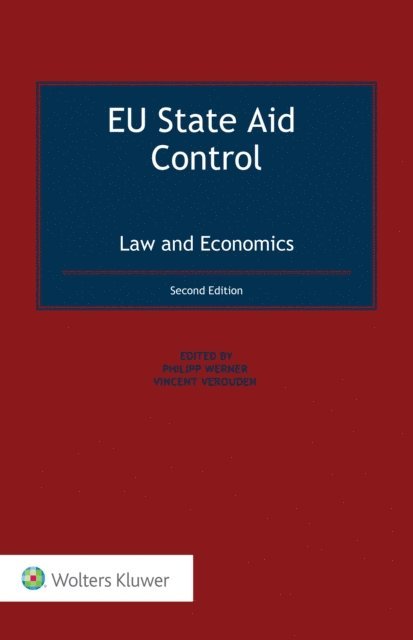
EU State Aid Control
Law and Economics
Second Edition
Edited by Philipp Werner & Vincent Verouden
When the first edition of EU State Aid Control – Law and Economics was published eight years ago, it was the first of a kind in its in-depth analysis of the legal and economic principles of EU State aid control, thoroughly exploring the main rationales of State aid and the various trade-offs that underlie the rules and the decisions taken by the Commission and the Courts.
Since then, a lot has happened. The world has seen developments that seemed to be a thing of the past: Brexit, the COVID-19 pandemic, and Russia’s invasion of Ukraine. European politics and the law of the European Union have had to adapt to these challenges and changes, and EU State aid law has been no exception. In recent years, the European Commission has conducted a review and adaptation of the General Block Exemption Regulation (GBER), as well as its Guidelines and communications covering practically all areas of State aid control. We have also seen new rules emerging, such as the EU/UK Trade and Cooperation Agreement, a new set of crisis rules in the wake of the COVID-19 pandemic, the Foreign Subsidies Regulation, and the Temporary Crisis and Transition Framework, which are all profoundly influencing, expanding, and modifying State aid control law and practice in the EU. At the same time, the European Courts have shaped State aid law through several important judgments.
The second edition of this book reflects these developments and their legal and economic implications. It has been thoroughly revised, updated and expanded. New chapters include a chapter on State aid control beyond the EU, dealing with Brexit and the Foreign Subsidies Regulation; a chapter on State aid in times of crisis, which discusses not only the COVID rules but also the broader implications of the use of temporary crisis rules on the enforcement of State aid rules; and chapters on State aid procedure and private enforcement of State aid.
As a critical assessment of the current status of EU State aid control from both legal and economic perspectives and as an authoritative guide through its complexities and pitfalls, this book will be of immeasurable value, now and in the coming years, to all stakeholders required to understand, interpret and apply the State aid rules.
Philipp Werner is a Partner in Jones Day’s Brussels office. He has extensive experience in the area of State aid and advises Member States as well as public and private companies on all areas of State aid and competition law. Vincent Verouden is an Economic and Policy Analyst at the European Commission, responsible for the ex-post evaluation of competition policy and enforcement. He previously worked as a Director of an economic consultancy active in the field of competition economics (2014-2019) and held various positions in DG Competition, including that of Deputy Chief Economist (2012-2014).
2 880 kr
Läs direkt efter köp
EU State Aid Control
Law and Economics
Second Edition
Edited by Philipp Werner & Vincent Verouden
When the first edition of EU State Aid Control – Law and Economics was published eight years ago, it was the first of a kind in its in-depth analysis of the legal and economic principles of EU State aid control, thoroughly exploring the main rationales of State aid and the various trade-offs that underlie the rules and the decisions taken by the Commission and the Courts.
Since then, a lot has happened. The world has seen developments that seemed to be a thing of the past: Brexit, the COVID-19 pandemic, and Russia’s invasion of Ukraine. European politics and the law of the European Union have had to adapt to these challenges and changes, and EU State aid law has been no exception. In recent years, the European Commission has conducted a review and adaptation of the General Block Exemption Regulation (GBER), as well as its Guidelines and communications covering practically all areas of State aid control. We have also seen new rules emerging, such as the EU/UK Trade and Cooperation Agreement, a new set of crisis rules in the wake of the COVID-19 pandemic, the Foreign Subsidies Regulation, and the Temporary Crisis and Transition Framework, which are all profoundly influencing, expanding, and modifying State aid control law and practice in the EU. At the same time, the European Courts have shaped State aid law through several important judgments.
The second edition of this book reflects these developments and their legal and economic implications. It has been thoroughly revised, updated and expanded. New chapters include a chapter on State aid control beyond the EU, dealing with Brexit and the Foreign Subsidies Regulation; a chapter on State aid in times of crisis, which discusses not only the COVID rules but also the broader implications of the use of temporary crisis rules on the enforcement of State aid rules; and chapters on State aid procedure and private enforcement of State aid.
As a critical assessment of the current status of EU State aid control from both legal and economic perspectives and as an authoritative guide through its complexities and pitfalls, this book will be of immeasurable value, now and in the coming years, to all stakeholders required to understand, interpret and apply the State aid rules.
Philipp Werner is a Partner in Jones Day’s Brussels office. He has extensive experience in the area of State aid and advises Member States as well as public and private companies on all areas of State aid and competition law. Vincent Verouden is an Economic and Policy Analyst at the European Commission, responsible for the ex-post evaluation of competition policy and enforcement. He previously worked as a Director of an economic consultancy active in the field of competition economics (2014-2019) and held various positions in DG Competition, including that of Deputy Chief Economist (2012-2014).
4 090 kr
Tillfälligt slut