Virginia Haufler – författare
Visar alla böcker från författaren Virginia Haufler. Handla med fri frakt och snabb leverans.
3 produkter
3 produkter
E-bok
Engelska, 20251 108 kr
Läs direkt efter köp
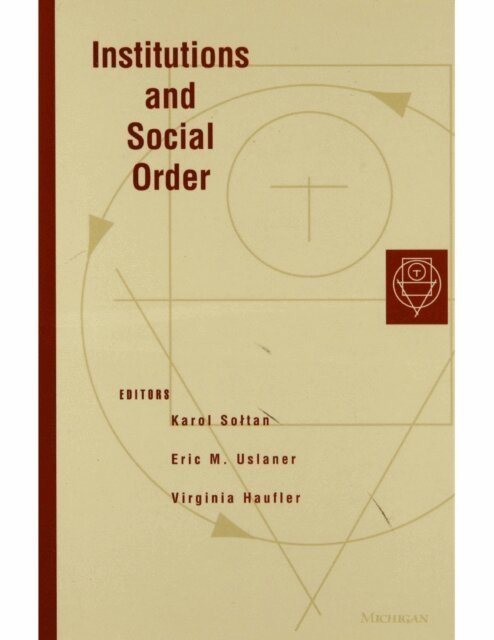
"e;Institutionalism"e; is the buzzword of the 1980s and 1990s in the social sciences. What is new in the contemporary analysis of institutions and what does it offer to the study of social order? In this book a distinguished group of social scientists drawn from political science, economics, and sociology, explore this question and show us how different theoretical approaches to institutional analysis can be joined to build a more thorough understanding of institutions. The modern analysis of institutions has taken two separate paths. Rational choice theories identified institutions as a strategic response to collective action problems and as instruments for the promotion of cooperation. Contrary to these theories, such cooperation is fundamental to social order and a prerequisite for economic growth and development. An alternate form of institutionalism, drawn from sociological and historical analysis, de-emphasized the role of choice, strategy, and design in the construction of many of the major institutions in social life. This form of institutional analysis pointed to the role of prior choices, common norms, and culture in making certain options and choices unthinkable or impossible. Institutions, according to this view, may represent a certain kind of social order, but they do not always promote cooperation and economic growth.The more recent theories in the "e;new institutionalism"e; bring these seemingly irreconcilable perspectives closer together. New institutionalists argue that institutions must be grounded in the social fabric, and thus rational choice must be combined with historical and cultural variables. The papers collected in this volume address the merging of rational choice and historical-sociological institutionalism in the "e;new institutionalism."e; Institutions and Social Order offer a conversation that enables us to explore the commonalities -- and divisions -- between the disciplies and the ways these disciplines define and use institutions in their analysis. The contributors include Randall L. Calvert, Christopher Clague, Kathleen Cook, Peter A. Hall, Virginia Haufler, Gary Miller, Karol Soltan, Rosemary C. R. Taylor, Eric M. Uslaner, and Barry R. Weingast.
Häftad, Engelska, 1999
490 kr
Skickas inom 5-8 vardagar
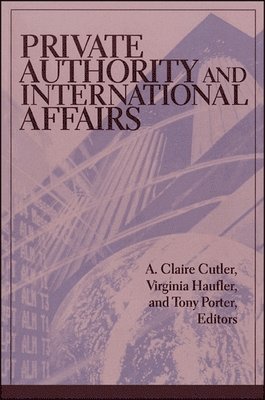
Explores in detail the degree to which private sector firms are beginning to replace governments in "governing" some areas of international relations.Governments today are too often unwilling to intervene in global commerce, and international organizations are too often unable to govern effectively. In their place, firms increasingly cooperate internationally to establish the rules and standards of behavior for themselves and for others, taking on the mantle of authority to govern specific issue areas. Are they stepping into the breach to supply needed collective goods? Or are they organizing themselves in order to prevent governments from interfering in their business? This book explores the meaning of this private international authority, both for theory and policy, through case studies of specific industries, associations, and issue areas in both contemporary and historical perspective.[Contributors include Pamela Burke, Lynn Mytelka and Michel Delapierre, Liora Salter, Susan Sell, Timothy Sinclair, Deborah Spar, and Michael Webb.]
Inbunden, Engelska, 1999
1 042 kr
Tillfälligt slut
Explores in detail the degree to which private sector firms are beginning to replace governments in "governing" some areas of international relations.Governments today are too often unwilling to intervene in global commerce, and international organizations are too often unable to govern effectively. In their place, firms increasingly cooperate internationally to establish the rules and standards of behavior for themselves and for others, taking on the mantle of authority to govern specific issue areas. Are they stepping into the breach to supply needed collective goods? Or are they organizing themselves in order to prevent governments from interfering in their business? This book explores the meaning of this private international authority, both for theory and policy, through case studies of specific industries, associations, and issue areas in both contemporary and historical perspective.[Contributors include Pamela Burke, Lynn Mytelka and Michel Delapierre, Liora Salter, Susan Sell, Timothy Sinclair, Deborah Spar, and Michael Webb.]