Volker Mahnke – författare
Visar alla böcker från författaren Volker Mahnke. Handla med fri frakt och snabb leverans.
4 produkter
4 produkter
Inbunden, Engelska, 2000
3 635 kr
Skickas inom 5-8 vardagar
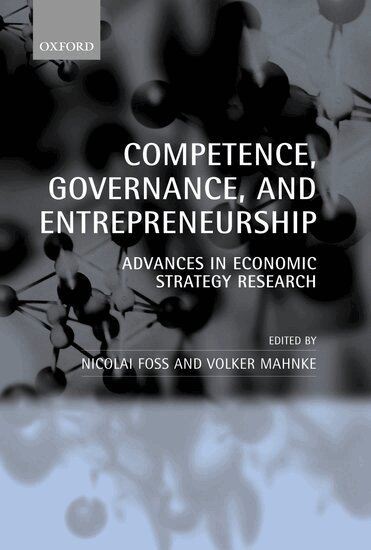
The 'theory of the firm' is a significant part of modern economics. Because it informs strategic choices, it is highly relevant to business administration in general, and for strategic management in particular. Two dominant streams may be identified in the literature, namely the 'competence' and 'governance' perspectives on the firm. While there has been little direct discussion between the main proponents of these perspectives, both claim that they are reaching for a 'strategic theory of the firm'. Such a theory would not only shed light on the classical questions considered in the theory of the firm (e.g. why firms exist, what determines their boundaries and internal organization), but would also be helpful for informing strategy issues, such as understanding strategic flexibility, strategic options, and the sources of competitive advantage. This volume brings together prominent voices on competence, governance, and entrepreneurship to advance and stimulate economic strategy research. By pooling and mobilizing intellectual resources of both competence and governance perspectives, the contributions show that an innovative joint venture between these two main perspectives potentially leads to a new avenue of future research on strategic issues such as 'corporate growth', 'interfirm cooperation', and 'corporate entrepreneurship'.
Häftad, Engelska, 2002
697 kr
Skickas inom 3-6 vardagar
The 'theory of the firm' is a significant part of modern economics. Because it informs strategic choices, it is also highly relevant to business administration in particular. Two dominant streams may be identified in the literature, namely the 'competence' and 'governance' perspectives on the firm. While there has been little direct discussion between the main proponents of these perspectives, both claim that they are reaching for a strategic theory of the firm. Such a theory would not only shed light on the classical questions considered in the theory of the firm (e.g. why firms exist, what determines their boundaries and internal organization), but would also be helpful for informing strategy issues, such as understanding strategic flexibility, strategic options, and the sources of competitive advantage.This volume brings together leading thinkers on competence, governance, and entrepreneurship to advance and stimulate economic strategy research. By pooling and mobilizing intellectual resources of both competence and governance perspectives, the contributions show that an innovative joint venture between these two main perspectives potentially leads to a new avenue of future research on strategic issues such as corporate growth, interfirm cooperation, and corporate entrepreneurship.
E-bok
PDF, Engelska, 2012583 kr
Läs direkt efter köp
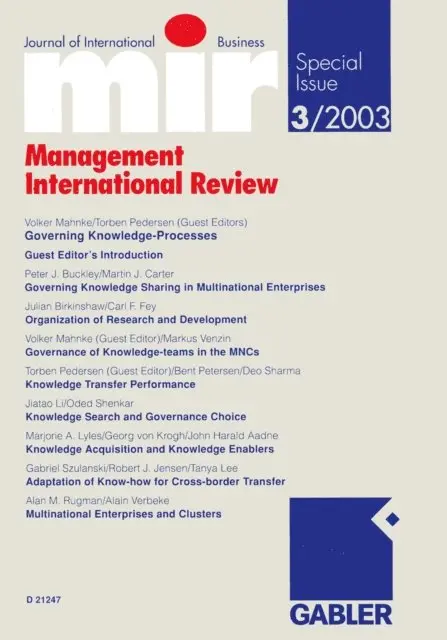
lication. Key criteria for inclusion included a sound combination of conceptuali zation and empirical grounding in response to the questions above. Peter J. Buckley and Martin J. Carter in their paper Governing Knowledge Sharing in Multinational Enterprises examines knowledge-sharing processes in four UK MNCs. A key challenge is to design governance architectures so that application strategy (uses of a given portfolio of knowledge) and discovery strategy (new combinations of knowledge) can be supported through knowledge sharing. A key trade-off obtains here between integration and partitioning of knowledge assets, whereby increased partitioning facilitates local knowledge sharing but complicates global integration. In addition, coordination mechanisms employed in the governance of knowledge sharing may be organized centrally or decentrally, whereby central organization may lead to knowledge loss and managerial overload while decentral organization may lead to loss of control. An important contingency in resolving these governance problems is the extent to which firms follow application and discovery strategies. In addition, the authors recommend to closely integrate incentive systems with attempts for knowledge sharing including individual incentives and rewards. Julian Birkinshaw and Carl F. Fey examine the Organization of Research and Development in Large Multinational Firms in a sample of 107 firms based in the UK and Sweden. The key challenge addressed in this paper is how knowledge creation is governed and how this impacts R&D performance. Several trade-offs obtain. First, headquarter centred vs.
Del 3 - mir Special Issue
Governing Knowledge-Processes
Häftad, Engelska, 2003
415 kr
Skickas inom 10-15 vardagar
lication. Key criteria for inclusion included a sound combination of conceptuali zation and empirical grounding in response to the questions above. Peter J. Buckley and Martin J. Carter in their paper Governing Knowledge Sharing in Multinational Enterprises examines knowledge-sharing processes in four UK MNCs. A key challenge is to design governance architectures so that application strategy (uses of a given portfolio of knowledge) and discovery strategy (new combinations of knowledge) can be supported through knowledge sharing. A key trade-off obtains here between integration and partitioning of knowledge assets, whereby increased partitioning facilitates local knowledge sharing but complicates global integration. In addition, coordination mechanisms employed in the governance of knowledge sharing may be organized centrally or decentrally, whereby central organization may lead to knowledge loss and managerial overload while decentral organization may lead to loss of control. An important contingency in resolving these governance problems is the extent to which firms follow application and discovery strategies. In addition, the authors recommend to closely integrate incentive systems with attempts for knowledge sharing including individual incentives and rewards. Julian Birkinshaw and Carl F. Fey examine the Organization of Research and Development in Large Multinational Firms in a sample of 107 firms based in the UK and Sweden. The key challenge addressed in this paper is how knowledge creation is governed and how this impacts R&D performance. Several trade-offs obtain. First, headquarter centred vs.