W. Bruce Croft – författare
Visar alla böcker från författaren W. Bruce Croft. Handla med fri frakt och snabb leverans.
8 produkter
8 produkter
E-bok
PDF, Engelska, 20062 925 kr
Läs direkt efter köp
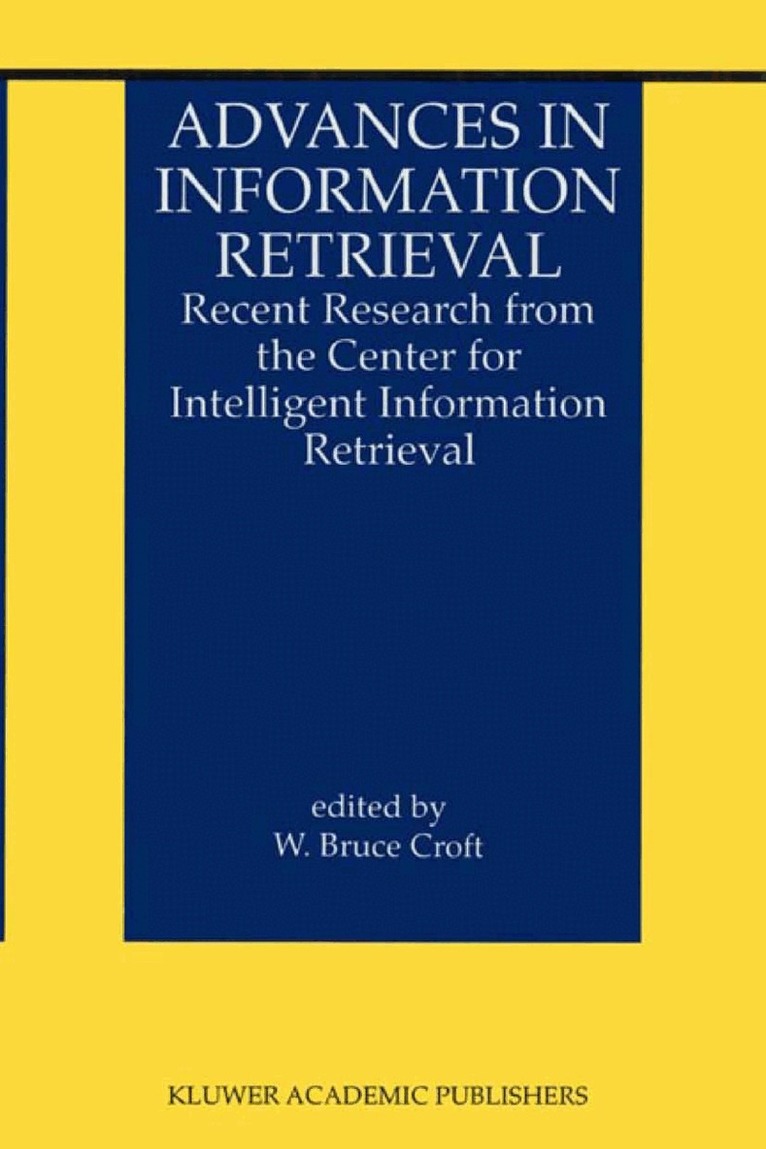
The Center for Intelligent Information Retrieval (CIIR) was formed in the Computer Science Department ofthe University ofMassachusetts, Amherst in 1992. The core support for the Center came from a National Science Foun- tion State/Industry/University Cooperative Research Center(S/IUCRC) grant, although there had been a sizeable information retrieval (IR) research group for over 10 years prior to that grant. Thebasic goal ofthese Centers is to combine basic research, applied research, and technology transfer. The CIIR has been successful in each of these areas, in that it has produced over 270 research papers, has been involved in many successful government and industry collaborations, and has had a significant role in high-visibility Internet sites and start-ups. As a result of these efforts, the CIIR has become known internationally as one of the leading research groups in the area of information retrieval. The CIIR focuses on research that results in more effective and efficient access and discovery in large, heterogeneous, distributed, text and multimedia databases. The scope of the work that is done in the CIIR is broad and goes significantly beyond “traditional” areas of information retrieval such as retrieval models, cross-lingual search, and automatic query expansion. The research includes both low-level systems issues such as the design of protocols and architectures for distributed search, as well as more human-centered topics such as user interface design, visualization and data mining with text, and multimedia retrieval.
Del 7 - Information Retrieval Series
Advances in Information Retrieval
Recent Research from the Center for Intelligent Information Retrieval
Inbunden, Engelska, 2000
2 230 kr
Skickas inom 10-15 vardagar
The Center for Intelligent Information Retrieval (CIIR) was formed in the Computer Science Department ofthe University ofMassachusetts, Amherst in 1992. The core support for the Center came from a National Science Foun- tion State/Industry/University Cooperative Research Center(S/IUCRC) grant, although there had been a sizeable information retrieval (IR) research group for over 10 years prior to that grant. Thebasic goal ofthese Centers is to combine basic research, applied research, and technology transfer. The CIIR has been successful in each of these areas, in that it has produced over 270 research papers, has been involved in many successful government and industry collaborations, and has had a significant role in high-visibility Internet sites and start-ups. As a result of these efforts, the CIIR has become known internationally as one of the leading research groups in the area of information retrieval. The CIIR focuses on research that results in more effective and efficient access and discovery in large, heterogeneous, distributed, text and multimedia databases. The scope of the work that is done in the CIIR is broad and goes significantly beyond “traditional” areas of information retrieval such as retrieval models, cross-lingual search, and automatic query expansion. The research includes both low-level systems issues such as the design of protocols and architectures for distributed search, as well as more human-centered topics such as user interface design, visualization and data mining with text, and multimedia retrieval.
Del 13 - Information Retrieval Series
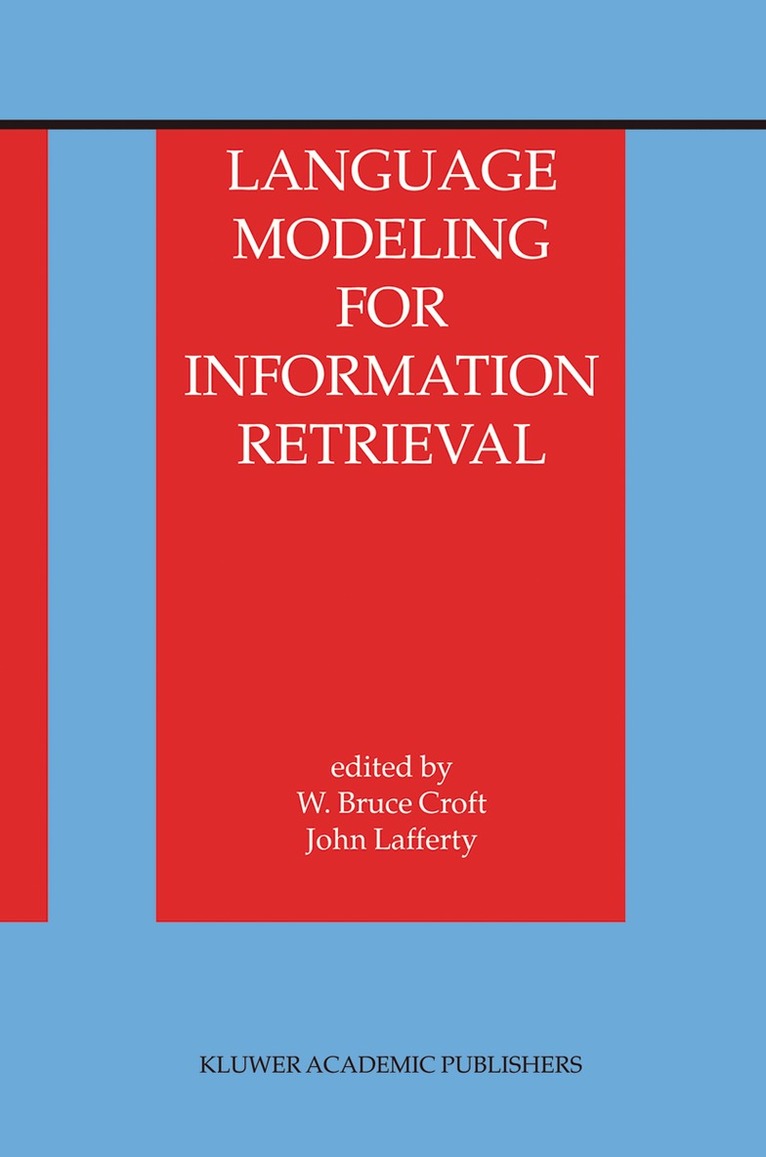
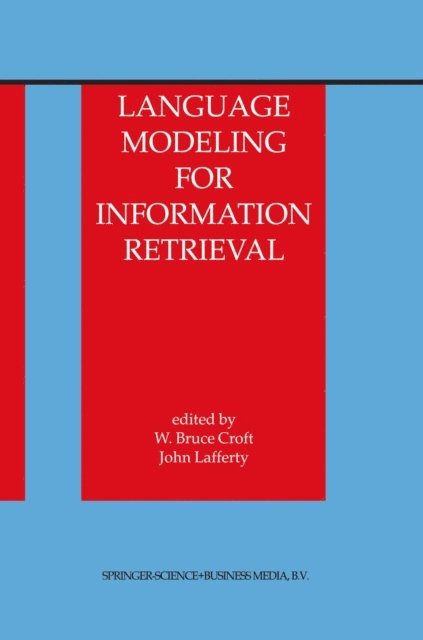
Language Modeling for Information Retrieval
Inbunden, Engelska, 2003
1 119 kr
Skickas inom 10-15 vardagar
A statisticallanguage model, or more simply a language model, is a prob abilistic mechanism for generating text. Such adefinition is general enough to include an endless variety of schemes. However, a distinction should be made between generative models, which can in principle be used to synthesize artificial text, and discriminative techniques to classify text into predefined cat egories. The first statisticallanguage modeler was Claude Shannon. In exploring the application of his newly founded theory of information to human language, Shannon considered language as a statistical source, and measured how weH simple n-gram models predicted or, equivalently, compressed natural text. To do this, he estimated the entropy of English through experiments with human subjects, and also estimated the cross-entropy of the n-gram models on natural 1 text. The ability of language models to be quantitatively evaluated in tbis way is one of their important virtues. Of course, estimating the true entropy of language is an elusive goal, aiming at many moving targets, since language is so varied and evolves so quickly. Yet fifty years after Shannon's study, language models remain, by all measures, far from the Shannon entropy liInit in terms of their predictive power. However, tbis has not kept them from being useful for a variety of text processing tasks, and moreover can be viewed as encouragement that there is still great room for improvement in statisticallanguage modeling.
E-bok
PDF, Engelska, 20121 459 kr
Läs direkt efter köp
Information retrieval (IR) is becoming an increasingly important area as scientific, business and government organisations take up the notion of "information superhighways" and make available their full text databases for searching. Containing a selection of 35 papers taken from the 17th Annual SIGIR Conference held in Dublin, Ireland in July 1994, the book addresses basic research and provides an evaluation of information retrieval techniques in applications. Topics covered include text categorisation, indexing, user modelling, IR theory and logic, natural language processing, statistical and probabilistic models of information retrieval systems, routing, passage retrieval, and implementation issues.
Del 7 - Information Retrieval Series
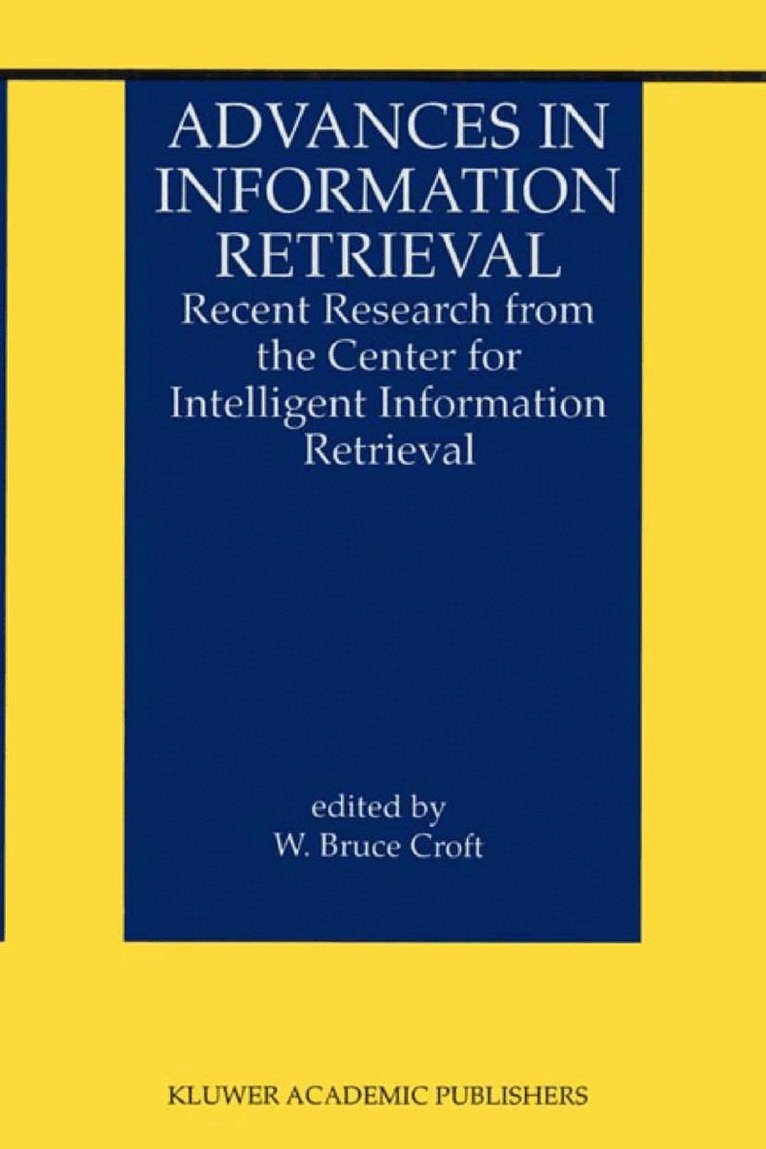
Advances in Information Retrieval
Recent Research from the Center for Intelligent Information Retrieval
Häftad, Engelska, 2013
2 230 kr
Skickas inom 10-15 vardagar
The Center for Intelligent Information Retrieval (CIIR) was formed in the Computer Science Department ofthe University ofMassachusetts, Amherst in 1992. The core support for the Center came from a National Science Foun- tion State/Industry/University Cooperative Research Center(S/IUCRC) grant, although there had been a sizeable information retrieval (IR) research group for over 10 years prior to that grant. Thebasic goal ofthese Centers is to combine basic research, applied research, and technology transfer. The CIIR has been successful in each of these areas, in that it has produced over 270 research papers, has been involved in many successful government and industry collaborations, and has had a significant role in high-visibility Internet sites and start-ups. As a result of these efforts, the CIIR has become known internationally as one of the leading research groups in the area of information retrieval. The CIIR focuses on research that results in more effective and efficient access and discovery in large, heterogeneous, distributed, text and multimedia databases. The scope of the work that is done in the CIIR is broad and goes significantly beyond “traditional” areas of information retrieval such as retrieval models, cross-lingual search, and automatic query expansion. The research includes both low-level systems issues such as the design of protocols and architectures for distributed search, as well as more human-centered topics such as user interface design, visualization and data mining with text, and multimedia retrieval.
Häftad, Engelska, 1994
1 125 kr
Skickas inom 10-15 vardagar
Information retrieval (IR) is becoming an increasingly important area as scientific, business and government organisations take up the notion of "information superhighways" and make available their full text databases for searching. Containing a selection of 35 papers taken from the 17th Annual SIGIR Conference held in Dublin, Ireland in July 1994, the book addresses basic research and provides an evaluation of information retrieval techniques in applications. Topics covered include text categorisation, indexing, user modelling, IR theory and logic, natural language processing, statistical and probabilistic models of information retrieval systems, routing, passage retrieval, and implementation issues.
Del 13 - Information Retrieval Series
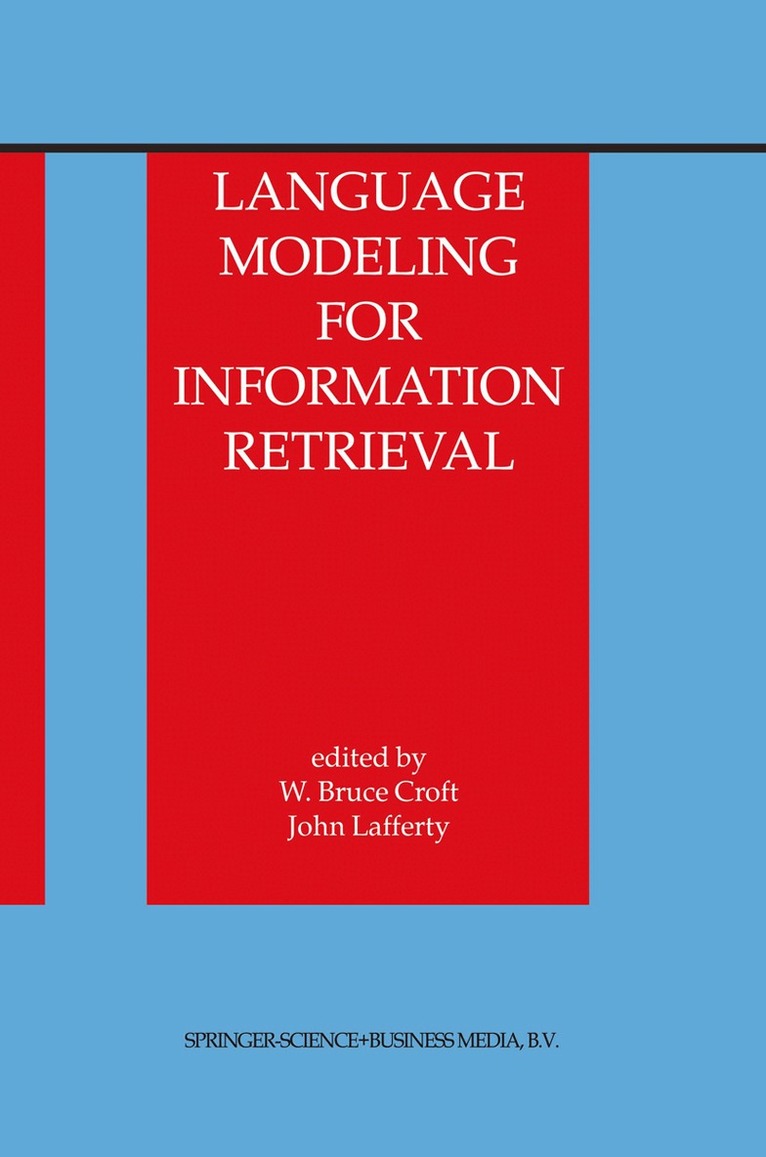
Language Modeling for Information Retrieval
Häftad, Engelska, 2010
1 123 kr
Skickas inom 10-15 vardagar
A statisticallanguage model, or more simply a language model, is a prob abilistic mechanism for generating text. Such adefinition is general enough to include an endless variety of schemes. However, a distinction should be made between generative models, which can in principle be used to synthesize artificial text, and discriminative techniques to classify text into predefined cat egories. The first statisticallanguage modeler was Claude Shannon. In exploring the application of his newly founded theory of information to human language, Shannon considered language as a statistical source, and measured how weH simple n-gram models predicted or, equivalently, compressed natural text. To do this, he estimated the entropy of English through experiments with human subjects, and also estimated the cross-entropy of the n-gram models on natural 1 text. The ability of language models to be quantitatively evaluated in tbis way is one of their important virtues. Of course, estimating the true entropy of language is an elusive goal, aiming at many moving targets, since language is so varied and evolves so quickly. Yet fifty years after Shannon's study, language models remain, by all measures, far from the Shannon entropy liInit in terms of their predictive power. However, tbis has not kept them from being useful for a variety of text processing tasks, and moreover can be viewed as encouragement that there is still great room for improvement in statisticallanguage modeling.
E-bok
PDF, Engelska, 20131 459 kr
Läs direkt efter köp
A statisticallanguage model, or more simply a language model, is a prob abilistic mechanism for generating text. Such adefinition is general enough to include an endless variety of schemes. However, a distinction should be made between generative models, which can in principle be used to synthesize artificial text, and discriminative techniques to classify text into predefined cat egories. The first statisticallanguage modeler was Claude Shannon. In exploring the application of his newly founded theory of information to human language, Shannon considered language as a statistical source, and measured how weH simple n-gram models predicted or, equivalently, compressed natural text. To do this, he estimated the entropy of English through experiments with human subjects, and also estimated the cross-entropy of the n-gram models on natural 1 text. The ability of language models to be quantitatively evaluated in tbis way is one of their important virtues. Of course, estimating the true entropy of language is an elusive goal, aiming at many moving targets, since language is so varied and evolves so quickly. Yet fifty years after Shannon''s study, language models remain, by all measures, far from the Shannon entropy liInit in terms of their predictive power. However, tbis has not kept them from being useful for a variety of text processing tasks, and moreover can be viewed as encouragement that there is still great room for improvement in statisticallanguage modeling.