W. Edward Steinmueller - Böcker
Visar alla böcker från författaren W. Edward Steinmueller. Handla med fri frakt och snabb leverans.
6 produkter
6 produkter
3 156 kr
Skickas inom 5-8 vardagar
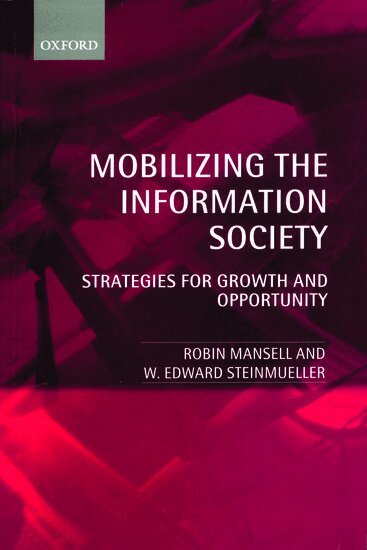
'Mobilizing the Information Society' provides a critical assessment of progress towards the Information Society. It begins from the premise that the construction of the Information Society in Europe is a dynamic process and that the journey towards a society that is so heavily dependent on capacities to generate, distribute, and use digital information is far from straightforward.The book draws upon empirical research generated by researchers based in the United Kingdom, The Netherlands, Italy, and France that was originally funded by the European Commission's Fourth Framework Advanced Communication Technologies and Services (ACTS) Programme which ran from 1994 to 1998. This book updates the original research, integrates the results around core themes, and provides an assessment of progress that has been made towards addressing key issues of interest to policy makers, the business community, and technology and service users. The authors lay the foundation for more useful theories of the process of change, more appropriate strategies to achieve the desired aims, and more effective policies for increasing the benefits and mitigating the effects of dislocation and exclusion from the Information Society.'Mobilizing the Information Society' provides unique insights into the social, economic, and political forces that are structuring the pathway to the Information Society - and its consequences for business and individuals in their everyday lives.
789 kr
Skickas inom 7-10 vardagar
Mobilizing the Information Society comprehensively and critically examines the interaction between social, regulatory, and market developments underlying the growing use of new technologies such as the personal computer and the Internet. Based upon empirical research by an international team, it offers insights needed to understand public policy, corporate strategy, and individual choices taken in response to the deluge of new technological opportunities.A principal theme of Mobilizing the Information Society is that changes are governed by public decisions that establish the institutional framework in which the private sector operates. The quality and value of the information society for the citizen is not the inevitable consequence of market and technological forces. Policy choices, however, that fail to take market and technical influences into account will prove ineffective. The authors lay the foundation for improved theories of the process of change, more appropriate strategies to achieve desired aims, and more effective policies for mitigating the effects of dislocation and exclusion from the information society.Mobilizing the Information Society offers unique insights into the social, economic, and political forces that are structuring the pathway to the information society, and their consequences for businesses and citizens in their everyday lives.
2 461 kr
Skickas inom 7-10 vardagar
This book re-examines the rationale for public policy, concluding that the prevailing 'public knowledge' model is evolving towards a networked or distributed model of knowledge production and use in which public and private institutions play complementary roles. It provides a set of tools and models to assess the impact of the new network model of funding and governance, and argues that governments need to adapt their funding and administrative priorities and procedures to support the emergence and healthy growth of research networks. The book goes on to explain that interdependencies and complementarities in the production and distribution of knowledge require a new and more contextual, flexible and complex approach to government funding, monitoring and assessment. The chapters in this book issue a series of challenges to the next generation of science and technology policy. The need for new systems of governance in science and innovation make a single, all encompassing rationale for public funding unnecessary and irrelevant. The new policy questions that matter concern the means and mechanisms for intervention - the use of policy to harness, support and expand the interaction and dynamism of research networks composed of public and private actors.
New Frontiers in the Economics of Innovation and New Technology
Essays in Honour of Paul A. David
Inbunden, Engelska, 2006
2 655 kr
Skickas inom 7-10 vardagar
Recent research on the economics of innovation has acknowledged the importance of path dependence and networks in the evolution of economies and the diffusion of new techniques, products, and processes. These are topics pioneered by Paul A. David, one of the world's leading scholars in the economics of innovation. This outstanding collection provides a fitting tribute to the diversity and depth of Paul David's contributions. The papers included range from simulation models of the evolution of market structure in the presence of innovation, through historical investigations of knowledge networks and empirical analysis of contemporary networks, to the analysis of the diffusion of innovations using simulation and analytic models and of the diffusion of knowledge using patent data.With an emphasis on simulation models, data analysis, and historical evidence, this book will be required reading for researchers in innovation economics and regional development as well as economists, sociologists, and historians of innovation and intellectual property.
962 kr
Skickas inom 7-10 vardagar
This book re-examines the rationale for public policy, concluding that the prevailing 'public knowledge' model is evolving towards a networked or distributed model of knowledge production and use in which public and private institutions play complementary roles. It provides a set of tools and models to assess the impact of the new network model of funding and governance, and argues that governments need to adapt their funding and administrative priorities and procedures to support the emergence and healthy growth of research networks. The book goes on to explain that interdependencies and complementarities in the production and distribution of knowledge require a new and more contextual, flexible and complex approach to government funding, monitoring and assessment. The chapters in this book issue a series of challenges to the next generation of science and technology policy. The need for new systems of governance in science and innovation make a single, all encompassing rationale for public funding unnecessary and irrelevant. The new policy questions that matter concern the means and mechanisms for intervention - the use of policy to harness, support and expand the interaction and dynamism of research networks composed of public and private actors.
New Frontiers in the Economics of Innovation and New Technology
Essays in Honour of Paul A. David
Häftad, Engelska, 2007
862 kr
Skickas inom 7-10 vardagar
Recent research on the economics of innovation has acknowledged the importance of path dependence and networks in the evolution of economies and the diffusion of new techniques, products, and processes. These are topics pioneered by Paul A. David, one of the world's leading scholars in the economics of innovation. This outstanding collection provides a fitting tribute to the diversity and depth of Paul David's contributions. The papers included range from simulation models of the evolution of market structure in the presence of innovation, through historical investigations of knowledge networks and empirical analysis of contemporary networks, to the analysis of the diffusion of innovations using simulation and analytic models and of the diffusion of knowledge using patent data.With an emphasis on simulation models, data analysis, and historical evidence, this book will be required reading for researchers in innovation economics and regional development as well as economists, sociologists, and historians of innovation and intellectual property.