W. H. Marlow - Böcker
Visar alla böcker från författaren W. H. Marlow. Handla med fri frakt och snabb leverans.
2 produkter
2 produkter
536 kr
Skickas inom 10-15 vardagar
The suggestion by Dr. Franklin S. Harris, Jr. , that these books be written arose pursuant to the editor's plaints that despite the implicitly or explicitly ack nowledged importance of both aerosols and particulate matter in innumerable domains of technology and human welfare, investigations of these subjects were generally not supported independently of the narrowest conceivable domains of their appli cations. Frank Harris, who has long been a contributor in one of the important domains of aerosol macrophysics, atmospheric optics, challenged the editor to elaborate his views. Ideally, they would have taken the form of a monograph; however, there is as yet an insufficient body of information to present a unified treatment. At the same time, substantial efforts are in progress in the component fields to hold the promise for the emergence of unifying elements which will even tually facilitate their presentation to be made with a high degree of integrity. There are numerous pertinent and systematic tie-ins between project-oriented aerosol work and basic physical investigations which are themselves quite closely akin to much classical and current work in physical science. The most significant aspect of these tie-ins is their potential for making substantial contributions to the functional needs of the applications areas while stimulating significant questions of basic physics. For this to be possible, it is necessary that the most relevant areas of physics be identified in such a manner as to make clear their re levance for aerosol-related studies and vice versa.
Del 29 - Topics in Current Physics
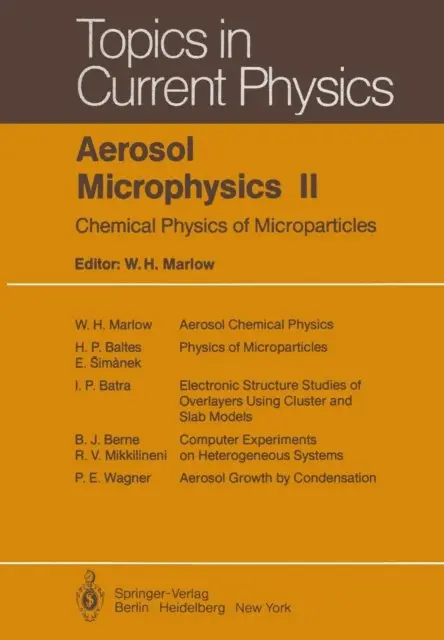
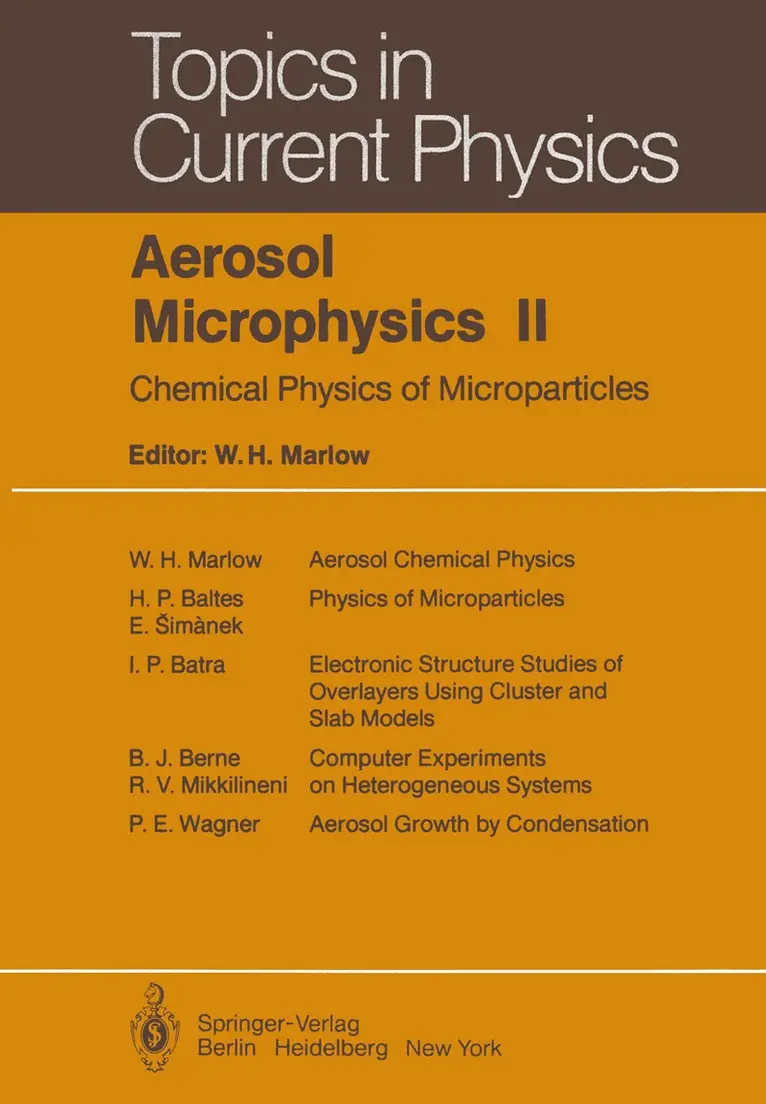
Aerosol Microphysics II
Chemical Physics of Microparticles
Häftad, Engelska, 2011
536 kr
Skickas inom 10-15 vardagar
Aerosols, which are gas-phase dispersions of particulate matter, draw upon and con tribute to multidisciplinary work in technology and the natural sciences. As has been true throughout the history of science with other fields of interest whose un derlying disciplinary structure was either unclear or insufficiently well developed to contribute effectively to those fields, "aerosol science" has. developed its own methods and lore somewhat sequestered from the main lines of contemporary physical thought. Indeed, this independent development is the essential step in which syste matic or phenomenological descriptions are evolved with validity of sufficient gen erality to suggest the potential for development of a physically rigorous and gen eralizable body of knowledge. At the same time, the field has stimulated many ques tions which, limited to its own resources, are hopelessly beyond explanation. As Kuhn pointed out in The Structure of Scientific Revolution [2nd enlarged edition (University of Chicago Press, Chicago 1970) Chapter II and Postscript-1969) this is a very common juncture in the development of a science. In brief, the transition from this earlier stage to the mature stage of the science involves a general re cognition and agreement of what the foundations of the field consist of. By this critical step, a field settles upon a common language which is well defined rather than the ambiguous, and often undefined descriptors prevalent at the earlier stage.