Wendy Lynne Lee - Böcker
Visar alla böcker från författaren Wendy Lynne Lee. Handla med fri frakt och snabb leverans.
3 produkter
3 produkter
1 833 kr
Skickas inom 10-15 vardagar
If we were to ask what is the root cause of our current and unprecedented environmental crisis, climate change, many, particularly on the progressive Left, would refer to the excesses of capitalism—and they’d be right. In Eco-Nihilism: The Philosophical Geopolitics of the Climate Change Apocalypse, Wendy Lynne Lee demonstrates that there are no versions of conquest capital compatible with the fact of a finite planet and that a logic whose operating premise is growth is destined to not only exhaust our planetary resources, but also generate profound social injustice and geopolitical violence in its pursuit. Nonetheless, it is clear that the violence and injustice of capital is selective—some benefit greatly while others are subjugated to its pathological drive to profit. Hence, Lee argues that any comprehensive analysis of what Jason Moore has dubbed the Capitalocene must include an equally probing account of human chauvinism, that is, the axes along which capital is supplied with resources and labor. Defined in terms of race, sex, gender, and species, these axes come ready-made to the advantage of capitalist commodification. Without an understanding of how and why, humanity will remain doomed to settling for a sustainably unjust world as opposed to realizing a just and desirable one. Indeed, on our current trajectory, we may not even achieve the sustainable. The introduction of climate change into the mix of environmental deterioration, the ever-widening economic gap between global North and global South, and the accelerating violence of terrorism, civil war, and human slavery make of a warming planet a combustible world. The only way out requires ending the myth of endless resources, a rejection of climate change denial, and a radical re-valuation of human-centeredness, not as a locus of power, but as an opportunity to take moral and epistemic responsibility for a world whose biotic diversity and ecological integrity make the struggle to realize it worthwhile. This solution demands not only an end to capitalism, but the deliberate reclamation of value—aesthetic, moral, and civic—and a radical transformation of both personal and collective conscience. Lee appeals to the experiential aesthetics of John Dewey and the feminist concept of the standpoint of the subjugated. She argues for a version of the precautionary principle informed by an environmentally and socially responsible concept of the desirable future as the clearest path away from the precipice.
336 kr
Skickas inom 7-10 vardagar
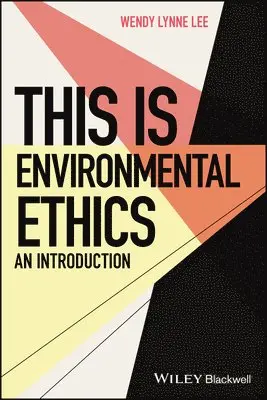
Provides students and scholars with a comprehensive introduction to the growing field of environmental philosophy and ethics Mitigating the effects of climate change will require global cooperation and lasting commitment. Of the many disciplines addressing the ecological crisis, philosophy is perhaps best suited to develop the conceptual foundations of a viable and sustainable environmental ethic. This is Environmental Ethics provides an expansive overview of the key theories underpinning contemporary discussions of our moral responsibilities to non-human nature and living creatures. Adopting a critical approach, author Wendy Lynne Lee closely examines major moral theories to discern which ethic provides the compass needed to navigate the social, political, and economic challenges of potentially catastrophic environmental transformation, not only, but especially the climate crisis. Lee argues that the ethic ultimately adopted must make the welfare of non-human animals and plant life a priority in our moral decision-making, recognizing that ecological conditions form the existential conditions of all life on the planet. Throughout the text, detailed yet accessible chapters demonstrate why philosophy is relevant and useful in the face of an uncertain environmental future. Questions which environmental theory might best address the environmental challenges of climate change and the potential for recurring pandemicDiscusses how inequalities of race, sex, gender, economic status, geography, and species impact our understanding of environmental dilemmasExplores the role of moral principles in making decisions to resolve real-world dilemmasIncorporates extensive critiques of moral extensionist and ecocentric argumentsIntroduces cutting-edge work done by radical “deep green” writers, animal rights theorists, eco-phenomenologists, and ecofeministsThis is Environmental Ethics is essential reading for undergraduate students in courses on philosophy, geography, environmental studies, feminist theory, ecology, human and animal rights, and social justice, as well as an excellent graduate-level introduction to the key theories and thinkers of environmental philosophy.
1 236 kr
Skickas inom 10-15 vardagar
In Climate Crisis and the Kleptocene: On The Commodification of Sentience the author argues that capitalism is not merely a system of economic exchange, but an ideology of value that, in virtue of the existential demand for permanent growth, must reduce other forms of value—moral, civic, and aesthetic—to exchange value. The ontology of capital accumulation can neither afford nor accede to any exemption to its fundamentally kleptocratic logic of commodification. Thus, among its most significant originary acts is to nullify the value of sentience as an obstacle to commodification. A number of well-known environmental writers including David Wallace-Wells, Michael Mann, Gary Francione, and Jason Moore, however, miss this critical element of the ontology of capital and thereby end up either defending reformist incarnations of capital conquest or, as Andreas Malm puts it, offering “hybridist” and ultimately self-defeating accounts of the history of capitalism. Malm’s own realist account, however, does not go quite far enough to see beyond human chauvinism, down to the roots of the logic of commodification—namely, that nothing sentient or non-sentient, living or nonliving, organic or inorganic is irreducible to the exchange value of an ideology whose essence is “grow or die.”