Wilfried Hartmann - Böcker
Visar alla böcker från författaren Wilfried Hartmann. Handla med fri frakt och snabb leverans.
7 produkter
7 produkter
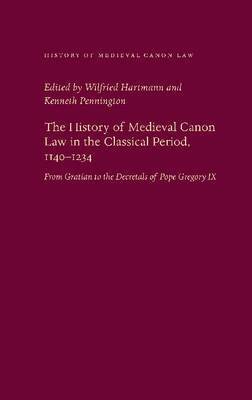
History of Medieval Canon Law in the Classical Period, 1140-1234
From Gratian to the Decretals of Pope Gregory IX
Inbunden, Engelska, 2008
740 kr
Skickas inom 10-15 vardagar
Gratian has long been called the father of Canon Law. This latest volume in the ongoing ""History of Medieval Canon Law"" series covers the period from Gratian's initial teaching of canon law during the 1120s to just before the promulgation of the Decretals of Pope Gregory IX in 1234.Gratian's contributions to the birth of canon law and European jurisprudence were significant: he introduced a new methodology of teaching law by using hypothetical cases and by integrating - and inserting in the texts themselves - his own comments on the canons. He also used the dialectical method to analyze legal problems that he raised in his cases. Though this methodology was first developed by Peter Abelard and others in the schools of Northern France, Gratian was the first to apply it to legal texts with the publication of his Decretum (ca. 1140). Because the Decretum was not just a collection of texts but an analysis of the sources and doctrines of ecclesiastical law, his book enjoyed immediate success across Europe. The Decretum was adopted by teachers from England to Italy and Germany to Spain. Gratian's successors later applied his methodology to the papal appellate decisions (decretals) that gradually became the foundation of canon law in the later Middle Ages.In this volume, distinguished legal historians contribute noteworthy essays on the commentaries on Gratian, the beginnings of decretal collections and commentaries on them, and the importance of conciliar legislation for the growth of canon law. There are also chapters on the influence of Roman law on canon law and the teaching of canon law in law schools.Contributors are James A. Brundage, Anne Duggan, Charles Duggan, A. Garcia y Garcia, Joseph Goering, Michael H. Hoeflich, Peter Landau, Wolfgang P. Muller, Jasonne Grabher O'Brien, Kenneth Pennington, and Rudolf Weigand.
729 kr
Skickas inom 7-10 vardagar
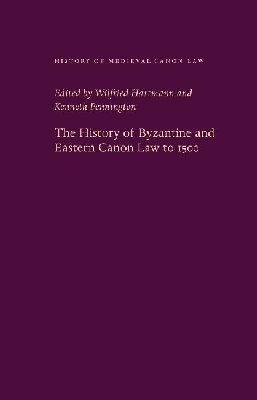
This newest volume in the History of Medieval Canon Law series surveys the history of Byzantine and Eastern canon law. Beginning in the Patristic Age, Susan Wessel outlines the evolution of ecclesiastical law before the Council of Nicaea (325 A.D.). She covers the earliest documents and councils in the Christian tradition, and concludes that the councils replaced other sources of authority as bishops moved to a more democratic model of church organisation. Heinz Ohme then offers a detailed analysis of the Greek councils and the writings of the Greek Fathers. He treats the sources of canonical material of Byzantine canon law down to the Quinisext Council (Trullanum, 692). Spyros Troianos presents a comprehensive survey of the Greek canonical collections and their compilers from the fourth to the eleventh century. In extending his coverage to 1500, Troianos provides bibliographical and biographical information about the most important Byzantine canonists who remain virtually unknown in English language literature: John Zonaras, Alexios Aristenos, and the Byzantine Gratian, Theodore Balsamon. With Hubert Kaufhold's contribution, the book also explores the wide range and variety of law in Eastern Christian communities, including Western Syrians (Jacobites), the Copts, Ethiopians, Armenians, Georgians, Nestorians, and Maronites.
804 kr
Skickas inom 10-15 vardagar
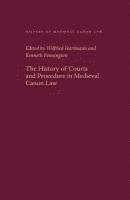
Understanding the rules of procedure and the practices of medieval and early modern courts is of great importance for historians of every stripe. The authors and editors of this volume present readers with a description of court procedure, the sources for investigating the work of the courts, the jurisprudence and the norms that regulated the courts, as well as a survey of the variety of courts that populated the European landscape. Not least, the authors wish to show the relationship between the jurisprudence that governed judicial procedure and what happened in the court room.By the end of the thirteenth century, court procedure in continental Europe in secular and ecclesiastical courts shared many characteristics. As the academic jurists of the Ius commune began to excavate the norms of procedure from Justinian’s great codification of law and then to expound them in the classroom and in their writings, they shaped the structure of ecclesiastical courts and secular courts as well. These essays also illuminate striking differences in the sources that we find in different parts of Europe. In northern Europe the archives are rich but do not always provide the details we need to understand a particular case. In Italy and Southern France the documentation is more detailed than in other parts of Europe but here too the historical records do not answer every question we might pose to them. In Spain, detailed documentation is strangely lacking, if not altogether absent. Iberian conciliar canons and tracts on procedure tell us much about practicein Spanish courts. As these essays demonstrate, scholars who want to peer into the medieval courtroom, must also read letters, papal decretals, chronicles, conciliar canons, and consilia to provide a nuanced and complete picture of what happened in medieval trials. This volume will give sophisticated guidance to all readers with an interest in European law and courts.
Del 17001 - Reclam Universal-Bibliothek
Deutsche Geschichte 1 in Quellen und Darstellungen
Häftad, Tyska
141 kr
Skickas inom 3-6 vardagar
265 kr
Skickas inom 3-6 vardagar
286 kr
Skickas inom 5-8 vardagar
Del 69 - Schriften Des Historischen Kollegs
Recht und Gericht in Kirche und Welt um 900
Inbunden, Tyska, 2007
1 060 kr
Skickas inom 5-8 vardagar