Wilhelm Roepke - Böcker
Visar alla böcker från författaren Wilhelm Roepke. Handla med fri frakt och snabb leverans.
13 produkter
13 produkter
701 kr
Skickas inom 10-15 vardagar
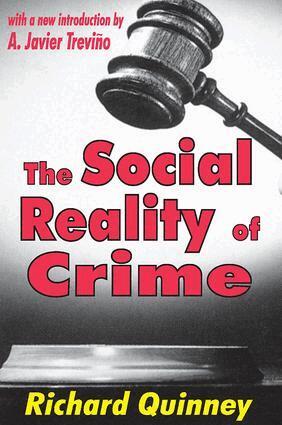
Richard Quinney's The Social Reality of Crime remains an eloquent and important statement on crime, law, and justice. At the time of its appearance in 1970, Quinney's theory not only liberated the field from a recitation of the practices of the police, courts, and corrections, it also represented a marked departure from traditional analysis which viewed criminal behavior as pathological. Quinney not only advanced criminological thought, he inspired scores of students of crime and criminal justice to reorient their perceptions of the justice system.The Social Reality of Crime swept the criminological community and motivated an entire generation of researchers to question definitions of crime and labels of criminality. The book's popularity quickly turned Quinney into a criminologist with an international reputation. Excerpts from the book's first chapter, which is devoted to the theory of the social reality of crime, are now routinely reprinted in anthologies on criminology and deviant behavior. The theory itself is discussed in most criminology textbooks.This new edition of The Social Reality of Crime will renew inspiration for Quinney's unique critical-social constructionist perspective that has been so significant to the development of theoretical work in the fields of criminology, social problems, and the sociology of law.
Bedeutung Des Traumas Für Die Entstehung Der Carcinome Und Sarcome an Der Hand Des Materials Der Chirurgischen Klinik ...
Inbunden, Tyska, 2023
336 kr
Skickas inom 5-8 vardagar
Bedeutung Des Traumas Für Die Entstehung Der Carcinome Und Sarcome an Der Hand Des Materials Der Chirurgischen Klinik ...
Häftad, Tyska, 2023
168 kr
Skickas inom 5-8 vardagar
2 098 kr
Skickas inom 10-15 vardagar
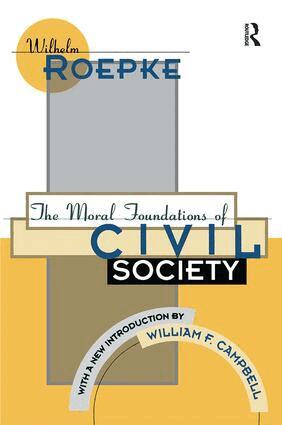
Wilhelm Roepke may have been the soundest economist of the twentieth century. He understood the limitations as well as the strengths of his discipline. Economists are often tempted to take the easy way out, by denying reality to aspects of human existence and reducing them to arbitrary and subjective tastes and preferences. Roepke never does this, and this is his strength. He realizes that all of these are legitimate aspects of human experience which must be satisfied in a balanced and harmonious social existence. Nature, sex, religion, beauty, and politics are all meaningful as parts of the whole. Problems occur only when each segment attempts to become the whole.The original title of this book, Civitas Humana, contains a double meaning. It promises a treatment of questions fundamental not only to human society but also to humane society. The volume combines distinct aspects of life. Half of the book is devoted to questions of economic and social life. The other half examines spiritual and national life. Chapters include "Moral Foundations," "The Place of Science in the City of Man," "Counterweights to the State," "Congestion and Proletarianisation of Society," and "Economic System and International New Order."Although Roepke recognized the validity of the nation in the modern world, he was constantly trying to find the smaller agencies within society in which real allegiances and loyalties were to be developed. His ideas continue to be of significance. As described by William F. Campbell in the new introduction, The Moral Foundations of Civil Society is a necessary addition to the libraries of economists, sociologists, theologians, and philosophers.
2 098 kr
Skickas inom 10-15 vardagar
Roepke's The Social Crisis of Our Time is a series of blasts against the "malformations" of economics: the Nazi and Communist forms of collectivism both come in for severe criticism. Roepke shows the process by which the Western liberal tradition itself makes possible these rebellions against open economic systems. The drive toward social welfare, full employment policies, and the state management of fiscal fluctuations all lead away from free societies no less than market economies.
2 300 kr
Skickas inom 10-15 vardagar
Richard Quinney's The Social Reality of Crime remains an eloquent and important statement on crime, law, and justice. At the time of its appearance in 1970, Quinney's theory not only liberated the field from a recitation of the practices of the police, courts, and corrections, it also represented a marked departure from traditional analysis which viewed criminal behavior as pathological. Quinney not only advanced criminological thought, he inspired scores of students of crime and criminal justice to reorient their perceptions of the justice system.The Social Reality of Crime swept the criminological community and motivated an entire generation of researchers to question definitions of crime and labels of criminality. The book's popularity quickly turned Quinney into a criminologist with an international reputation. Excerpts from the book's first chapter, which is devoted to the theory of the social reality of crime, are now routinely reprinted in anthologies on criminology and deviant behavior. The theory itself is discussed in most criminology textbooks.This new edition of The Social Reality of Crime will renew inspiration for Quinney's unique critical-social constructionist perspective that has been so significant to the development of theoretical work in the fields of criminology, social problems, and the sociology of law.
736 kr
Skickas inom 10-15 vardagar
Roepke's The Social Crisis of Our Time is a series of blasts against the "malformations" of economics: the Nazi and Communist forms of collectivism both come in for severe criticism. Roepke shows the process by which the Western liberal tradition itself makes possible these rebellions against open economic systems. The drive toward social welfare, full employment policies, and the state management of fiscal fluctuations all lead away from free societies no less than market economies.
715 kr
Skickas inom 10-15 vardagar
Wilhelm Roepke may have been the soundest economist of the twentieth century. He understood the limitations as well as the strengths of his discipline. Economists are often tempted to take the easy way out, by denying reality to aspects of human existence and reducing them to arbitrary and subjective tastes and preferences. Roepke never does this, and this is his strength. He realizes that all of these are legitimate aspects of human experience which must be satisfied in a balanced and harmonious social existence. Nature, sex, religion, beauty, and politics are all meaningful as parts of the whole. Problems occur only when each segment attempts to become the whole.The original title of this book, Civitas Humana, contains a double meaning. It promises a treatment of questions fundamental not only to human society but also to humane society. The volume combines distinct aspects of life. Half of the book is devoted to questions of economic and social life. The other half examines spiritual and national life. Chapters include "Moral Foundations," "The Place of Science in the City of Man," "Counterweights to the State," "Congestion and Proletarianisation of Society," and "Economic System and International New Order."Although Roepke recognized the validity of the nation in the modern world, he was constantly trying to find the smaller agencies within society in which real allegiances and loyalties were to be developed. His ideas continue to be of significance. As described by William F. Campbell in the new introduction, The Moral Foundations of Civil Society is a necessary addition to the libraries of economists, sociologists, theologians, and philosophers.
153 kr
Skickas inom 5-8 vardagar
Del 3 - Sozialwissenschaftliche Forschungen
Die Arbeitsleistung Im Deutschen Kalibergbau
Unter Besonderer Berücksichtigung Des Hannoverschen Kalibergbaues
Inbunden, Tyska, 1923
1 744 kr
Skickas inom 7-10 vardagar
247 kr
Skickas inom 5-8 vardagar
402 kr
Skickas inom 5-8 vardagar
217 kr
Skickas inom 5-8 vardagar