William Brustein – författare
Visar alla böcker från författaren William Brustein. Handla med fri frakt och snabb leverans.
3 produkter
3 produkter
446 kr
Skickas inom 5-8 vardagar
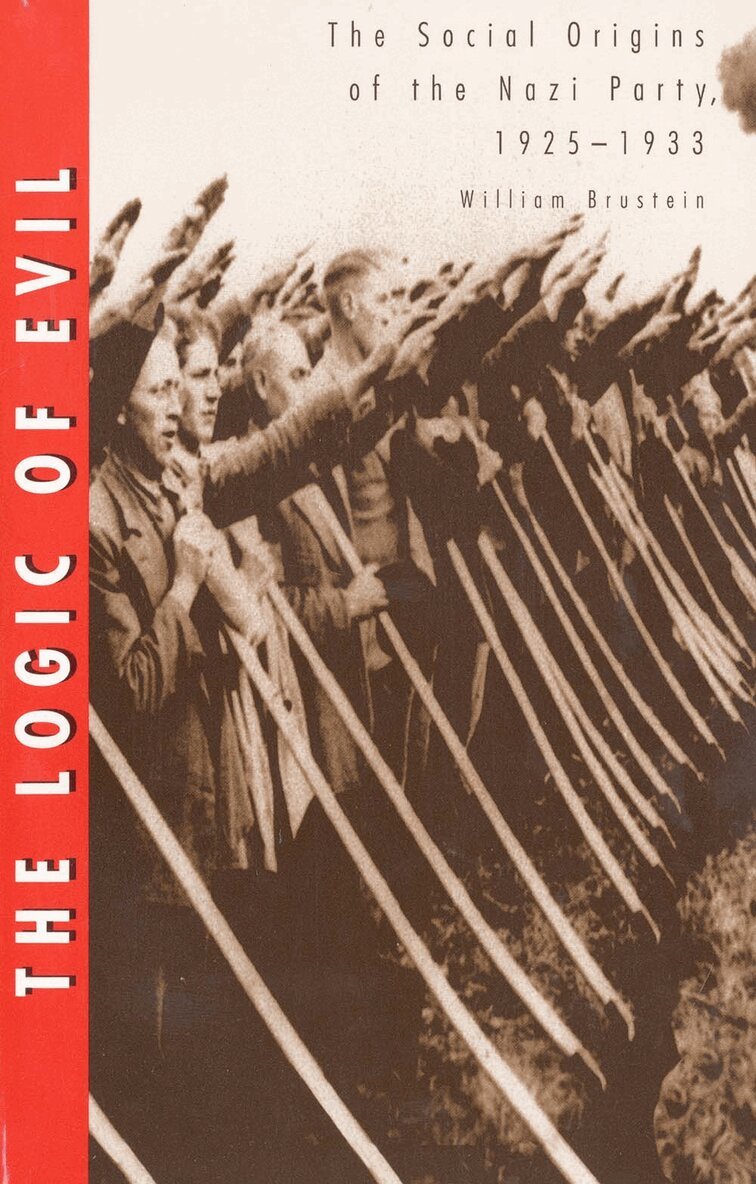
Why did millions of apparently sane, rational Germans join the Nazi Party between 1925 and 1933? In this provocative book, William Brustein argues that the Nazi Party's emergence as the most popular political party in Germany was eminently logical—that it resulted largely from its success at fashioning economic programs that addressed the material needs of a wide range of German citizens.Brustein has carefully analyzed a huge collection of pre-1933 Nazi Party membership data drawn from the official files at the Berlin Document Center. He argues that Nazi followers were more representative of German society as a whole—that they included more workers, more single women, and more Catholics—than most previous scholars have believed. Further, says Brustein, the patterns of membership reveal that people joined the Nazi Party not because of Hitler's irrational appeal or charisma or anti-Semitism, but because the party, through its shrewd and proactive program, offered more benefits to more people than did the other political parties in Weimar Germany. According to Brustein, Nazi supporters were no different from citizens anywhere who select a political party or candidate they believe will promote their economic interests. The roots of evil, he suggests, may be ordinary indeed.
Del 17 - California Series on Social Choice and Political Economy
Social Origins of Political Regionalism
France, 1849-1981
Häftad, Engelska, 2021
323 kr
Skickas inom 7-10 vardagar
William Brustein’s The Social Origins of Political Regionalism: France 1849–1981 tackles a central puzzle in modern French history: why regions with similar agrarian economies—like Argentré-du-Plessis in Brittany and Bonnieux in Provence—have persistently voted in opposite ideological blocs for more than a century. Brustein notes that while western France has consistently aligned with the Right, Mediterranean France has been just as reliably Left, a striking divergence visible in national legislative elections from 1849 through 1981. He situates this pattern within the broader phenomenon of political regionalism, whereby entire areas maintain distinctive political loyalties across generations, as seen in the American South, Canadian Saskatchewan, or Indian Kerala. Existing explanations, Brustein argues, falter because they fail to bridge history’s concern with local particularities and sociology’s search for generalizable models. His solution is a theoretical framework that fuses rational-choice assumptions about individual behavior with the Marxist concept of the mode of production.According to Brustein, discrete regional modes of production shaped distinct social structures in France, which in turn generated enduring constellations of cultivators’ interests and predictable patterns of political behavior. To test this mode-of-production theory, he turns to archival data from three pivotal legislative contests: 1849, when the divisions of Left and Right were first clearly marked; 1914, on the eve of World War I; and 1981, when François Mitterrand’s Socialist victory brought the Left to power. France provides an ideal case, he contends, not only because of its long-standing and sharply polarized regional voting blocs but also because both western and Mediterranean regions were largely agrarian and politically peripheral, making economic structural differences more salient. By combining comparative theory with close empirical analysis, Brustein demonstrates that regional political cultures were not simply accidents of geography or tradition but products of deeply rooted economic and social arrangements, offering a model with implications well beyond the French case.This title is part of UC Press's Voices Revived program, which commemorates University of California Press’s mission to seek out and cultivate the brightest minds and give them voice, reach, and impact. Drawing on a backlist dating to 1893, Voices Revived makes high-quality, peer-reviewed scholarship accessible once again using print-on-demand technology. This title was originally published in 1988.
Del 17 - California Series on Social Choice and Political Economy
Social Origins of Political Regionalism
France, 1849-1981
Inbunden, Engelska, 2021
1 469 kr
Skickas inom 3-6 vardagar
William Brustein’s The Social Origins of Political Regionalism: France 1849–1981 tackles a central puzzle in modern French history: why regions with similar agrarian economies—like Argentré-du-Plessis in Brittany and Bonnieux in Provence—have persistently voted in opposite ideological blocs for more than a century. Brustein notes that while western France has consistently aligned with the Right, Mediterranean France has been just as reliably Left, a striking divergence visible in national legislative elections from 1849 through 1981. He situates this pattern within the broader phenomenon of political regionalism, whereby entire areas maintain distinctive political loyalties across generations, as seen in the American South, Canadian Saskatchewan, or Indian Kerala. Existing explanations, Brustein argues, falter because they fail to bridge history’s concern with local particularities and sociology’s search for generalizable models. His solution is a theoretical framework that fuses rational-choice assumptions about individual behavior with the Marxist concept of the mode of production.According to Brustein, discrete regional modes of production shaped distinct social structures in France, which in turn generated enduring constellations of cultivators’ interests and predictable patterns of political behavior. To test this mode-of-production theory, he turns to archival data from three pivotal legislative contests: 1849, when the divisions of Left and Right were first clearly marked; 1914, on the eve of World War I; and 1981, when François Mitterrand’s Socialist victory brought the Left to power. France provides an ideal case, he contends, not only because of its long-standing and sharply polarized regional voting blocs but also because both western and Mediterranean regions were largely agrarian and politically peripheral, making economic structural differences more salient. By combining comparative theory with close empirical analysis, Brustein demonstrates that regional political cultures were not simply accidents of geography or tradition but products of deeply rooted economic and social arrangements, offering a model with implications well beyond the French case.This title is part of UC Press's Voices Revived program, which commemorates University of California Press’s mission to seek out and cultivate the brightest minds and give them voice, reach, and impact. Drawing on a backlist dating to 1893, Voices Revived makes high-quality, peer-reviewed scholarship accessible once again using print-on-demand technology. This title was originally published in 1988.