William E. Schiesser – författare
902 kr
Läs direkt efter köp
765 kr
Skickas inom 10-15 vardagar
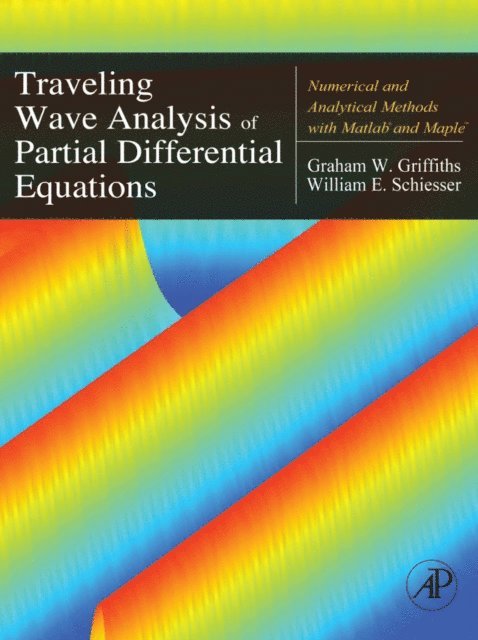
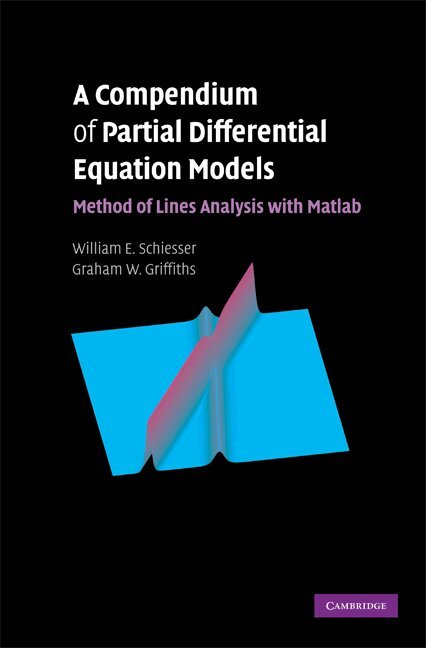
Although the Partial Differential Equations (PDE) models that are now studied are usually beyond traditional mathematical analysis, the numerical methods that are being developed and used require testing and validation. This is often done with PDEs that have known, exact, analytical solutions. The development of analytical solutions is also an active area of research, with many advances being reported recently, particularly traveling wave solutions for nonlinear evolutionary PDEs. Thus, the current development of analytical solutions directly supports the development of numerical methods by providing a spectrum of test problems that can be used to evaluate numerical methods.
This book surveys some of these new developments in analytical and numerical methods, and relates the two through a series of PDE examples. The PDEs that have been selected are largely "named'' since they carry the names of their original contributors. These names usually signify that the PDEs are widely recognized and used in many application areas. The authors' intention is to provide a set of numerical and analytical methods based on the concept of a traveling wave, with a central feature of conversion of the PDEs to ODEs.
�The Matlab and Maple software will be available for download from this website shortly.
www.pdecomp.net
Includes a spectrum of applications in science, engineering, applied mathematics Presents a combination of numerical and analytical methods Provides transportable computer codes in Matlab and Maple766 kr
Läs direkt efter köp
783 kr
Läs direkt efter köp
1 534 kr
Skickas inom 10-15 vardagar
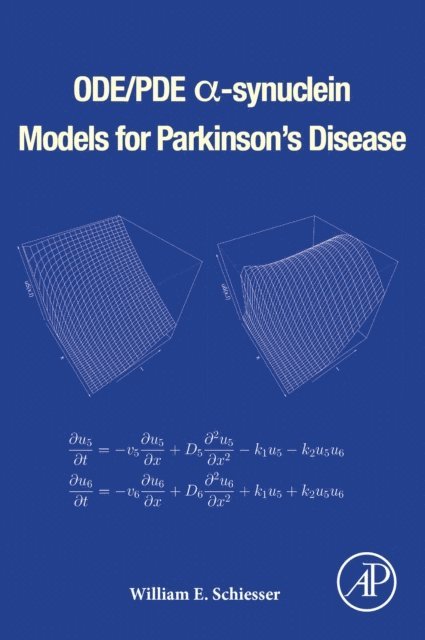
ODE/PDE Alpha-Synuclein Models for Parkinson's Disease discusses a mechanism for the evolution of Parkinson's Disease (PD) based on the dynamics of the protein ?-synuclein, a monomer that has been implicated in this disease. Specifically, ?-synuclein morphs and aggregates into a polymer that can interfere with functioning neurons and lead to neurodegenerative pathology. This book first demonstrates computer-based implementation of a prototype ODE/PDE model for the dynamics of the ?-synuclein monomer and polymer, and then details the methodology for the numerical integration of ODE/PDE systems which can be applied to computer-based analyses of alternative models based on the reader's interest.
This book facilitates immediate computer use for research without the necessity to first learn the basic concepts of numerical analysis for ODE/PDEs and programming algorithms
Includes PDE routines based on the method of lines (MOL) for computer-based implementation of ODE/PDE models Offers transportable computer source codes for readers, with line-by-line code descriptions relating to the mathematical model and algorithms Authored by a leading researcher and educator in ODE/PDE models2 182 kr
Läs direkt efter köp
1 483 kr
Skickas inom 10-15 vardagar
Numerical PDE Analysis of Retinal Neovascularization Mathematical Model Computer Implementation in R provides a methodology for the analysis of neovascularization (formation of blood capillaries) in the retina. It describes the starting point-a system of three partial differential equations (PDEs)-that define the evolution of (1) capillary tip density, (2) blood capillary density and (3) concentration of vascular endothelial growth factor (VEGF) in the retina as a function of space (distance along the retina), x, and time, t, the three PDE dependent variables for (1), (2) and (3), and designated as u1(x, t), u2(x, t), u3(x, t), amongst other topics.
Includes PDE routines based on the method of lines (MOL) for computer-based implementation of PDE models Offers transportable computer source codes for readers in R, with line-by-line code descriptions as it relates to the mathematical model and algorithms Authored by a leading researcher and educator in PDE models2 108 kr
Läs direkt efter köp
1 714 kr
Skickas inom 10-15 vardagar
ODE/PDE Analysis of Antibiotic/Antimicrobial Resistance: Programming in R presents mathematical models for antibiotic/antimicrobial resistance based on ordinary and partial differential equations (ODE/PDEs). Sections cover the basic ODE model, the detailed PDE model that gives the spatiotemporal distribution of four dependent variable components, including susceptible bacteria population density, resistant bacteria population density, plasmid number, and antibiotic concentration. The computer-based implementation of the example models is presented through routines coded (programmed) in R, a quality, open-source scientific computing system that is readily available from the Internet. As such, formal mathematics is minimized and no theorems and proofs are required.
The PDE analysis is based on the method of lines (MOL), an established general algorithm for PDEs that is implemented with finite differences. Routines are available from a download link so that the example models can be executed without having to first study numerical methods and computer coding. Routines can then be applied to variations and extensions of the antibiotic/antimicrobial models, such as changes in the ODE/PDE parameters (constants) and the form of the model equations.
Includes PDE routines based on the method of lines (MOL) for computer-based implementation of PDE models Offers transportable computer source codes for readers in R, with line-by-line code descriptions as it relates to mathematical model and algorithms Authored by a leading researcher and educator in PDE models2 402 kr
Läs direkt efter köp
1 714 kr
Skickas inom 10-15 vardagar
Spatiotemporal Modeling of Stem Cell Differentiation: Partial Differentiation Equation Analysis in R covers topics surrounding how stem cells evolve into specialized cells during tissue formation and in diseased tissue regeneration. As the process of stem cell differentiation occurs in space and time, the mathematical modeling of spatiotemporal development is expressed in this book as systems of partial differential equations (PDEs). In addition, the book explores important feature of six PDE model which can represent, for example, the development of tissue in organs. In addition, the book covers the computer-based implementation of example models through routines coded (programmed) in R.
The routines described in the book are available from a download link so that example models can be executed without having to first study numerical methods and computer coding. The routines can then be applied to variations and extensions of the stem differentiation models, such as changes in the PDE parameters (constants) and the form of the model equations.
Includes PDE routines based on the method of lines (MOL) for computer-based implementation of PDE models Offers transportable computer source codes for readers in R, with line-by-line code descriptions for mathematical models and algorithms Authored by a leading researcher and educator in PDE models2 402 kr
Läs direkt efter köp
1 826 kr
Skickas inom 10-15 vardagar
Modeling of Post-Myocardial Infarction: ODE/PDE Analysis with R presents mathematical models for the dynamics of a post-myocardial (post-MI), aka, a heart attack. The mathematical models discussed consist of six ordinary differential equations (ODEs) with dependent variables Mun; M1; M2; IL10; T?; IL1. The system variables are explained as follows: dependent variable Mun = cell density of unactivated macrophage; dependent variable M1 = cell density of M1 macrophage; dependent variable M2 = cell density of M2 macrophage; dependent variable IL10 = concentration of IL10, (interleuken-10); dependent variable T? = concentration of TNF-? (tumor necrosis factor-?); dependent variable IL1 = concentration of IL1 (interleuken-1).
The system of six ODEs does not include a spatial aspect of an MI in the cardiac tissue. Therefore, the ODE model is extended to include a spatial effect by the addition of diffusion terms. The resulting system of six diffusion PDEs, with x (space) and t (time) as independent variables, is integrated (solved) by the numerical method of lines (MOL), a general numerical algorithm for PDEs.
Includes PDE routines based on the method of lines (MOL) for computer-based implementation of PDE models Offers transportable computer source codes for readers in R, with line-by-line code descriptions as it relates to the mathematical model and algorithms Authored by a leading researcher and educator in PDE models2 599 kr
Läs direkt efter köp
1 727 kr
Skickas inom 10-15 vardagar
2 370 kr
Läs direkt efter köp
1 905 kr
Skickas inom 7-10 vardagar
1 596 kr
Läs direkt efter köp
Features a solid foundation of mathematical and computational tools to formulate and solve real-world PDE problems across various fields
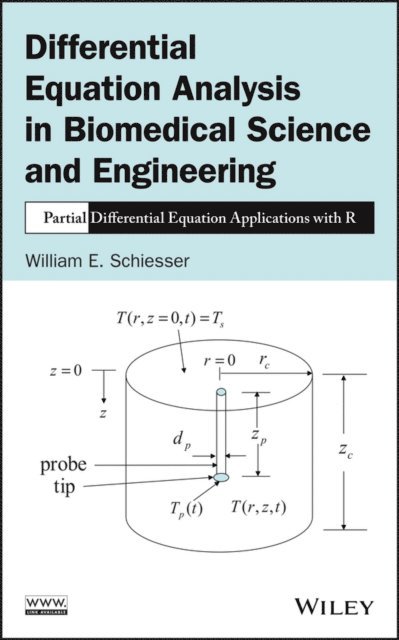
With a step-by-step approach to solving partial differential equations (PDEs), Differential Equation Analysis in Biomedical Science and Engineering: Partial Differential Equation Applications with R successfully applies computational techniques for solving real-world PDE problems that are found in a variety of fields, including chemistry, physics, biology, and physiology. The book provides readers with the necessary knowledge to reproduce and extend the computed numerical solutions and is a valuable resource for dealing with a broad class of linear and nonlinear partial differential equations.
The author’s primary focus is on models expressed as systems of PDEs, which generally result from including spatial effects so that the PDE dependent variables are functions of both space and time, unlike ordinary differential equation (ODE) systems that pertain to time only. As such, the book emphasizes details of the numerical algorithms and how the solutions were computed. Featuring computer-based mathematical models for solving real-world problems in the biological and biomedical sciences and engineering, the book also includes:
R routines to facilitate the immediate use of computation for solving differential equation problems without having to first learn the basic concepts of numerical analysis and programming for PDEs Models as systems of PDEs and associated initial and boundary conditions with explanations of the associated chemistry, physics, biology, and physiology Numerical solutions of the presented model equations with a discussion of the important features of the solutions Aspects of general PDE computation through various biomedical science and engineering applicationsDifferential Equation Analysis in Biomedical Science and Engineering: Partial Differential Equation Applications with R is an excellent reference for researchers, scientists, clinicians, medical researchers, engineers, statisticians, epidemiologists, and pharmacokineticists who are interested in both clinical applications and interpretation of experimental data with mathematical models in order to efficiently solve the associated differential equations. The book is also useful as a textbook for graduate-level courses in mathematics, biomedical science and engineering, biology, biophysics, biochemistry, medicine, and engineering.
1 391 kr
Skickas inom 5-8 vardagar
1 662 kr
Läs direkt efter köp
Features a solid foundation of mathematical and computational tools to formulate and solve real-world ODE problems across various fields
With a step-by-step approach to solving ordinary differential equations (ODEs), Differential Equation Analysis in Biomedical Science and Engineering: Ordinary Differential Equation Applications with R successfully applies computational techniques for solving real-world ODE problems that are found in a variety of fields, including chemistry, physics, biology, and physiology. The book provides readers with the necessary knowledge to reproduce and extend the computed numerical solutions and is a valuable resource for dealing with a broad class of linear and nonlinear ordinary differential equations.
The author’s primary focus is on models expressed as systems of ODEs, which generally result by neglecting spatial effects so that the ODE dependent variables are uniform in space. Therefore, time is the independent variable in most applications of ODE systems. As such, the book emphasizes details of the numerical algorithms and how the solutions were computed. Featuring computer-based mathematical models for solving real-world problems in the biological and biomedical sciences and engineering, the book also includes:
R routines to facilitate the immediate use of computation for solving differential equation problems without having to first learn the basic concepts of numerical analysis and programming for ODEs Models as systems of ODEs with explanations of the associated chemistry, physics, biology, and physiology as well as the algebraic equations used to calculate intermediate variables Numerical solutions of the presented model equations with a discussion of the important features of the solutions Aspects of general ODE computation through various biomolecular science and engineering applicationsDifferential Equation Analysis in Biomedical Science and Engineering: Ordinary Differential Equation Applications with R is an excellent reference for researchers, scientists, clinicians, medical researchers, engineers, statisticians, epidemiologists, and pharmacokineticists who are interested in both clinical applications and interpretation of experimental data with mathematical models in order to efficiently solve the associated differential equations. The book is also useful as a textbook for graduate-level courses in mathematics, biomedical science and engineering, biology, biophysics, biochemistry, medicine, and engineering.
1 613 kr
Läs direkt efter köp
Features a solid foundation of mathematical and computational tools to formulate and solve real-world PDE problems across various fields
With a step-by-step approach to solving partial differential equations (PDEs), Differential Equation Analysis in Biomedical Science and Engineering: Partial Differential Equation Applications with R successfully applies computational techniques for solving real-world PDE problems that are found in a variety of fields, including chemistry, physics, biology, and physiology. The book provides readers with the necessary knowledge to reproduce and extend the computed numerical solutions and is a valuable resource for dealing with a broad class of linear and nonlinear partial differential equations.
The author’s primary focus is on models expressed as systems of PDEs, which generally result from including spatial effects so that the PDE dependent variables are functions of both space and time, unlike ordinary differential equation (ODE) systems that pertain to time only. As such, the book emphasizes details of the numerical algorithms and how the solutions were computed. Featuring computer-based mathematical models for solving real-world problems in the biological and biomedical sciences and engineering, the book also includes:
R routines to facilitate the immediate use of computation for solving differential equation problems without having to first learn the basic concepts of numerical analysis and programming for PDEs Models as systems of PDEs and associated initial and boundary conditions with explanations of the associated chemistry, physics, biology, and physiology Numerical solutions of the presented model equations with a discussion of the important features of the solutions Aspects of general PDE computation through various biomedical science and engineering applicationsDifferential Equation Analysis in Biomedical Science and Engineering: Partial Differential Equation Applications with R is an excellent reference for researchers, scientists, clinicians, medical researchers, engineers, statisticians, epidemiologists, and pharmacokineticists who are interested in both clinical applications and interpretation of experimental data with mathematical models in order to efficiently solve the associated differential equations. The book is also useful as a textbook for graduate-level courses in mathematics, biomedical science and engineering, biology, biophysics, biochemistry, medicine, and engineering.
1 619 kr
Läs direkt efter köp
Features a solid foundation of mathematical and computational tools to formulate and solve real-world ODE problems across various fields
With a step-by-step approach to solving ordinary differential equations (ODEs), Differential Equation Analysis in Biomedical Science and Engineering: Ordinary Differential Equation Applications with R successfully applies computational techniques for solving real-world ODE problems that are found in a variety of fields, including chemistry, physics, biology, and physiology. The book provides readers with the necessary knowledge to reproduce and extend the computed numerical solutions and is a valuable resource for dealing with a broad class of linear and nonlinear ordinary differential equations.
The author’s primary focus is on models expressed as systems of ODEs, which generally result by neglecting spatial effects so that the ODE dependent variables are uniform in space. Therefore, time is the independent variable in most applications of ODE systems. As such, the book emphasizes details of the numerical algorithms and how the solutions were computed. Featuring computer-based mathematical models for solving real-world problems in the biological and biomedical sciences and engineering, the book also includes:
R routines to facilitate the immediate use of computation for solving differential equation problems without having to first learn the basic concepts of numerical analysis and programming for ODEs Models as systems of ODEs with explanations of the associated chemistry, physics, biology, and physiology as well as the algebraic equations used to calculate intermediate variables Numerical solutions of the presented model equations with a discussion of the important features of the solutions Aspects of general ODE computation through various biomolecular science and engineering applicationsDifferential Equation Analysis in Biomedical Science and Engineering: Ordinary Differential Equation Applications with R is an excellent reference for researchers, scientists, clinicians, medical researchers, engineers, statisticians, epidemiologists, and pharmacokineticists who are interested in both clinical applications and interpretation of experimental data with mathematical models in order to efficiently solve the associated differential equations. The book is also useful as a textbook for graduate-level courses in mathematics, biomedical science and engineering, biology, biophysics, biochemistry, medicine, and engineering.
1 475 kr
Skickas inom 11-20 vardagar
2 146 kr
Skickas inom 5-8 vardagar
1 391 kr
Skickas inom 11-20 vardagar
1 582 kr
Läs direkt efter köp
Presents the methodology and applications of ODE and PDE models within biomedical science and engineering
With an emphasis on the method of lines (MOL) for partial differential equation (PDE) numerical integration, Method of Lines PDE Analysis in Biomedical Science and Engineering demonstrates the use of numerical methods for the computer solution of PDEs as applied to biomedical science and engineering (BMSE). Written by a well-known researcher in the field, the book provides an introduction to basic numerical methods for initial/boundary value PDEs before moving on to specific BMSE applications of PDEs.
Featuring a straightforward approach, the book’s chapters follow a consistent and comprehensive format. First, each chapter begins by presenting the model as an ordinary differential equation (ODE)/PDE system, including the initial and boundary conditions. Next, the programming of the model equations is introduced through a series of R routines that primarily implement MOL for PDEs. Subsequently, the resulting numerical and graphical solution is discussed and interpreted with respect to the model equations. Finally, each chapter concludes with a review of the numerical algorithm performance, general observations and results, and possible extensions of the model. Method of Lines PDE Analysis in Biomedical Science and Engineering also includes:
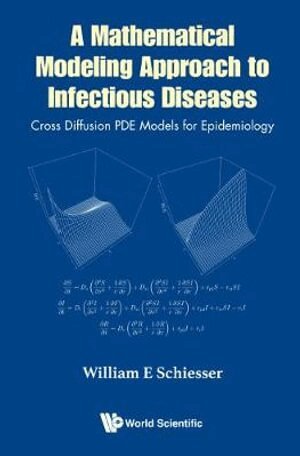
Examples of MOL analysis of PDEs, including BMSE applications in wave front resolution in chromatography, VEGF angiogenesis, thermographic tumor location, blood-tissue transport, two fluid and membrane mass transfer, artificial liver support system, cross diffusion epidemiology, oncolytic virotherapy, tumor cell density in glioblastomas, and variable grids Discussions on the use of R software, which facilitates immediate solutions to differential equation problems without having to first learn the basic concepts of numerical analysis for PDEs and the programming of PDE algorithms A companion website that provides source code for the R routines Method of Lines PDE Analysis in Biomedical Science and Engineering is an introductory reference for researchers, scientists, clinicians, medical researchers, mathematicians, statisticians, chemical engineers, epidemiologists, and pharmacokineticists as well as anyone interested in clinical applications and the interpretation of experimental data with differential equation models. The book is also an ideal textbook for graduate-level courses in applied mathematics, BMSE, biology, biophysics, biochemistry, medicine, and engineering.1 582 kr
Läs direkt efter köp
Presents the methodology and applications of ODE and PDE models within biomedical science and engineering
With an emphasis on the method of lines (MOL) for partial differential equation (PDE) numerical integration, Method of Lines PDE Analysis in Biomedical Science and Engineering demonstrates the use of numerical methods for the computer solution of PDEs as applied to biomedical science and engineering (BMSE). Written by a well-known researcher in the field, the book provides an introduction to basic numerical methods for initial/boundary value PDEs before moving on to specific BMSE applications of PDEs.
Featuring a straightforward approach, the book’s chapters follow a consistent and comprehensive format. First, each chapter begins by presenting the model as an ordinary differential equation (ODE)/PDE system, including the initial and boundary conditions. Next, the programming of the model equations is introduced through a series of R routines that primarily implement MOL for PDEs. Subsequently, the resulting numerical and graphical solution is discussed and interpreted with respect to the model equations. Finally, each chapter concludes with a review of the numerical algorithm performance, general observations and results, and possible extensions of the model. Method of Lines PDE Analysis in Biomedical Science and Engineering also includes:
Examples of MOL analysis of PDEs, including BMSE applications in wave front resolution in chromatography, VEGF angiogenesis, thermographic tumor location, blood-tissue transport, two fluid and membrane mass transfer, artificial liver support system, cross diffusion epidemiology, oncolytic virotherapy, tumor cell density in glioblastomas, and variable grids Discussions on the use of R software, which facilitates immediate solutions to differential equation problems without having to first learn the basic concepts of numerical analysis for PDEs and the programming of PDE algorithms A companion website that provides source code for the R routines Method of Lines PDE Analysis in Biomedical Science and Engineering is an introductory reference for researchers, scientists, clinicians, medical researchers, mathematicians, statisticians, chemical engineers, epidemiologists, and pharmacokineticists as well as anyone interested in clinical applications and the interpretation of experimental data with differential equation models. The book is also an ideal textbook for graduate-level courses in applied mathematics, BMSE, biology, biophysics, biochemistry, medicine, and engineering.1 502 kr
Skickas inom 11-20 vardagar
1 708 kr
Läs direkt efter köp
A comprehensive approach to numerical partial differential equations
Spline Collocation Methods for Partial Differential Equations combines the collocation analysis of partial differential equations (PDEs) with the method of lines (MOL) in order to simplify the solution process. Using a series of example applications, the author delineates the main features of the approach in detail, including an established mathematical framework. The book also clearly demonstrates that spline collocation can offer a comprehensive method for numerical integration of PDEs when it is used with the MOL in which spatial (boundary value) derivatives are approximated with splines, including the boundary conditions.
R, an open-source scientific programming system, is used throughout for programming the PDEs and numerical algorithms, and each section of code is clearly explained. As a result, readers gain a complete picture of the model and its computer implementation without having to fill in the details of the numerical analysis, algorithms, or programming. The presentation is not heavily mathematical, and in place of theorems and proofs, detailed example applications are provided.
Appropriate for scientists, engineers, and applied mathematicians, Spline Collocation Methods for Partial Differential Equations:
Introduces numerical methods by first presenting basic examples followed by more complicated applications Employs R to illustrate accurate and efficient solutions of the PDE models Presents spline collocation as a comprehensive approach to the numerical integration of PDEs and an effective alternative to other, well established methods Discusses how to reproduce and extend the presented numerical solutions Identifies the use of selected algorithms, such as the solution of nonlinear equations and banded or sparse matrix processing Features a companion website that provides the related R routinesSpline Collocation Methods for Partial Differential Equations is a valuable reference and/or self-study guide for academics, researchers, and practitioners in applied mathematics and engineering, as well as for advanced undergraduates and graduate-level students.
1 708 kr
Läs direkt efter köp
A comprehensive approach to numerical partial differential equations
Spline Collocation Methods for Partial Differential Equations combines the collocation analysis of partial differential equations (PDEs) with the method of lines (MOL) in order to simplify the solution process. Using a series of example applications, the author delineates the main features of the approach in detail, including an established mathematical framework. The book also clearly demonstrates that spline collocation can offer a comprehensive method for numerical integration of PDEs when it is used with the MOL in which spatial (boundary value) derivatives are approximated with splines, including the boundary conditions.
R, an open-source scientific programming system, is used throughout for programming the PDEs and numerical algorithms, and each section of code is clearly explained. As a result, readers gain a complete picture of the model and its computer implementation without having to fill in the details of the numerical analysis, algorithms, or programming. The presentation is not heavily mathematical, and in place of theorems and proofs, detailed example applications are provided.
Appropriate for scientists, engineers, and applied mathematicians, Spline Collocation Methods for Partial Differential Equations:
Introduces numerical methods by first presenting basic examples followed by more complicated applications Employs R to illustrate accurate and efficient solutions of the PDE models Presents spline collocation as a comprehensive approach to the numerical integration of PDEs and an effective alternative to other, well established methods Discusses how to reproduce and extend the presented numerical solutions Identifies the use of selected algorithms, such as the solution of nonlinear equations and banded or sparse matrix processing Features a companion website that provides the related R routinesSpline Collocation Methods for Partial Differential Equations is a valuable reference and/or self-study guide for academics, researchers, and practitioners in applied mathematics and engineering, as well as for advanced undergraduates and graduate-level students.