William J. Matthews – författare
Visar alla böcker från författaren William J. Matthews. Handla med fri frakt och snabb leverans.
5 produkter
5 produkter
4 090 kr
Skickas inom 10-15 vardagar
This volume is about freshwater fish in streams, lakes, reservoirs and special habitats around the world. It addresses approximately 20 major topics in freshwater fish ecology in a format suitable for use in graduate-level courses. The book focuses on basic ecology and contains much data from fisheries ecology. Dr. Matthews explains the way in which empirical studies, theoretical concepts and experimental evaluations blend into the current state-of-the-art with respect to each major topic and provides original data and interpretations on some points as well as new syntheses. Each chapter contains empirical information, a synthesis and a summary.
715 kr
Skickas inom 11-20 vardagar
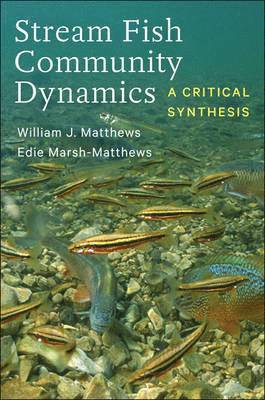
Ecologists have long struggled to understand community dynamics. In this groundbreaking book, leading fish ecologists William Matthews and Edie Marsh-Matthews apply long-term studies of stream fish communities to several enduring questions. This critical synthesis reaches to the heart of ecological theory, testing concepts against the four decades of data the authors have collected from numerous warm-water stream fish communities in the central and eastern United States. Stream Fish Community Dynamics draws together the work of a single research team to provide fresh analyses of the short- and long-term dynamics of numerous streams, each with multiple sampling sites. Conducting repeated surveys of fish communities at temporal scales from months to decades, the authors' research findings will fascinate anyone searching for a deeper understanding of community ecology. The study sites covered by this book range from small headwater creeks to large prairie rivers in Oklahoma and from Ozark and Ouachita mountain streams in Arkansas to the upland Roanoke River in Virginia.The book includes* A comparison of all global and local communities with respect to community composition at the species and family level, emergent community properties, and the relationship between those emergent properties and the environments of the study sites* Analyses of traits of individual species that are important to their distribution or success in harsh environments* A review of evidence for the importance of interactions-including competition and predation-in community dynamics of stream fishes* An assessment of disturbance effects in fish community dynamics* New analysis of the short- and long-term dynamics of variation in stream fish communities, illustrating the applicability and importance of the "loose equilibrium concept"* New analyses and comparisons of spatiotemporal variation in community dynamics and beta diversity partitioning* An overview of the effects of fish in ecosystems in the central and eastern United States The book ends with a summary chapter that places the authors' findings in broader contexts and describes how the "loose equilibrium concept"-which may be the most appropriate default assumption for dynamics of stream fishes in the changing climate of the future-applies to many kinds of stream fish communities.
4 090 kr
Skickas inom 10-15 vardagar
Nearly a decade ago I began planning this book with the goal of summarizing the existing body of knowledge on ecology of freshwater fishes in a way similar to that of H. B. N. Hynes' comprehensive treatise Ecology of Running Waters for streams. The time seemed appropriate, as there had been several recent volumes that synthesized much information on a range of topics important in fish ecology, from biogeographic to local scales. For example, the "Fish Atlas" (Lee et aI. , 1980) had provided range maps and basic entry to the original literature for all freshwater fishes in North America, and in 1986 Hocutt and Wiley's Zoogeography of North American Fishes provided a detailed synthesis of virtually everything known about distributional ecology of fishes on that continent. Tim Berra (1981) had summarized in convenient map form the worldwide distribution of all freshwater fish families, and Joe Nelson's 1976 and 1984 editions of Fishes of the World had appeared. To complement these "big picture" views of fish distributions, the volume on Community and Evolutionary Ecology of North American Freshwater Fishes, edited by David Heins and myself (Matthews and Heins, 1987), had provided an opportunity for more than 30 individuals or groups to summarize their work on stream fishes (albeit mostly for warmwater systems).
411 kr
Kommande
Oklahoma Fishes: A Regional Field Guide covers the identification, distribution, and ecology of the fish species that occur in the rivers, streams, and reservoirs of Oklahoma. William Matthews and Edie Marsh-Matthews take a nontraditional approach by dividing the state into seven regions based on watershed boundaries and distribution patterns of fish species. They also simplify species identification by basing it on "suites" of external characteristics (such as body, mouth, and fin shape) instead of using dichotomous keys that require detailed knowledge of fish anatomy.The unique region-specific approach and illustrated identification system make this field guide to Oklahoma fishes more navigable and accessible to readers when compared to previous field guides focusing on fishes statewide. With comprehensive coverage of new species recognized in the past twenty years, updated nomenclature, and more than 660 detailed illustrations, Oklahoma Fishes: A Regional Field Guide serves as the most up-to-date field guide to fishes inhabiting bodies of water in Oklahoma and the immediate surrounding areas. Whether for anglers, fish managers, or ichthyologists, this book is a must-have.
204 kr
Skickas inom 5-8 vardagar