Wolfgang Herzner – författare
Visar alla böcker från författaren Wolfgang Herzner. Handla med fri frakt och snabb leverans.
3 produkter
3 produkter
E-bok
PDF, Tyska, 2019611 kr
Läs direkt efter köp
In kaum einer Architektenbiographie des ausgehenden 19. Jahrhunderts spiegeln sich der strahlende Glanz historistischer Baukunst, die dynamische Entwicklung Wiens, jüdische Emanzipationsbestrebungen und zunehmender Antisemitismus derart konzentriert wider wie im Falle Wilhelm Stiassnys.Wilhelm Stiassny (1842-1910) war ein vielseitiger Architekt der Donaumonarchie, erfolgreicher Wiener Kommunalpolitiker sowie ambitionierter Vertreter jüdischer Interessen. Seine Biographie offenbart einen herausragenden Repräsentanten der bewegten Epoche des Fin de Siècle und spiegelt das zunehmend spannungsgeladene Umfeld des erfolgreichen jüdischen Großbürgertums wider. Vor der Folie der kulturellen, politischen, sozialen sowie städtebaulichen Auf- und Umbrüche der Donaumetropole wird eine weit über das übliche Schema einer Architektenbiographie hinausgehende Analyse geboten, die Stiassnys architektonisches Oeuvre in den Mittelpunkt stellt. Dazu zählen repräsentativ gestaltete Wohn- und Geschäftshäuser, Villen, Gebäude für soziale Einrichtungen, Synagogen, Zeremonienhallen und Grabdenkmäler. Vieles entstand in Zusammenarbeit mit namhaften jüdischen Auftraggebern, deren Bedeutung für das Werk Stiassnys ebenso sichtbar wird wie sein Verdienst um die Gründung des Jüdischen Museums.
Häftad, Engelska, 1994
565 kr
Skickas inom 10-15 vardagar
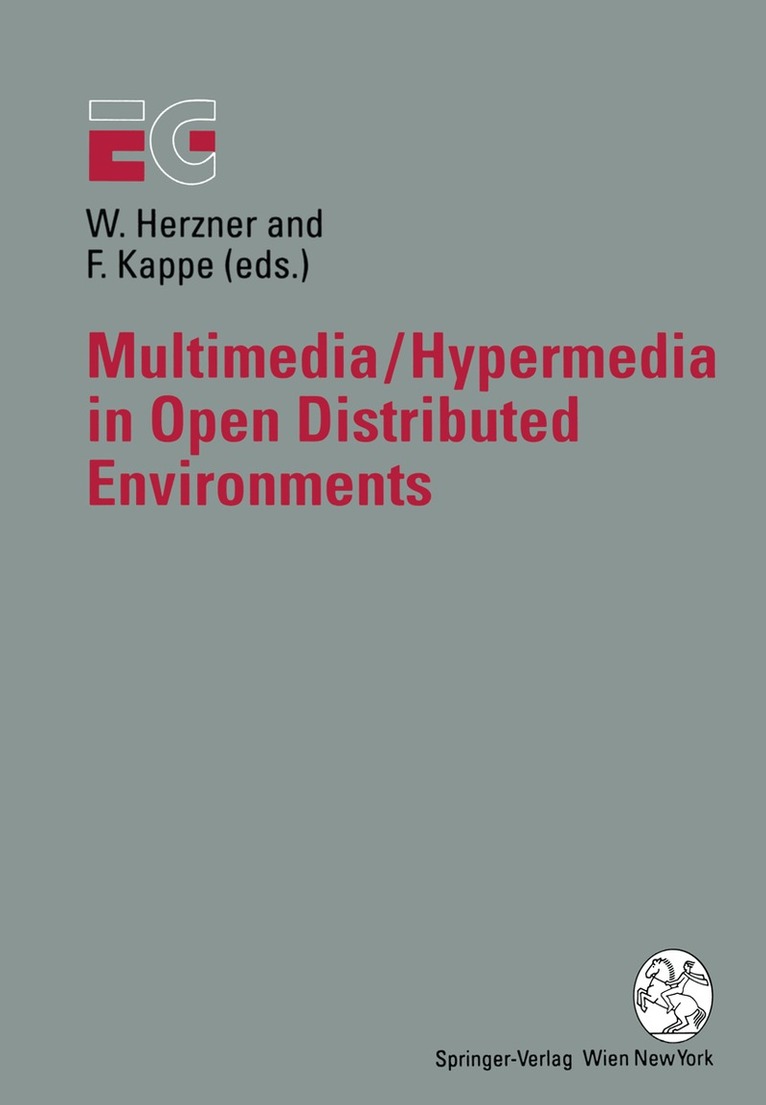
Over the last few years, multimedia hardware and applications have become widely available in the personal computer and workstation environments, and multimedia is rapidly becoming an integral part of stand-alone, single-user sy stems. In contrast, the problems encountered when moving to open, distributed environments are only just beginning to be identified. Examples are the trans mission of dynamic data (video, sound) over large distances and cooperative work. Following on from two successful workshops on multimedia, EG-MM '94 concentrates on topics related to multimedia/hypermedia in open, distributed environments. The goal of this symposium was not only to give a comprehensive overview of the current state of research, development, and standardisation in the field, but also to provide an opportunity for live demonstrations to experience directly the presented results. The symposium program consists of two invited keynote speeches, eight tech .nical sessions, one tutorial, and one demonstration session. A workshop following immediately after the symposium provides an opportunity for in-depth discussi ons of open problems among experts. It is intended to fill a gap often experienced at larger meetings and conferences: the lack of time to discuss in detail issues raised during the event, such as the characteristics of different approaches to a certain problem. It is intended that the results of the workshop be published as a Eurographics Technical Report.
E-bok
PDF, Engelska, 2012734 kr
Läs direkt efter köp
Over the last few years, multimedia hardware and applications have become widely available in the personal computer and workstation environments, and multimedia is rapidly becoming an integral part of stand-alone, single-user sy stems. In contrast, the problems encountered when moving to open, distributed environments are only just beginning to be identified. Examples are the trans mission of dynamic data (video, sound) over large distances and cooperative work. Following on from two successful workshops on multimedia, EG-MM ''94 concentrates on topics related to multimedia/hypermedia in open, distributed environments. The goal of this symposium was not only to give a comprehensive overview of the current state of research, development, and standardisation in the field, but also to provide an opportunity for live demonstrations to experience directly the presented results. The symposium program consists of two invited keynote speeches, eight tech .nical sessions, one tutorial, and one demonstration session. A workshop following immediately after the symposium provides an opportunity for in-depth discussi ons of open problems among experts. It is intended to fill a gap often experienced at larger meetings and conferences: the lack of time to discuss in detail issues raised during the event, such as the characteristics of different approaches to a certain problem. It is intended that the results of the workshop be published as a Eurographics Technical Report.