Wolfgang Linert – författare
Visar alla böcker från författaren Wolfgang Linert. Handla med fri frakt och snabb leverans.
13 produkter
13 produkter
Inbunden, Engelska, 2001
1 090 kr
Skickas inom 10-15 vardagar
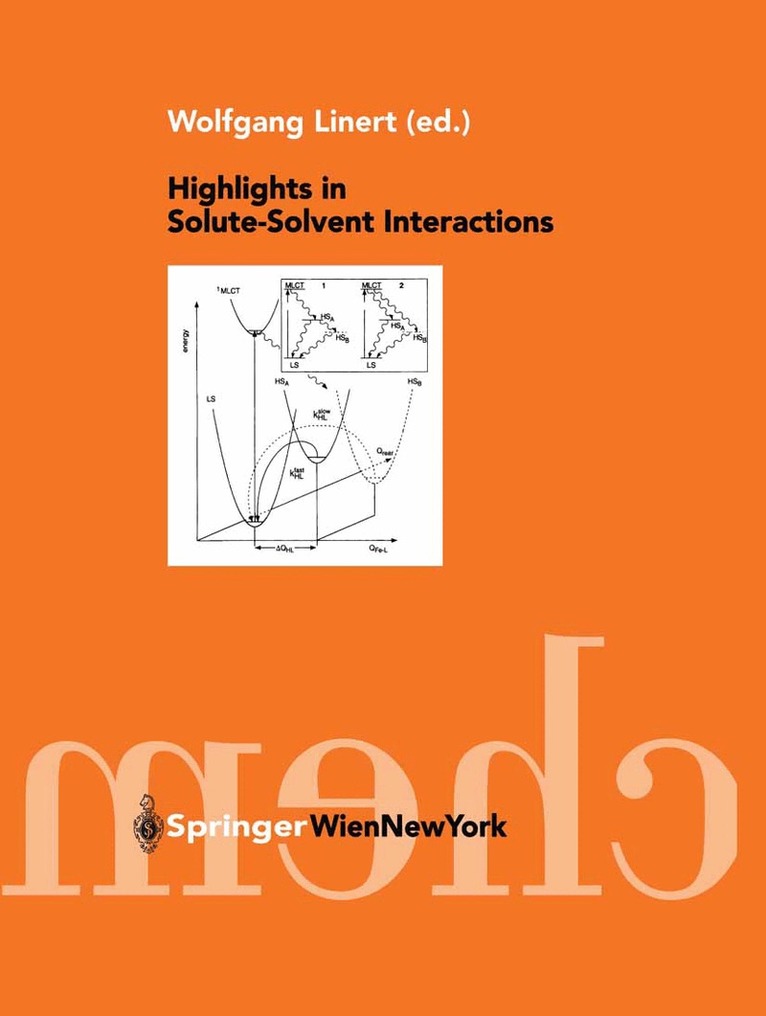
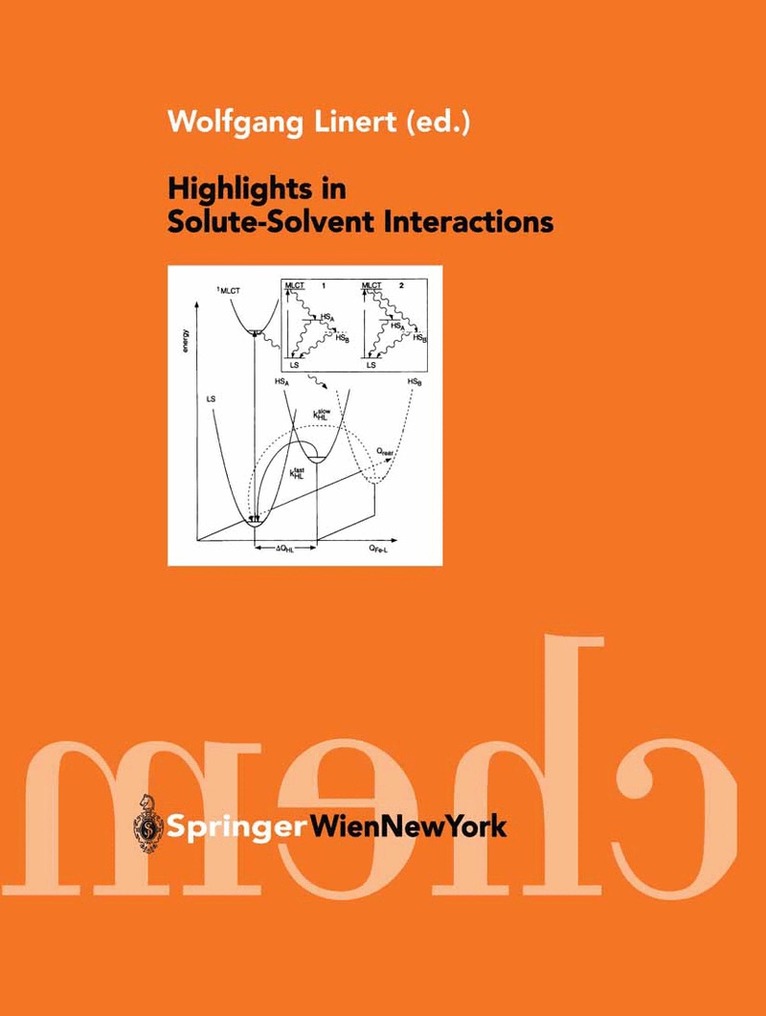
This book emphasizes a broad spectrum of features in solution chemistry, reaching from recent developments in the empirical characterization of solvent-solute interactions up to modern theoretical descriptions of liquid-state systems, from solid-liquid interfaces to preferential solvation in mixed solvents. Accordingly, this collection presents the most important, though strongly different approaches to the understanding of the mutual influences between solute and solvent. Descriptions of actual and practically useful applications of these concepts are included.
Inbunden, Engelska, 2003
1 090 kr
Skickas inom 10-15 vardagar
high as 35 K. The rush to room temperature was won by Miller and Epstein again who showed that V(TCNEh is a disordered ferrimagnet above room temperature. Verdaguer opened the saga of Prussian blue derivatives, finally reporting a ferri- magnet comprising chromium(III), vanadium(II), and vanadium(III) which orders above room temperature. Nowadays the attempts to prepare molecular magnets which can be used at room temperature are continuing but at the same time there are many attempts to synthe- sise molecular magnets which have properties which are difficult to be met in inor- ganic magnets. Day reported an organic superconductor coexisting in the same lattice of a molecular paramagnet, while more recently Coronado reported a mole- cular ferromagnet hosting in the lattice an organic conductor. This is an example of ferromagnetic conductor in which the active electrons, namely conducting and mag- netic, are separated. Many efforts are currently done to investigate chiral magnets and to use light to influence the magnetic properties of the materials.
Inbunden, Engelska, 2001
548 kr
Skickas inom 10-15 vardagar
'Why are atoms so small?' asks 'naive physicist' in Erwin Schrodinger's book 'What is Life? The Physical Aspect of the Living Cell'. 'The question is wrong' answers the author, 'the actual problem is why we are built of such an enormous number of these particles'. The idea that everything is built of atoms is quite an old one. It seems that l Democritus himself borrowed it from some obscure Phoenician source . The arguments for the existence of small indivisible units of matter were quite simple. 2 According to Lucretius observable matter would disappear by 'wear and tear' (the world exists for a sufficiently long, if not infinitely long time) unless there are some units which cannot be further split into parts. th However, in the middle of the 19 century any reference to the atomic structure of matter was considered among European physicists as a sign of extremely bad taste and provinciality. The hypothesis of the ancient Greeks (for Lucretius had translated Epicurean philosophy into Latin hexameters) was at that time seen as bringing nothing positive to exact science. The properties of gaseous, liquid and solid bodies, as well as the behaviour of heat and energy, were successfully described by the rapidly developing science of thermodynamics.
E-bok
PDF, Engelska, 2011687 kr
Läs direkt efter köp
''Why are atoms so small?'' asks ''naive physicist'' in Erwin Schrodinger''s book ''What is Life? The Physical Aspect of the Living Cell''. ''The question is wrong'' answers the author, ''the actual problem is why we are built of such an enormous number of these particles''. The idea that everything is built of atoms is quite an old one. It seems that l Democritus himself borrowed it from some obscure Phoenician source . The arguments for the existence of small indivisible units of matter were quite simple. 2 According to Lucretius observable matter would disappear by ''wear and tear'' (the world exists for a sufficiently long, if not infinitely long time) unless there are some units which cannot be further split into parts. th However, in the middle of the 19 century any reference to the atomic structure of matter was considered among European physicists as a sign of extremely bad taste and provinciality. The hypothesis of the ancient Greeks (for Lucretius had translated Epicurean philosophy into Latin hexameters) was at that time seen as bringing nothing positive to exact science. The properties of gaseous, liquid and solid bodies, as well as the behaviour of heat and energy, were successfully described by the rapidly developing science of thermodynamics.
Häftad, Engelska, 2012
548 kr
Skickas inom 10-15 vardagar
'Why are atoms so small?' asks 'naive physicist' in Erwin Schrodinger's book 'What is Life? The Physical Aspect of the Living Cell'. 'The question is wrong' answers the author, 'the actual problem is why we are built of such an enormous number of these particles'. The idea that everything is built of atoms is quite an old one. It seems that l Democritus himself borrowed it from some obscure Phoenician source . The arguments for the existence of small indivisible units of matter were quite simple. 2 According to Lucretius observable matter would disappear by 'wear and tear' (the world exists for a sufficiently long, if not infinitely long time) unless there are some units which cannot be further split into parts. th However, in the middle of the 19 century any reference to the atomic structure of matter was considered among European physicists as a sign of extremely bad taste and provinciality. The hypothesis of the ancient Greeks (for Lucretius had translated Epicurean philosophy into Latin hexameters) was at that time seen as bringing nothing positive to exact science. The properties of gaseous, liquid and solid bodies, as well as the behaviour of heat and energy, were successfully described by the rapidly developing science of thermodynamics.
Inbunden, Engelska, 2012
1 680 kr
Skickas inom 10-15 vardagar
Metal ions in the brain are a necessity as well as a poison. The presence of metal ions in the active sites of biological catalysts or metalloproteins and in the biological functioning of nucleic acids is very well documented and they are required for brain activity. On the other hand, metals are very effective in generating oxidative stress. This effect does not only play a role in immunology but also is the root of practically all neurodegenerative disorders by inducing disease via the death of neurons. Managing metal ions in the brain could therefore be an important strategy in the search for therapeutic agents used in the treatment of neurodegenerative diseases. This new title gives an overview to key topics in the area of metal ions in the brain. It focuses on the role of metal ions in neurological systems by describing their advantageous functions as well as their poisonous features. It is therefore of interest for scientists in biochemistry and biophysics, physiology, toxicology as well as for physicians focused on this topic.
E-bok
PDF, Engelska, 20121 995 kr
Läs direkt efter köp
Metal ions in the brain are a necessity as well as a poison. The presence of metal ions in the active sites of biological catalysts or metalloproteins and in the biological functioning of nucleic acids is very well documented and they are required for brain activity. On the other hand, metals are very effective in generating oxidative stress. This effect does not only play a role in immunology but also is the root of practically all neurodegenerative disorders by inducing disease via the death of neurons. Managing metal ions in the brain could therefore be an important strategy in the search for therapeutic agents used in the treatment of neurodegenerative diseases. This new title gives an overview to key topics in the area of metal ions in the brain. It focuses on the role of metal ions in neurological systems by describing their advantageous functions as well as their poisonous features. It is therefore of interest for scientists in biochemistry and biophysics, physiology, toxicology as well as for physicians focused on this topic.
Häftad, Engelska, 2014
1 631 kr
Skickas inom 10-15 vardagar
Metal ions in the brain are a necessity as well as a poison. The presence of metal ions in the active sites of biological catalysts or metalloproteins and in the biological functioning of nucleic acids is very well documented and they are required for brain activity. On the other hand, metals are very effective in generating oxidative stress. This effect does not only play a role in immunology but also is the root of practically all neurodegenerative disorders by inducing disease via the death of neurons. Managing metal ions in the brain could therefore be an important strategy in the search for therapeutic agents used in the treatment of neurodegenerative diseases. This new title gives an overview to key topics in the area of metal ions in the brain. It focuses on the role of metal ions in neurological systems by describing their advantageous functions as well as their poisonous features. It is therefore of interest for scientists in biochemistry and biophysics, physiology, toxicology as well as for physicians focused on this topic.
E-bok
PDF, Engelska, 20121 367 kr
Läs direkt efter köp
E-bok
PDF, Engelska, 20121 367 kr
Läs direkt efter köp
Most organic molecules retain their integrity when dissolved, and even though in such cases the effects exerted by solvents are, in the language of the coordination chemist, of the "outer sphere" kind, the choice of solvent can be critical to the successful outcome of an operation or preparation. Solubilities of reactants and products must be taken into account, and even if the organic principals in the reactions retain their integrity, many of the reagents are electrolytes, and their state of aggregation will affect their reactivity. In testifying to the importance of understanding solute-solvent interactions I draw attention to a large class of inorganic species for which the involvement in the chemical and physical properties by the solvent is even more deeply seated. It is comprised by the large body of metal atoms in low oxidation states for which solvent molecules intervene as reagents. At the same time, because the ions carry charges, the effects arising from outer sphere interactions are usually greater than they are for neutral molecules. To cite an example: when FeCb(s) is dissolved in water to form a dilute - say O. OlO- solution there is a complete reorganization of the coordination sphere of the cation. Whereas in the solid each cation is surrounded by six chloride ions, in the solution the dominant form is [Fe(H20)6]3+ followed by [Fe(H20)sCI]2+, [Fe(H20)4CI2]+, etc. in rapidly decreasing abundance.
Häftad, Engelska, 2012
1 090 kr
Skickas inom 10-15 vardagar
Most organic molecules retain their integrity when dissolved, and even though in such cases the effects exerted by solvents are, in the language of the coordination chemist, of the "outer sphere" kind, the choice of solvent can be critical to the successful outcome of an operation or preparation. Solubilities of reactants and products must be taken into account, and even if the organic principals in the reactions retain their integrity, many of the reagents are electrolytes, and their state of aggregation will affect their reactivity. In testifying to the importance of understanding solute-solvent interactions I draw attention to a large class of inorganic species for which the involvement in the chemical and physical properties by the solvent is even more deeply seated. It is comprised by the large body of metal atoms in low oxidation states for which solvent molecules intervene as reagents. At the same time, because the ions carry charges, the effects arising from outer sphere interactions are usually greater than they are for neutral molecules. To cite an example: when FeCb(s) is dissolved in water to form a dilute - say O. OlO- solution there is a complete reorganization of the coordination sphere of the cation. Whereas in the solid each cation is surrounded by six chloride ions, in the solution the dominant form is [Fe(H20)6]3+ followed by [Fe(H20)sCI]2+, [Fe(H20)4CI2]+, etc. in rapidly decreasing abundance.
Inbunden, Engelska, 1996
1 000 kr
Tillfälligt slut
The book is intended to help under- and postgraduate students and young scientists in the correct application of NMR to the solution of physico-chemical problems concerning the study of equilibria in solution. The first part of the book (Chapters 1-3) is a trivium, but should enable a student to design and conduct simple physico-chemical NMR experiments. The following chapters give illustrative material on the physico-chemical applications of NMR of increasing complexity. These chapters include the problem of determination of equilibrium and rate constants in solution, the study of paramagnetism using NMR, the application of Dynamic NMR techniques and relaxation measurements. A multipurpose nonlinear regression program is supplied (on disc for PC) and is referred to throughout the book.
Inbunden, Engelska, 2004
1 617 kr
Tillfälligt slut
This book surveys the relatively new area of the synthesis of organic ligands when metal ions act as a template. In the last fifty years this field has undergone an explosive development, marked by a great amount of literature. The material in the book has been arranged according to the type of chemical reaction involved. In this frame, the basic principles of metal template reactions and the shape of the molecules are considered. Designed to satisfy the demands of students, young researchers doing their PhDs, and those working in the field of coordination chemistry, the book details the role of the metal ions and the specific properties of the formed complexes.Metal Mediated Template Synthesis of Ligands offers a comprehensive analysis with wide-ranging references and provides an extensive overview of research on metal-directed organic ligands over the past five decades.