Wolfgang Schweickard – författare
12 137 kr
Skickas inom 11-20 vardagar
8 717 kr
Skickas inom 5-8 vardagar
12 987 kr
Skickas inom 5-8 vardagar
12 987 kr
Skickas inom 5-8 vardagar
12 788 kr
Skickas inom 5-8 vardagar
11 198 kr
Läs direkt efter köp
11 198 kr
Läs direkt efter köp
10 458 kr
Läs direkt efter köp
11 893 kr
Läs direkt efter köp
8 000 kr
Läs direkt efter köp
Since about 4000 years ago, lexicography has been a component of all cultures in which script was known. The path of its development goes from word lists on clay tablets to computer stored data banks. In our day, lexicography has a scientific and a non-scientific form. The former form comprises works on various sources of information and reference that pursue various important purposes, such as: help in the acquisition of the mother tongue and of foreign languages; in various types of acquisition of scientific and technical knowledge; in translation; and in cultural exchange and in ideological developments, either within one`s own or in a foreign linguistic community. The social importance of lexicography is occasionally taken cognizance of even in international politics.
The last two decades have witnessed an upsurge in interest in lexicography. On the one hand, international contacts are becoming more intimate in terms both of culture and economy; on the other hand and as far as scientific considerations go, the lexicon is being studied more within the framework of various theories, problems of the vocabulary are being studied within the area of foreign language teaching, and the application of the computer in lexicography and in other fields has brought new problems, together with many advantages. The increase in interest in the lexicon has been accompanied by the emergence of the study of dictionaries as a scientific discipline. This discipline studies the tools of reference as to their forms, structures, the way they are used, their history, and their criticism; ultimately, it is the study of those reference tools in relation to the culture in which they are embedded.
The Encyclopedia deals with lexicography and with the study of dictionaries; its three volumes cover the whole area in a great wealth of detail but in a coherent way: authors have written 349 articles in English, French, and German. They are distributed in 38 chapters.
The Encyclopedia pursues the following goals:
to describe the lexicography of all the language families, with particular attention given to the European languages and their transplanted varieties, to develop a typology of the lexicographic reference books, above all the linguistic dictionaries, within the various cultures and societies, to provide the basis for the study of the lexicon within a general theory of lexicography in relation to the study of various functions of dictionaries in individual cultures and in relation to the theories of the lexicon in various linguistic schools of thought, to develop the methodology of lexicographic work in all its phases, beginning with the appointments of a lexicographic office and ending with the application of the computer, to pinpoint areas in greatest need of improvement both in the lexicographic practice of individual territories and in the theory of lexicography, to offer a rich bibliography both of dictionaries and of secondary literature, to foster the development of lexicography into a discipline that while pursuing practical goals will be suitable for being taught and learned in a scientific way.11 026 kr
Läs direkt efter köp
7 007 kr
Skickas inom 5-8 vardagar
10 818 kr
Skickas inom 5-8 vardagar
9 327 kr
Läs direkt efter köp
The basis for this additional volume are the three volumes of the handbooks Dictionaries. An International Encyclopedia of Lexicography (HSK 5.1–5.3), published between 1989 and 1991. An updating has been perceived as an important desideratum for a considerable time. In the present Supplementary Volume the premises and subjects of HSK 5.1–5.3 are complemented by new articles that take account of the practice-internal and theoretical developments of the last 15 years. Special attention has been given to the following topics: the status and function of lexicographic reference works, the history of lexicography, the theory of lexicography, lexicographic processes, lexicographic training and lexicographic institutions, new metalexicographic methods, electronic and, especially, computer-assisted lexicography.
3 277 kr
Skickas inom 5-8 vardagar
3 116 kr
Läs direkt efter köp
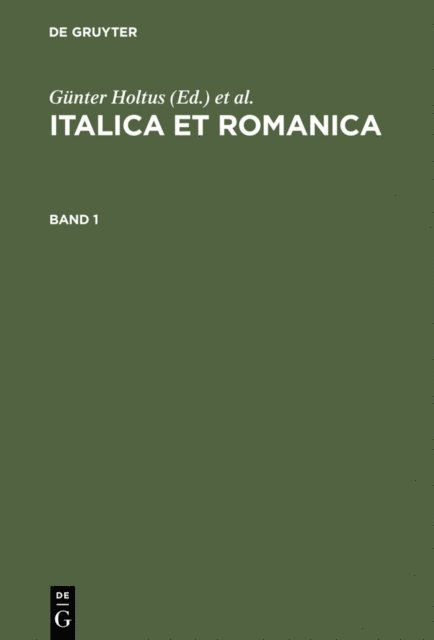
Die Festschrift zum 65. Geburtstag des Romanisten Günter Holtus versammelt 67 Aufsätze von Sprach- und Literaturwissenschaftlern aus Europa, den USA und Lateinamerika. Zentrale Themenfelder sind die Varietätenlinguistik, die seit den 80er und 90er Jahren des 20. Jahrhunderts die romanistische Diskussion wesentlich mitbestimmt hat, die traditionellen sprachwissenschaftlichen Kerndisziplinen Sprachgeschichte und Lexikologie, die Editionsphilologie und Skriptaforschung, die seit ihren Anfängen immer wieder für lebhafte Diskussionen gesorgt haben, sowie Stand und Perspektiven der Romanistik als universitärer Disziplin.
6 039 kr
Läs direkt efter köp
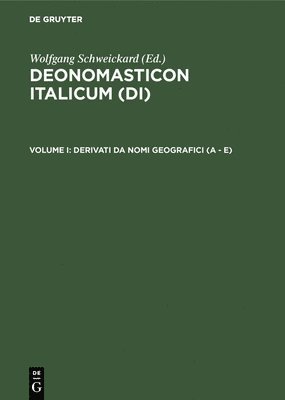
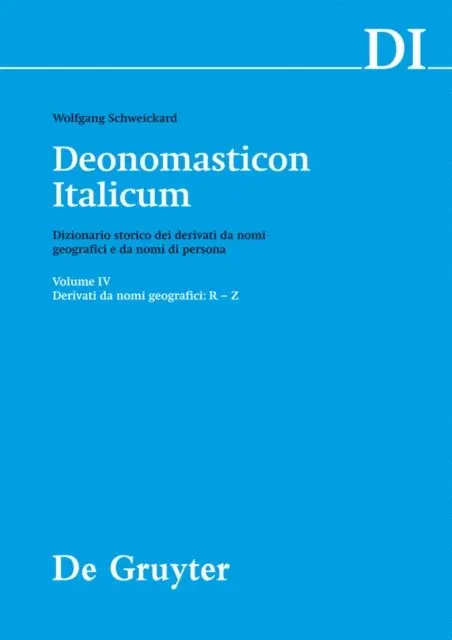
Das Deonomasticon Italicum bietet eine systematische historische Aufarbeitung und Kommentierung der Lexeme des Italienischen, die von Eigennamen abgeleitet sind. Erfasst werden Ableitungen von geographischen Namen, einschließlich des wort- und kulturgeschichtlich besonders interessanten Bereichs der Ethnika, sowie Ableitungen von Personennamen. Der erste Teil des Wörterbuchs (4 Bände) gilt den Ableitungen von geographischen Namen; der zweite Teil (ca. 2 Bände) den Personennamen. Die Erscheinungsweise wurde ab Teil zwei von Faszikeln auf Bände umgestellt.
2 526 kr
Läs direkt efter köp
2 586 kr
Skickas inom 5-8 vardagar
2 621 kr
Läs direkt efter köp
Die auf 500 Seiten erweiterte und überarbeitete Bibliographie verzeichnet die breite Quellengrundlage des DI aus Wörterbüchern des Italienischen, literarischen und historiographischen Quellen sowie elektronischen Korpora aktueller Tageszeitungen und aktualisiert das Supplemento bibliografico (Umfang 100 Seiten), das beim Projektstart 1997 erschienen ist.
Dictionnaire Étymologique Roman (DÉRom)
2 405 kr
Skickas inom 5-8 vardagar
2 583 kr
Läs direkt efter köp
The Dictionnaire Étymologique Roman (DÉRom) presents the first attempt at etymologizing the ancestral vocabulary of the Romance languages since the publication of Meyer-Lübke’s REW. Deviating from practices commonly accepted and applied in etymological research, the DÉRom adopts a method that has so far, due to the extensive documentation of written Latin, been dismissed as being little viable for Romance Studies: the comparative analysis of grammar, used to reconstruct proto-Romance lexemes. This volume contains some 250 articles, written and revised by 40 specialists in Romance linguistics based in twelve countries, as well as a detailed presentation of the theoretical groundwork of this project.
2 526 kr
Läs direkt efter köp
2 583 kr
Läs direkt efter köp
The Dictionnaire Étymologique Roman (DÉRom) presents the first attempt at etymologizing the ancestral vocabulary of the Romance languages since the publication of Meyer-Lübke’s REW. Deviating from practices commonly accepted and applied in etymological research, the DÉRom adopts a method that has so far, due to the extensive documentation of written Latin, been dismissed as being little viable for Romance Studies: the comparative analysis of grammar, used to reconstruct proto-Romance lexemes. This volume contains some 250 articles, written and revised by 40 specialists in Romance linguistics based in twelve countries, as well as a detailed presentation of the theoretical groundwork of this project.
2 586 kr
Skickas inom 5-8 vardagar
2 621 kr
Läs direkt efter köp
This second volume on the Dictionnaire Étymologique Roman (DÉRom) contains forty new lexicographical articles as well as an extensive theoretical section which discusses various questions pertaining to the methods, problems and implications of comparative reconstruction in Romance linguistics (phonology, semantics, grammar, geolinguistics and cartography).
2 621 kr
Läs direkt efter köp
This second volume on the Dictionnaire Étymologique Roman (DÉRom) contains forty new lexicographical articles as well as an extensive theoretical section which discusses various questions pertaining to the methods, problems and implications of comparative reconstruction in Romance linguistics (phonology, semantics, grammar, geolinguistics and cartography).
Dictionnaire Étymologique Roman (DÉRom) 3
Entre idioroman et protoroman
2 474 kr
Skickas inom 5-8 vardagar
2 353 kr
Läs direkt efter köp
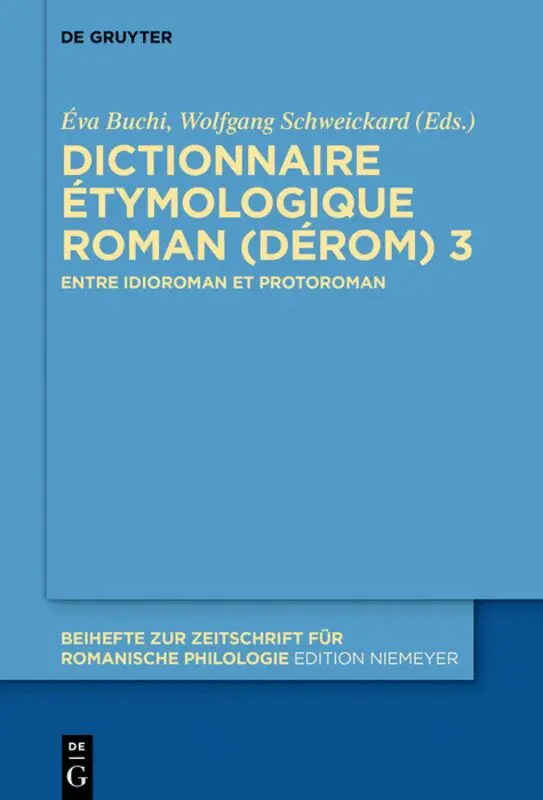
Ce troisième volume du Dictionnaire Étymologique Roman (DÉRom) contient une quarantaine d’articles, pour la plupart des étymons protoromans héréditaires (ainsi */''mεle/ s.m. ‘miel’), mais aussi des emprunts au gaulois (dont */mol''ton-e/ s.m. ‘bélier’). La méthode de la reconstruction comparative qui caractérise le projet permet d’atteindre le lexique de l’ancêtre commun des parlers romans dans sa variation interne, qu’elle soit phonologique (ainsi pour */''nomin-a-/ v.tr. ‘nommer’ et sa variante dissimilée */''lomin-a-/), morphologique (par exemple */''ɡɛner-u/ s.m. ‘gendre’ et sa variante flexionnelle */''ɡɛner-e/) ou même lexicale (ainsi, pour ‘écorce’, la synonymie diasystémique entre */''skɔrti-a/ et */''rusk-a/). La partie théorique et méthodologique du volume réunit des chapitres consacrés à des questions comme l’infrastructure idioromane du DÉRom (sur la base des exemples du roumain, du francoprovençal et de l’aragonais), la polysémie et la synonymie au sein d’une protolangue ou encore les emprunts du protoroman au substrat celtique ou, inversement, les emprunts du basque au protoroman.
2 353 kr
Läs direkt efter köp
Ce troisième volume du Dictionnaire Étymologique Roman (DÉRom) contient une quarantaine d’articles, pour la plupart des étymons protoromans héréditaires (ainsi */''mεle/ s.m. ‘miel’), mais aussi des emprunts au gaulois (dont */mol''ton-e/ s.m. ‘bélier’). La méthode de la reconstruction comparative qui caractérise le projet permet d’atteindre le lexique de l’ancêtre commun des parlers romans dans sa variation interne, qu’elle soit phonologique (ainsi pour */''nomin-a-/ v.tr. ‘nommer’ et sa variante dissimilée */''lomin-a-/), morphologique (par exemple */''ɡɛner-u/ s.m. ‘gendre’ et sa variante flexionnelle */''ɡɛner-e/) ou même lexicale (ainsi, pour ‘écorce’, la synonymie diasystémique entre */''skɔrti-a/ et */''rusk-a/). La partie théorique et méthodologique du volume réunit des chapitres consacrés à des questions comme l’infrastructure idioromane du DÉRom (sur la base des exemples du roumain, du francoprovençal et de l’aragonais), la polysémie et la synonymie au sein d’une protolangue ou encore les emprunts du protoroman au substrat celtique ou, inversement, les emprunts du basque au protoroman.