Xingqian Ye - Böcker
Visar alla böcker från författaren Xingqian Ye. Handla med fri frakt och snabb leverans.
3 produkter
3 produkter
3 161 kr
Skickas inom 10-15 vardagar
Goji berries (Lycium barbarum), which are widely distributed in Northwestern China, Southeastern Europe and the Mediterranean areas, have traditionally been employed in Chinese medicine from ancient times. Goji berries, also known as wolfberry, have become increasingly popular in the Western world because of their nutritional properties, often advertised as a superfood in Europe and North America. With the development of analysis methods, various chemical constituents have been identified, including carbohydrates, carotenoids, flavonoids, betaine, cerebroside, -sitosterol, amino acids, trace elements, vitamins and other constituents. Polysaccharides have been identified as one of the major active ingredients responsible for biological activities. Phytochemicals in Goji Berries: Applications in Functional Foods, a volume in the Functional Foods and Nutraceuticals Series, provides information about the chemical, biochemical, botanic properties, bioactive components and health benefits of Goji berries. It also discusses postharvest storage technology, processing technology, and the development and utilization of Goji berry by-products in medicinal foods and functional foods, as well as addressing food safety issues. Features: Provide information on Goji fruit origin and growing conditions, distribution, and biochemical properties Discusses such medicinal properties and health benefits of Goji berries as the capacity to lower blood pressure, treat anemia, maintain cholesterol levels in the normal range and decrease risk of cardiovascular disease. Additionally, Goji berries have anti-inflammatory and anti-tumor properties, among others Includes information on traditional products, new products and innovative processing technologies This book will serve college and university students majoring in food science, nutrition, pharmaceutical science, and botanical science. It also will serve as a unique reference for food science professionals pursuing functional foods, marketing expansion, as well as nutritional dietary management. Readers will obtain sound scientific knowledge of the nutritional value and health benefits of the different Goji berry products such as juice, cake, soup, snacks, and medicinal foods. Also available in the Functional Foods and Nutraceuticals series:Korean Functional Foods: Composition, Processing and Health Benefits, edited by Kun-Young Park, Dae Young Kwon, Ki Won Lee, Sunmin Park (ISBN 978-1-4987-9965-2)Phytochemicals in Citrus: Applications in Functional Foods, edited by Xingqian Ye (ISBN 978-1-4987-4272-6)Food as Medicine: Functional Food Plants of Africa, by Maurice M. Iwu (ISBN 978-1-4987-0609-4)For a complete list of books in the series, please visit our website at https://www.crcpress.com/Functional-Foods-and-Nutraceuticals/book-series/CRCFUNFOONUT
3 256 kr
Skickas inom 7-10 vardagar
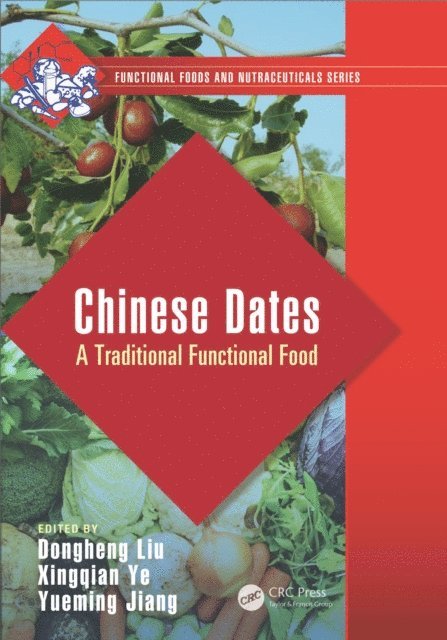
Chinese Dates: A Traditional Functional Food delivers unique information on Chinese dates (jujubes) as typical ethical foods and traditional health-promoting foods. It conveys a better understanding of Asian food cultures and provides historical information in regard to traditional functional foods and their dietary applications. It discusses the health-promoting benefits of a wide variety of jujube fruits and covers different jujube products, such as jujube fruit juice and cakes. It also looks into the many kinds of jujube fruit-based medicated diets, describes innovative new processing technologies and novel jujube products, and examines ethnomedicinal uses, pharmacological activity, and phytochemical constitutes of jujubes.The book’s four sections and nineteen chapters provide information on Chinese date’s origin, distribution, varieties, chemical composition, biochemical properties, traditional products and technology, innovative processing technology, food use, and health benefits. The first section explores the origin, distribution, germplasm, and growing conditions of Chinese dates. It also examines traditional jujube-based functional foods from a historical perspective.The second section looks into the chemical and biochemical properties of Chinese dates along with their health benefits. Topics within this section include a review of the current knowledge of fruit composition; chemical, biological, and antioxidant properties of jujubes from different geographical regions; and a mathematical analysis of the relationship between the composition and bioactivities of jujube fruit harvested at different stages of ripeness. This section also explores ethnomedicinal uses and pharmacological activity, phytochemical constituents and health benefits, and polysaccharide composition.Chinese date products and postharvest technology are covered in the third section, which includes a discussion of drying technology and postharvest treatments affecting storage quality. The fourth and final section deals with the Chinese date industry in various countries, including Australia, Turkey, Iran, and Romania.
2 557 kr
Skickas inom 10-15 vardagar
Citrus fruits have long been popular around the world due to their good flavor, taste, high nutritional value, and their healthy properties. Citrus is well known as a rich source of vitamin C. Citrus fruits also contain many other functional bioactive phytochemicals including terpenoids, triterpenes, flavonoids, amino acids, phenolic acids, mineral constituents, and polysaccharides, which are beneficial to human health. Citrus fruits are generally recognized as an outstanding source of biologically active compounds related to both nutritional and nutraceutical values. Phytochemicals in Citrus: Applications in Functional Foods focuses on up-to-date information on chemical properties of citrus fruits, citrus food products, and their health benefits. The 16 chapters in the book provide a knowledge base on the chemical composition, bioactive components, biochemical properties, food use, and health benefits of citrus fruits. The information in this book will help readers to better understand the health benefits of citrus fruits and products and their dietary applications. The book is a unique reference for food science professionals engaged in functional foods and nutritional dietary management. The book can also serve as a handy reference for college and university students majoring in food science, nutrition, pharmaceutical science, and horticultural science.