Y. Eliashberg - Böcker
Visar alla böcker från författaren Y. Eliashberg. Handla med fri frakt och snabb leverans.
3 produkter
3 produkter
1 006 kr
Skickas inom 7-10 vardagar
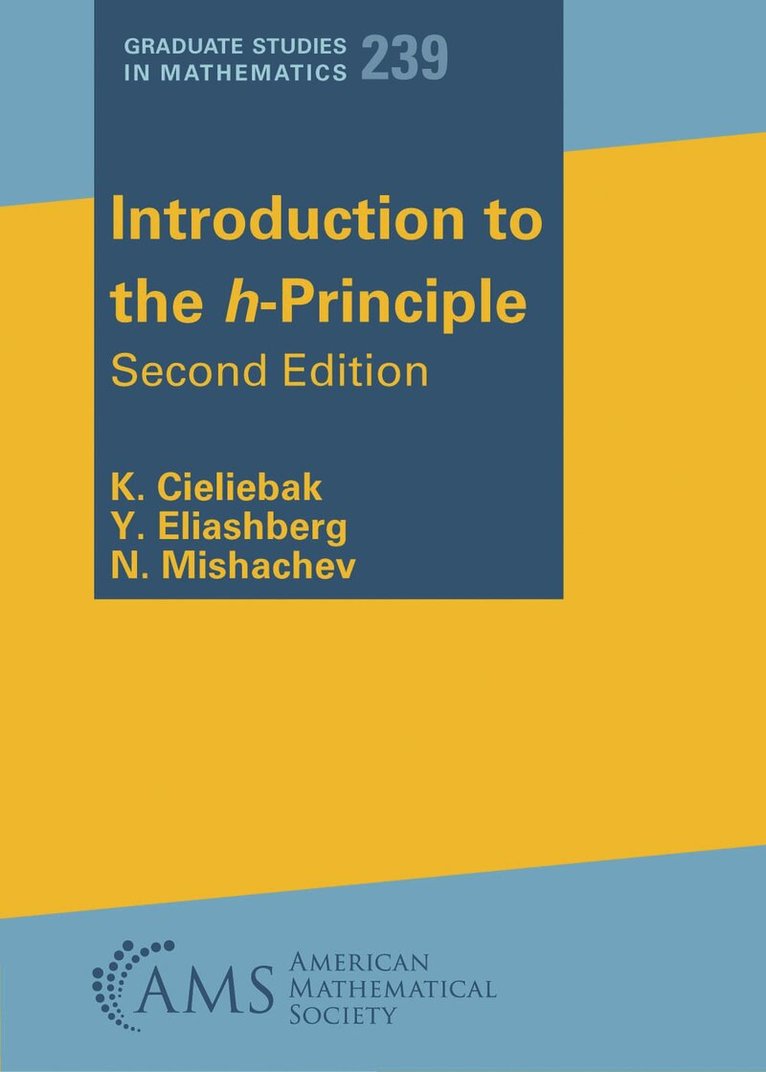
In differential geometry and topology one often deals with systems of partial differential equations as well as partial differential inequalities that have infinitely many solutions whatever boundary conditions are imposed. It was discovered in the 1950s that the solvability of differential relations (i.e., equations and inequalities) of this kind can often be reduced to a problem of a purely homotopy-theoretic nature. One says in this case that the corresponding differential relation satisfies the $h$-principle. Two famous examples of the $h$-principle, the Nash-Kuiper $C^1$-isometric embedding theory in Riemannian geometry and the Smale-Hirsch immersion theory in differential topology, were later transformed by Gromov into powerful general methods for establishing the $h$-principle. The authors cover two main methods for proving the $h$-principle: holonomic approximation and convex integration. The reader will find that, with a few notable exceptions, most instances of the $h$-principle can be treated by the methods considered here. A special emphasis is made on applications to symplectic and contact geometry. The present book is the first broadly accessible exposition of the theory and its applications, making it an excellent text for a graduate course on geometric methods for solving partial differential equations and inequalities. Geometers, topologists, and analysts will also find much value in this very readable exposition of an important and remarkable topic. This second edition of the book is significantly revised and expanded to almost twice of the original size. The most significant addition to the original book is the new part devoted to the method of wrinkling and its applications. Several other chapters (e.g., on multivalued holonomic approximation and foliations) are either added or completely rewritten.
1 518 kr
Skickas inom 7-10 vardagar
In differential geometry and topology one often deals with systems of partial differential equations as well as partial differential inequalities that have infinitely many solutions whatever boundary conditions are imposed. It was discovered in the 1950s that the solvability of differential relations (i.e., equations and inequalities) of this kind can often be reduced to a problem of a purely homotopy-theoretic nature. One says in this case that the corresponding differential relation satisfies the $h$-principle. Two famous examples of the $h$-principle, the Nash-Kuiper $C^1$-isometric embedding theory in Riemannian geometry and the Smale-Hirsch immersion theory in differential topology, were later transformed by Gromov into powerful general methods for establishing the $h$-principle. The authors cover two main methods for proving the $h$-principle: holonomic approximation and convex integration. The reader will find that, with a few notable exceptions, most instances of the $h$-principle can be treated by the methods considered here. A special emphasis is made on applications to symplectic and contact geometry. The present book is the first broadly accessible exposition of the theory and its applications, making it an excellent text for a graduate course on geometric methods for solving partial differential equations and inequalities. Geometers, topologists, and analysts will also find much value in this very readable exposition of an important and remarkable topic. This second edition of the book is significantly revised and expanded to almost twice of the original size. The most significant addition to the original book is the new part devoted to the method of wrinkling and its applications. Several other chapters (e.g., on multivalued holonomic approximation and foliations) are either added or completely rewritten.
536 kr
Skickas inom 10-15 vardagar
Reprint from GAFA, Vol. 5 (1995), No. 2. Enlarged by a short biography of Mikhail Gromov and a list of publications. In the last decades of the XX century tremendous progress has been achieved in geometry. The discovery of deep interrelations between geometry and other fields including algebra, analysis and topology has pushed it into the mainstream of modern mathematics. This Special Issue of Geometric And Functional Analysis (GAFA) in honour of Mikhail Gromov contains 14 papers which give a wide panorama of recent fundamental developments in modern geometry and its related subjects. CONTRIBUTORS: J. Bourgain, J. Cheeger, J. Cogdell, A. Connes, Y. Eliashberg, H. Hofer, F. Lalonde, W. Luo, G. Margulis, D. McDuff, H. Moscovici, G. Mostow, S. Novikov, G. Perelman, I. Piatetski-Shapiro, G. Pisier, X. Rong, Z. Rudnick, D. Salamon, P. Sarnak, R. Schoen, M. Shubin, K. Wysocki, and E. Zehnder. The book is a collection of important results and an enduring source of new ideas for researchers and students in a broad spectrum of directions related to all aspects of Geometry and its applications to Functional Analysis, PDE, Analytic Number Theory and Physics.