
Yakov M. Shnir – författare
Visar alla böcker från författaren . Handla med fri frakt och snabb leverans.
6 produkter
6 produkter

Inbunden, Engelska, 2018
1 850 kr
Skickas inom 7-10 vardagar
Solitons emerge in various non-linear systems as stable localized configurations, behaving in many ways like particles, from non-linear optics and condensed matter to nuclear physics, cosmology and supersymmetric theories. This book provides an introduction to integrable and non-integrable scalar field models with topological and non-topological soliton solutions. Focusing on both topological and non-topological solitons, it brings together debates around solitary waves and construction of soliton solutions in various models and provides a discussion of solitons using simple model examples. These include the Kortenweg-de-Vries system, sine-Gordon model, kinks and oscillons, and skyrmions and hopfions. The classical field theory of scalar field in various spatial dimensions is used throughout the book in presentation of related concepts, both at the technical and conceptual level. Providing a comprehensive introduction to the description and construction of solitons, this book is ideal for researchers and graduate students in mathematics and theoretical physics.

Inbunden, Engelska, 2005
1 515 kr
Skickas inom 10-15 vardagar
“One would be surprised if Nature had made no use of it.” P.A.M. Dirac According to some dictionaries, one meaning of the notion of “beauty” is “symmetry”. Probably, beauty is not entirely “in the eye of the beholder”. It seemstoberelatedtothesymmetryoftheobject.Fromaphysicalviewpoint, this de?nition is very attractive: it allows us to describe a central concept of theoretical physics over the last two centuries as being a quest for higher symmetry of Nature. The more symmetric the theory, the more beautiful it looks. Unfortunately, our imperfect (at least at low-energy scale) world is full of nasty broken symmetries. This has impelled physicists to try to understand how this happens. In some cases, it is possible to reveal the mechanism of violationandhowthesymmetrymayberecovered;thenourpictureofNature becomes a bit more beautiful. One of the problems of the broken symmetry that we see is that, while there are electric charges in our world, their counterparts, magnetic mo- poles, have not been found. Thus, in the absence of the monopoles, the s- metry between electric and magnetic quantities is lost. Can this symmetry be regained? In the history of theoretical physics, the hypothesis about the possible existence of a magnetic monopole has no analogy. There is no other purely theoretical construction that has managed not only to survive, without any experimental evidence, in the course of more than a century, but has also remained the focus of intensive research by generations of physicists.

E-bok
PDF, Engelska, 20061 416 kr
Läs direkt efter köp
“One would be surprised if Nature had made no use of it.” P.A.M. Dirac According to some dictionaries, one meaning of the notion of “beauty” is “symmetry”. Probably, beauty is not entirely “in the eye of the beholder”. It seemstoberelatedtothesymmetryoftheobject.Fromaphysicalviewpoint, this de?nition is very attractive: it allows us to describe a central concept of theoretical physics over the last two centuries as being a quest for higher symmetry of Nature. The more symmetric the theory, the more beautiful it looks. Unfortunately, our imperfect (at least at low-energy scale) world is full of nasty broken symmetries. This has impelled physicists to try to understand how this happens. In some cases, it is possible to reveal the mechanism of violationandhowthesymmetrymayberecovered;thenourpictureofNature becomes a bit more beautiful. One of the problems of the broken symmetry that we see is that, while there are electric charges in our world, their counterparts, magnetic mo- poles, have not been found. Thus, in the absence of the monopoles, the s- metry between electric and magnetic quantities is lost. Can this symmetry be regained? In the history of theoretical physics, the hypothesis about the possible existence of a magnetic monopole has no analogy. There is no other purely theoretical construction that has managed not only to survive, without any experimental evidence, in the course of more than a century, but has also remained the focus of intensive research by generations of physicists.

Häftad, Engelska, 2010
1 084 kr
Skickas inom 10-15 vardagar
“One would be surprised if Nature had made no use of it.” P.A.M. Dirac According to some dictionaries, one meaning of the notion of “beauty” is “symmetry”. Probably, beauty is not entirely “in the eye of the beholder”. It seemstoberelatedtothesymmetryoftheobject.Fromaphysicalviewpoint, this de?nition is very attractive: it allows us to describe a central concept of theoretical physics over the last two centuries as being a quest for higher symmetry of Nature. The more symmetric the theory, the more beautiful it looks. Unfortunately, our imperfect (at least at low-energy scale) world is full of nasty broken symmetries. This has impelled physicists to try to understand how this happens. In some cases, it is possible to reveal the mechanism of violationandhowthesymmetrymayberecovered;thenourpictureofNature becomes a bit more beautiful. One of the problems of the broken symmetry that we see is that, while there are electric charges in our world, their counterparts, magnetic mo- poles, have not been found. Thus, in the absence of the monopoles, the s- metry between electric and magnetic quantities is lost. Can this symmetry be regained? In the history of theoretical physics, the hypothesis about the possible existence of a magnetic monopole has no analogy. There is no other purely theoretical construction that has managed not only to survive, without any experimental evidence, in the course of more than a century, but has also remained the focus of intensive research by generations of physicists.
Inbunden, Engelska, 1995
2 391 kr
Tillfälligt slut
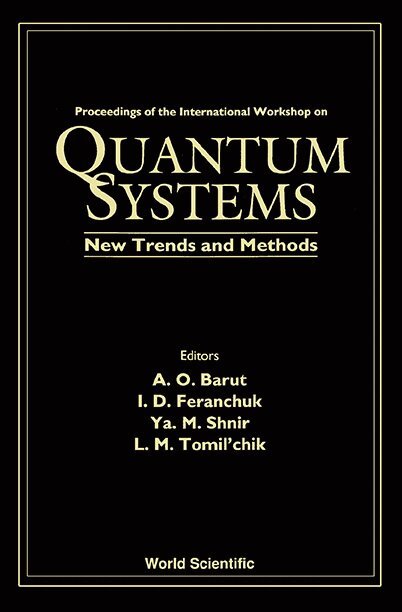
Quantum systems in all areas of physics, from atomic and molecular physics, nuclear and particle physics to condensed matter and astrophysics, provide a rich mosaic of different structures. Yet there are some simple and universal working principles of nature which seem to govern these structures and manifest themselves in various forms, as well as likely hypothetical ones which might do the same. For example, the same symmetry group structure occurs again and again in optics, atomic physics and particle physics. Concepts like potential, phases, bound states, tunneling, interference, solitons, radiation and resonance are universal.It is for those reasons that a collection of recent works in the many areas of physics on quantum structures and the methods for their investigation is important. The present volume fulfills this task to a large extent. The contributions are wide-ranging and yet there is a certain continuity. The main topics, namely non-perturbative methods in quantum theory, quantum nonlinear systems, quantum phases and magnetic monopoles, are covered by longer review articles and are enriched by many related contributions. It is also very appropriate that the corresponding mathematical methods, such as those for solving Schrödinger and relativistic wave equations, as well as those of algebra and group representations and analysis, are included in this volume.
Inbunden, Engelska, 2004
2 725 kr
Tillfälligt slut
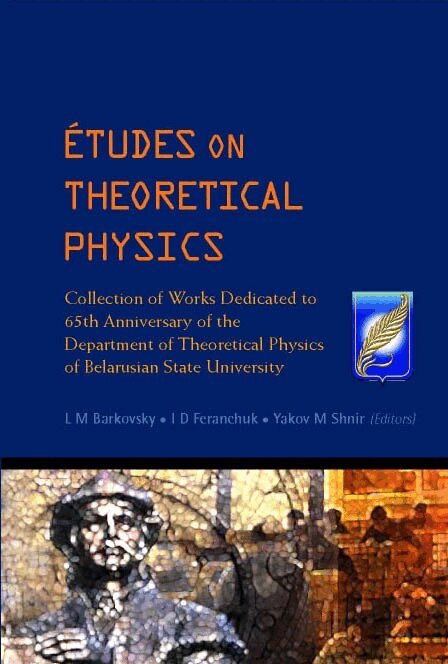
This volume presents the results of many decades of research carried out by the Department of Theoretical Physics of the Belarusian State University, one of former USSR's prominent universities, providing a “snapshot” of the research activities of the department. With contributions form leading researchers who graduated from the department and now working in well known research centers around the world, this collection of works consists of selected mini-reviews of a wide variety of research topics on modern theoretical physics. It includes information on the methods and applications used in the various different research topics.This volume will be useful for advanced graduate students and doctorates who specialize in theoretical physics as well as researchers who would like to get concise information on the methods and applications of modern theoretical physics.The proceedings have been selected for coverage in:• CC / Physical, Chemical& Earth Sciences• Index to Scientific Book Contents® (ISBC®)