Yanhong Wu – författare
Visar alla böcker från författaren Yanhong Wu. Handla med fri frakt och snabb leverans.
7 produkter
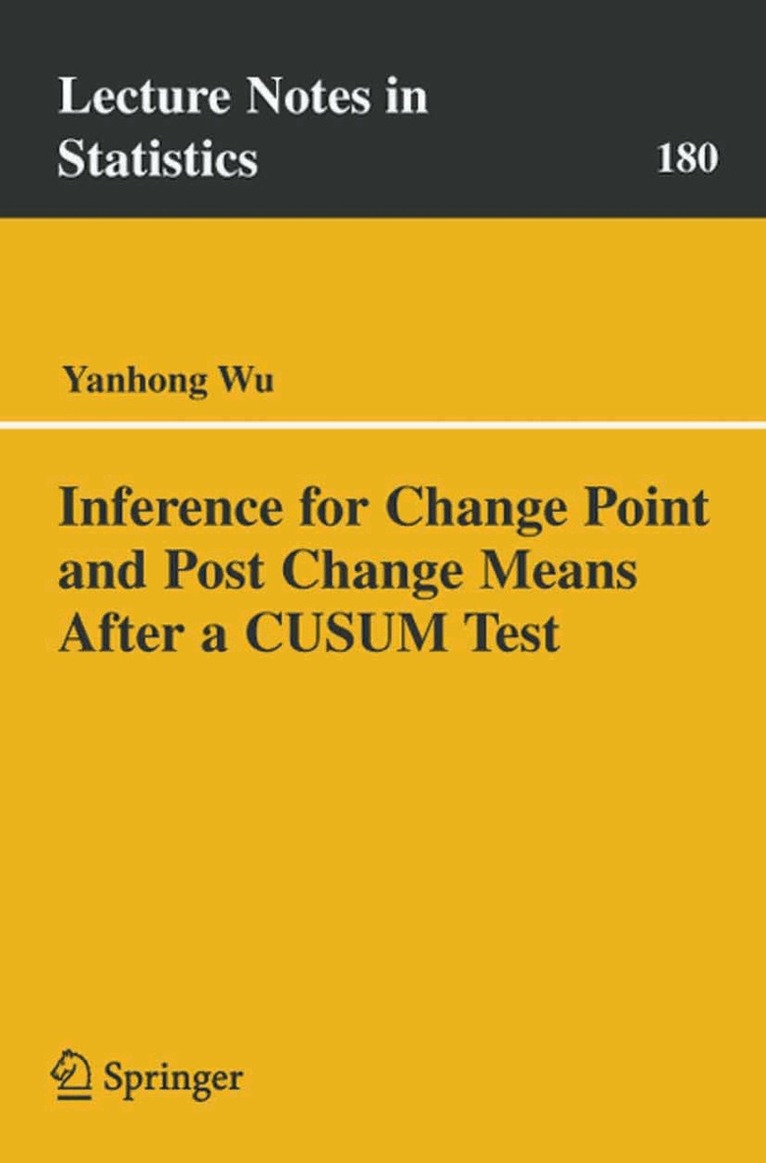
Inference for Change Point and Post Change Means After a CUSUM Test
Av Yanhong Wu
Häftad, 2005
551 kr
Lägg i varukorg
The change-point problem has attracted many statistical researchers and practitioners during the last few decades. Here, we only concentrate on the sequential change-point problem. Starting from the Shewhart chart with app- cations to quality control [see Shewhart (1931)], several monitoring …
Inference for Change Point and Post Change Means After a CUSUM Test
Av Yanhong Wu
E-bok, 2007
734 kr
Lägg i varukorg
The change-point problem has attracted many statistical researchers and practitioners during the last few decades. Here, we only concentrate on the sequential change-point problem. Starting from the Shewhart chart with app- cations to quality control [see Shewhart (1931)], several monitoring …
Probability and Statistical Models
Foundations for Problems in Reliability and Financial Mathematics
Av Arjun K. Gupta, Wei-Bin Zeng m. fl.
Inbunden, 2010
552 kr
Lägg i varukorg
Probability models are now a vital componentof every scienti c investigation. This book is intended to introduce basic ideas in stochastic modeling, with emphasis on models and techniques. These models lead to well-known parametric lifetime distributions, such as exponential, Weibull, and gamma …
Probability and Statistical Models
Foundations for Problems in Reliability and Financial Mathematics
Av Yanhong Wu, Wei-Bin Zeng m. fl.
E-bok, 2010
734 kr
Lägg i varukorg
Probability models are now a vital componentof every scienti c investigation. This book is intended to introduce basic ideas in stochastic modeling, with emphasis on models and techniques. These models lead to well-known parametric lifetime distributions, such as exponential, Weibull, and gamma …
Phonology of Shanghai Sign Language
Av Jisheng Zhang, Yanhong Wu m. fl.
Inbunden, 2024
2557 kr
Lägg i varukorg
Applying the framework of the Prosodic Model to naturalistic data, this book presents a systematic study of the phonological structure of Shanghai Sign Language (SHSL). It examines the handshape inventory of SHSL in terms of its underlying featural specifications, phonetic realization and …
Phonology of Shanghai Sign Language
Av Jisheng Zhang, Yanhong Wu m. fl.
E-bok, 2024
1909 kr
Lägg i varukorg
Applying the framework of the Prosodic Model to naturalistic data, this book presents a systematic study of the phonological structure of Shanghai Sign Language (SHSL). It examines the handshape inventory of SHSL in terms of its underlying featural specifications, phonetic realization and …
Phonology of Shanghai Sign Language
Av Jeroen van de Weijer, Yin'er Zhu m. fl.
E-bok, 2024
1868 kr
Lägg i varukorg
Applying the framework of the Prosodic Model to naturalistic data, this book presents a systematic study of the phonological structure of Shanghai Sign Language (SHSL). It examines the handshape inventory of SHSL in terms of its underlying featural specifications, phonetic realization and …