Yury A. Kutoyants – författare
Visar alla böcker från författaren Yury A. Kutoyants. Handla med fri frakt och snabb leverans.
7 produkter
7 produkter
1 072 kr
Skickas inom 10-15 vardagar
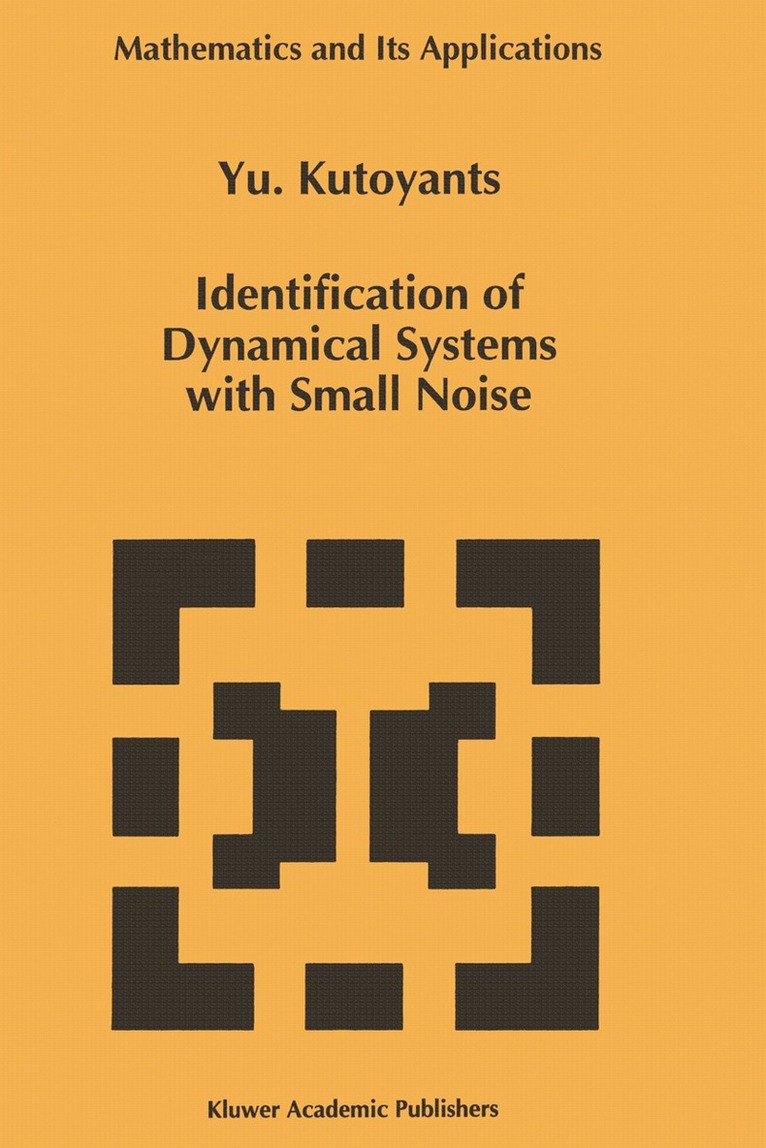
Small noise is a good noise. In this work, we are interested in the problems of estimation theory concerned with observations of the diffusion-type process Xo = Xo, 0 ~ t ~ T, (0. 1) where W is a standard Wiener process and St(') is some nonanticipative smooth t function. By the observations X = {X , 0 ~ t ~ T} of this process, we will solve some t of the problems of identification, both parametric and nonparametric. If the trend S(-) is known up to the value of some finite-dimensional parameter St(X) = St((}, X), where (} E e c Rd , then we have a parametric case. The nonparametric problems arise if we know only the degree of smoothness of the function St(X), 0 ~ t ~ T with respect to time t. It is supposed that the diffusion coefficient c is always known. In the parametric case, we describe the asymptotical properties of maximum likelihood (MLE), Bayes (BE) and minimum distance (MDE) estimators as c --+ 0 and in the nonparametric situation, we investigate some kernel-type estimators of unknown functions (say, StO,O ~ t ~ T). The asymptotic in such problems of estimation for this scheme of observations was usually considered as T --+ 00 , because this limit is a direct analog to the traditional limit (n --+ 00) in the classical mathematical statistics of i. i. d. observations. The limit c --+ 0 in (0. 1) is interesting for the following reasons.
1 232 kr
Skickas inom 10-15 vardagar
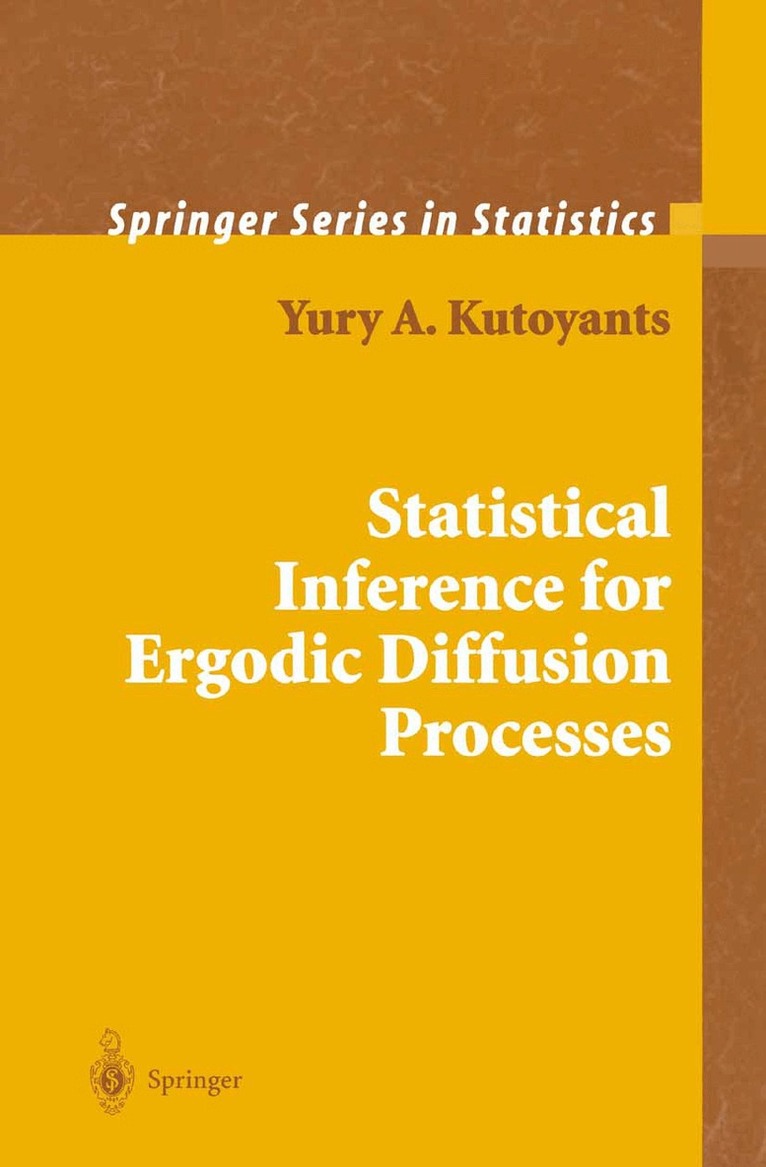
Statistical Inference for Ergodic Diffusion Processes encompasses a wealth of results from over ten years of mathematical literature. It provides a comprehensive overview of existing techniques, and presents - for the first time in book form - many new techniques and approaches. An elementary introduction to the field at the start of the book introduces a class of examples - both non-standard and classical - that reappear as the investigation progresses to illustrate the merits and demerits of the procedures. The statements of the problems are in the spirit of classical mathematical statistics, and special attention is paid to asymptotically efficient procedures. Today, diffusion processes are widely used in applied problems in fields such as physics, mechanics and, in particular, financial mathematics. This book provides a state-of-the-art reference that will prove invaluable to researchers, and graduate and postgraduate students, in areas such as financial mathematics, economics, physics, mechanics and the biomedical sciences.From the reviews:"This book is very much in the Springer mould of graduate mathematical statistics books, giving rapid access to the latest literature...It presents a strong discussion of nonparametric and semiparametric results, from both classical and Bayesian standpoints...I have no doubt that it will come to be regarded as a classic text." Journal of the Royal Statistical Society, Series A, v. 167
1 711 kr
Skickas inom 10-15 vardagar
Statistical Inference for Ergodic Diffusion Processes encompasses a wealth of results from over ten years of mathematical literature. It provides a comprehensive overview of existing techniques, and presents - for the first time in book form - many new techniques and approaches. An elementary introduction to the field at the start of the book introduces a class of examples - both non-standard and classical - that reappear as the investigation progresses to illustrate the merits and demerits of the procedures. The statements of the problems are in the spirit of classical mathematical statistics, and special attention is paid to asymptotically efficient procedures. Today, diffusion processes are widely used in applied problems in fields such as physics, mechanics and, in particular, financial mathematics. This book provides a state-of-the-art reference that will prove invaluable to researchers, and graduate and postgraduate students, in areas such as financial mathematics, economics, physics, mechanics and the biomedical sciences.
1 817 kr
Skickas inom 10-15 vardagar
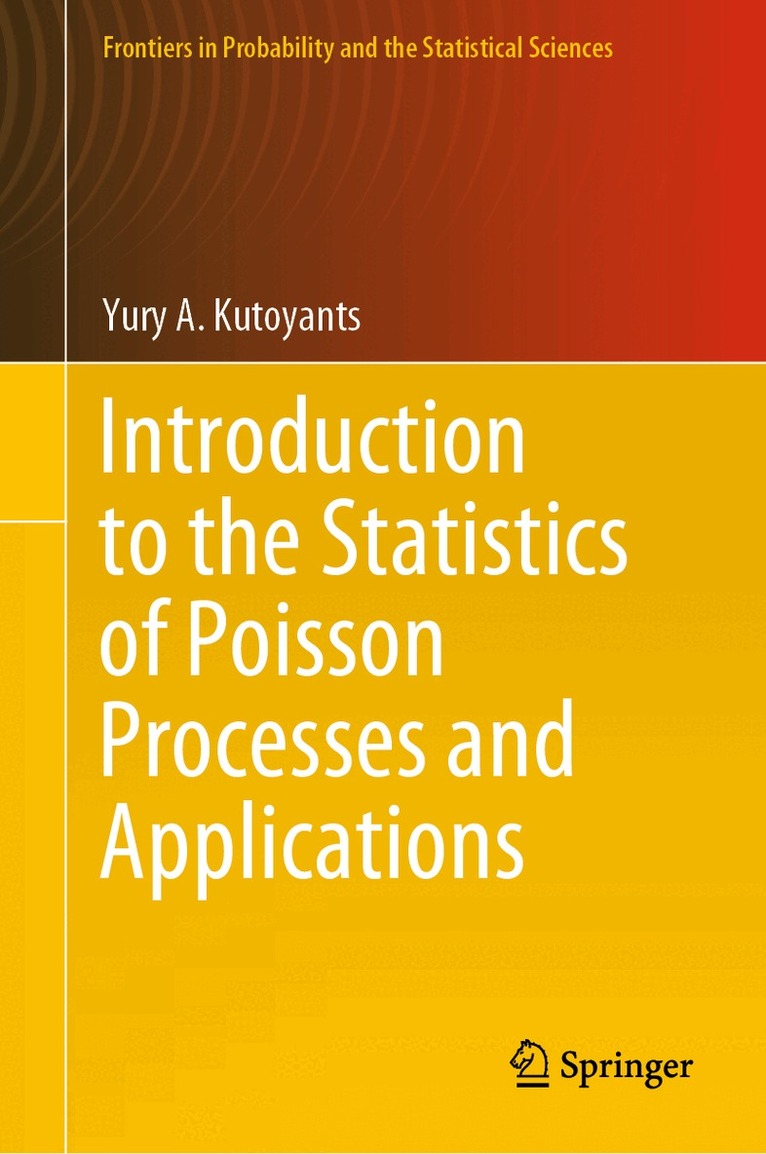
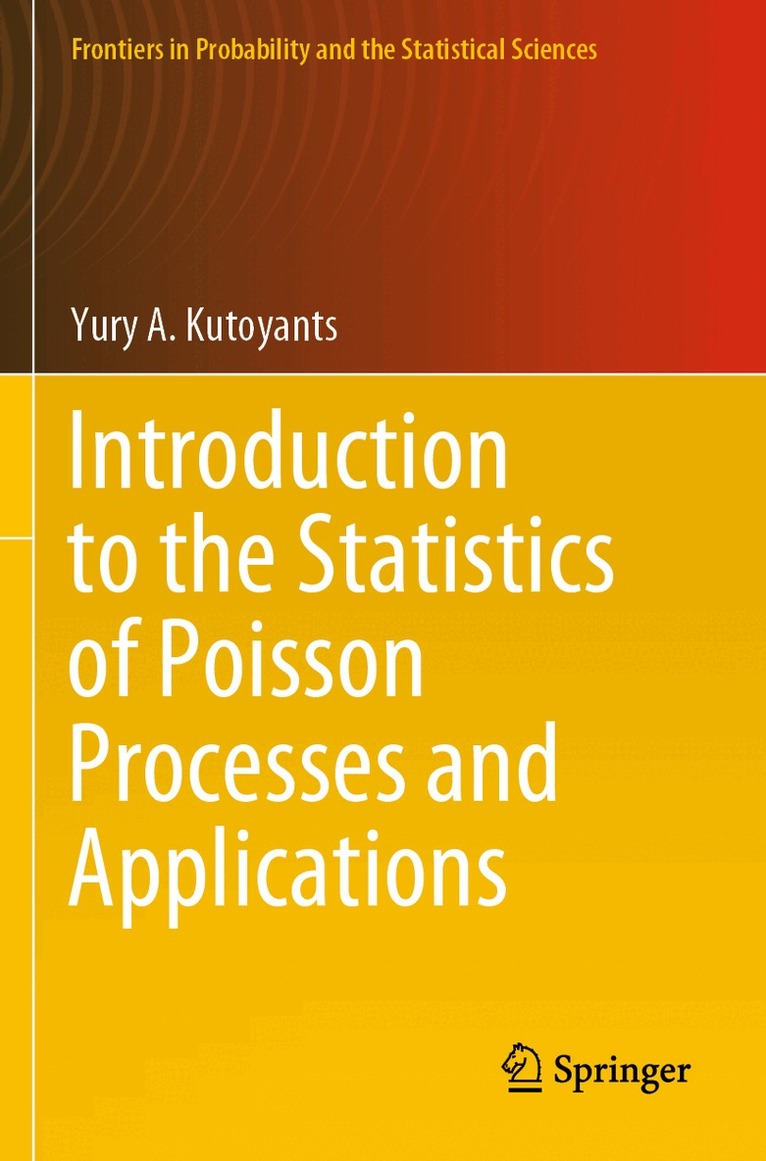
This book covers an extensive class of models involving inhomogeneous Poisson processes and deals with their identification, i.e. the solution of certain estimation or hypothesis testing problems based on the given dataset. These processes are mathematically easy-to-handle and appear in numerous disciplines, including astronomy, biology, ecology, geology, seismology, medicine, physics, statistical mechanics, economics, image processing, forestry, telecommunications, insurance and finance, reliability, queuing theory, wireless networks, and localisation of sources.Beginning with the definitions and properties of some fundamental notions (stochastic integral, likelihood ratio, limit theorems, etc.), the book goes on to analyse a wide class of estimators for regular and singular statistical models. Special attention is paid to problems of change-point type, and in particular cusp-type change-point models, then the focus turns to the asymptotically efficient nonparametric estimation of the mean function, the intensity function, and of some functionals. Traditional hypothesis testing, including some goodness-of-fit tests, is also discussed. The theory is then applied to three classes of problems: misspecification in regularity (MiR),corresponding to situations where the chosen change-point model and that of the real data have different regularity; optical communication with phase and frequency modulation of periodic intensity functions; and localization of a radioactive (Poisson) source on the plane using K detectors.Each chapter concludes with a series of problems, and state-of-the-art references are provided, making the book invaluable to researchers and students working in areas which actively use inhomogeneous Poisson processes.
1 817 kr
Skickas inom 10-15 vardagar
This book covers an extensive class of models involving inhomogeneous Poisson processes and deals with their identification, i.e. the solution of certain estimation or hypothesis testing problems based on the given dataset. These processes are mathematically easy-to-handle and appear in numerous disciplines, including astronomy, biology, ecology, geology, seismology, medicine, physics, statistical mechanics, economics, image processing, forestry, telecommunications, insurance and finance, reliability, queuing theory, wireless networks, and localisation of sources.Beginning with the definitions and properties of some fundamental notions (stochastic integral, likelihood ratio, limit theorems, etc.), the book goes on to analyse a wide class of estimators for regular and singular statistical models. Special attention is paid to problems of change-point type, and in particular cusp-type change-point models, then the focus turns to the asymptotically efficient nonparametric estimation of the mean function, the intensity function, and of some functionals. Traditional hypothesis testing, including some goodness-of-fit tests, is also discussed. The theory is then applied to three classes of problems: misspecification in regularity (MiR),corresponding to situations where the chosen change-point model and that of the real data have different regularity; optical communication with phase and frequency modulation of periodic intensity functions; and localization of a radioactive (Poisson) source on the plane using K detectors.Each chapter concludes with a series of problems, and state-of-the-art references are provided, making the book invaluable to researchers and students working in areas which actively use inhomogeneous Poisson processes.
1 924 kr
Skickas inom 10-15 vardagar
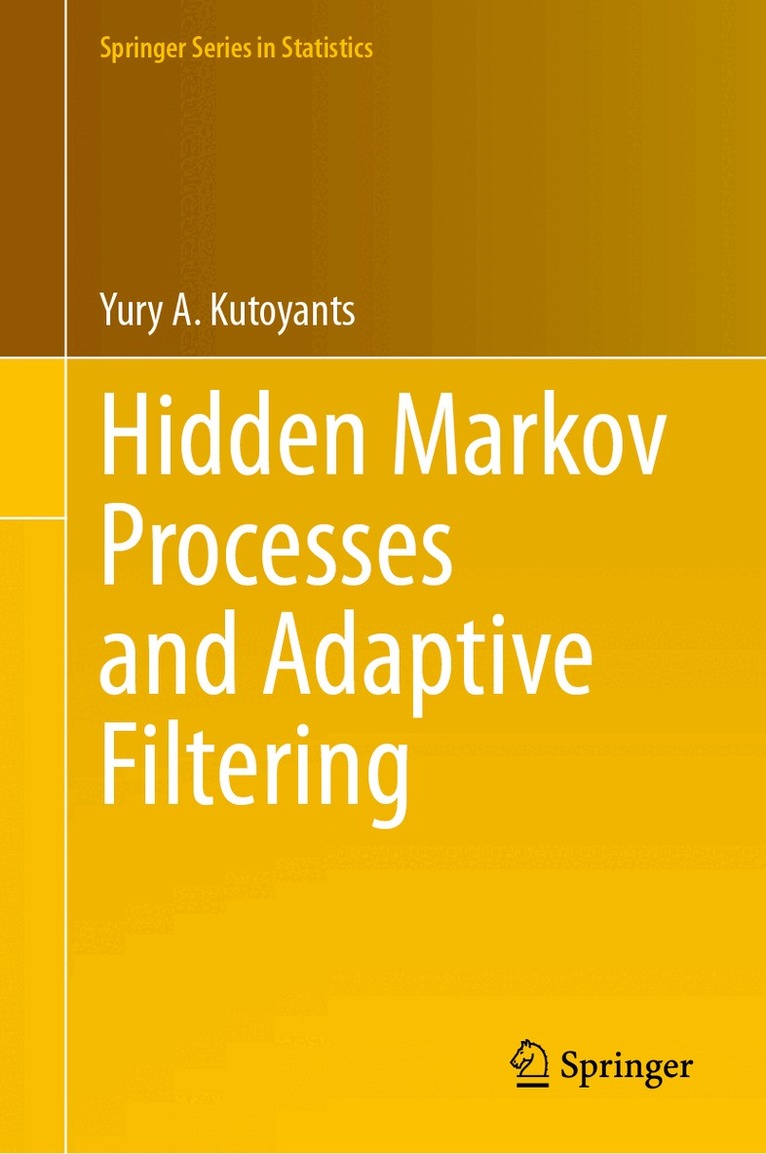
This book is devoted to the problem of adaptive filtering for partially observed systems depending on unknown parameters. Adaptive filters are proposed for a wide variety of models: Gaussian and conditionally Gaussian linear models of diffusion processes; some nonlinear models; telegraph signals in white Gaussian noise (all in continuous time); and autoregressive processes observed in white noise (discrete time). The properties of the estimators and adaptive filters are described in the asymptotics of small noise or large samples. The parameter estimators and adaptive filters have a recursive structure which makes their numerical realization relatively simple. The question of the asymptotic efficiency of the adaptive filters is also discussed. Readers will learn how to construct Le Cam’s One-step MLE for all these models and how this estimator can be transformed into an asymptotically efficient estimator process which has a recursive structure. The last chapter covers several applications of the developed method to such problems as localization of fixed and moving sources on the plane by observations registered by K detectors, estimation of a signal in noise, identification of a security price process, change point problems for partially observed systems, and approximation of the solution of BSDEs.Adaptive filters are presented for the simplest one-dimensional observations and state equations, known initial values, non-correlated noises, etc. However, the proposed constructions can be extended to a wider class of models, and the One-step MLE-processes can be used in many other problems where the recursive evolution of estimators is an important property. The book will be useful for students of filtering theory, both undergraduates (discrete time models) and postgraduates (continuous time models). The method described, preliminary estimator + One-step MLE-process + adaptive filter, will also be of interest to engineers and researchers working with partially observed models.
1 072 kr
Skickas inom 10-15 vardagar
Small noise is a good noise. In this work, we are interested in the problems of estimation theory concerned with observations of the diffusion-type process Xo = Xo, 0 ~ t ~ T, (0. 1) where W is a standard Wiener process and St(') is some nonanticipative smooth t function. By the observations X = {X , 0 ~ t ~ T} of this process, we will solve some t of the problems of identification, both parametric and nonparametric. If the trend S(-) is known up to the value of some finite-dimensional parameter St(X) = St((}, X), where (} E e c Rd , then we have a parametric case. The nonparametric problems arise if we know only the degree of smoothness of the function St(X), 0 ~ t ~ T with respect to time t. It is supposed that the diffusion coefficient c is always known. In the parametric case, we describe the asymptotical properties of maximum likelihood (MLE), Bayes (BE) and minimum distance (MDE) estimators as c --+ 0 and in the nonparametric situation, we investigate some kernel-type estimators of unknown functions (say, StO,O ~ t ~ T). The asymptotic in such problems of estimation for this scheme of observations was usually considered as T --+ 00 , because this limit is a direct analog to the traditional limit (n --+ 00) in the classical mathematical statistics of i. i. d. observations. The limit c --+ 0 in (0. 1) is interesting for the following reasons.