Yves Gambier – författare
Visar alla böcker från författaren Yves Gambier. Handla med fri frakt och snabb leverans.
9 produkter
Chinese Films Abroad
Distribution and Translation
Inbunden, 2024
2586 kr
Lägg i varukorg
This book examines Chinese films made and shown abroad roughly between the 1920s and the 2020s, from the beginning of the international exchange of the Chinese national film industry to the emergence of the concept of soft power.The periodisation of Chinese cinema(s) does not necessarily match the …
Chinese Films Abroad
Distribution and Translation
Häftad, 2025
607 kr
Lägg i varukorg
This book examines Chinese films made and shown abroad roughly between the 1920s and the 2020s, from the beginning of the international exchange of the Chinese national film industry to the emergence of the concept of soft power.The periodisation of Chinese cinema(s) does not necessarily match the …
Chinese Films Abroad
Distribution and Translation
E-bok, 2024
714 kr
Lägg i varukorg
This book examines Chinese films made and shown abroad roughly between the 1920s and the 2020s, from the beginning of the international exchange of the Chinese national film industry to the emergence of the concept of soft power. The periodisation of Chinese cinema(s) does not necessarily match the …
Chinese Films Abroad
Distribution and Translation
E-bok, 2024
693 kr
Lägg i varukorg
This book examines Chinese films made and shown abroad roughly between the 1920s and the 2020s, from the beginning of the international exchange of the Chinese national film industry to the emergence of the concept of soft power. The periodisation of Chinese cinema(s) does not necessarily match the …
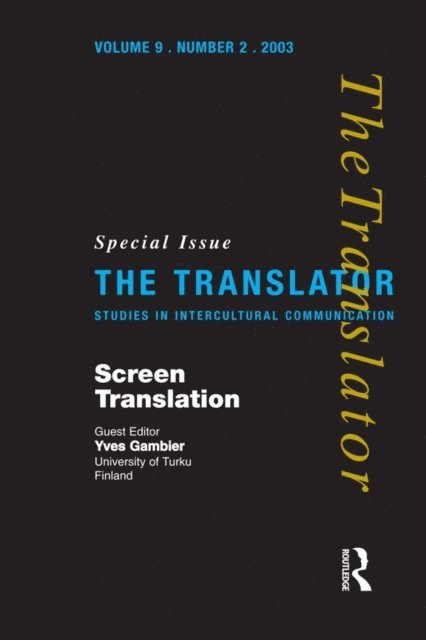
Screen Translation
Special Issue of The Translator (Volume 9/2, 2003)
Av Yves Gambier
E-bok, 2016
874 kr
Lägg i varukorg
There are three fundamental issues in the field of screen translation, namely, the relationship between verbal output and pictures and soundtrack, between a foreign language/culture and the target language/culture, and finally between the spoken code and the written one. All three issues are raised …
Screen Translation
Special Issue of The Translator (Volume 9/2, 2003)
Av Yves Gambier
E-bok, 2016
874 kr
Lägg i varukorg
There are three fundamental issues in the field of screen translation, namely, the relationship between verbal output and pictures and soundtrack, between a foreign language/culture and the target language/culture, and finally between the spoken code and the written one. All three issues are raised …
Screen Translation
Special Issue of The Translator (Volume 9/2, 2003)
Av Yves Gambier
Inbunden, 2017
3156 kr
Lägg i varukorg
There are three fundamental issues in the field of screen translation, namely, the relationship between verbal output and pictures and soundtrack, between a foreign language/culture and the target language/culture, and finally between the spoken code and the written one. All three issues are raised …
Screen Translation
Special Issue of The Translator (Volume 9/2, 2003)
Av Yves Gambier
Häftad, 2003
740 kr
Lägg i varukorg
There are three fundamental issues in the field of screen translation, namely, the relationship between verbal output and pictures and soundtrack, between a foreign language/culture and the target language/culture, and finally between the spoken code and the written one. All three issues are raised …
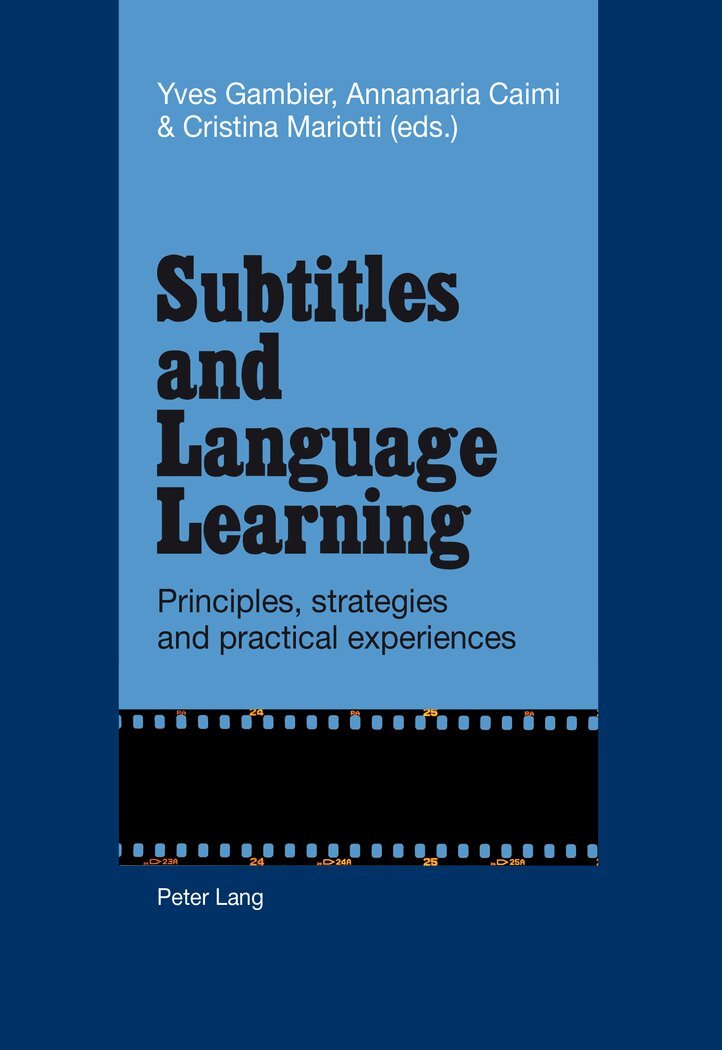
Subtitles and Language Learning
Principles, strategies and practical experiences
Av Annamaria Caimi, Cristina Mariotti m. fl.
Häftad, 2014
2132 kr
Lägg i varukorg
This book is meant to provide a scientific and educational guide for researchers, language professionals and students of applied linguistics. The collected articles incorporate past and recent research on the use of subtitles as foreign language learning tools, and describe some interesting …