
Zelim Skurbaty – författare
Visar alla böcker från författaren Zelim Skurbaty. Handla med fri frakt och snabb leverans.
2 produkter
2 produkter
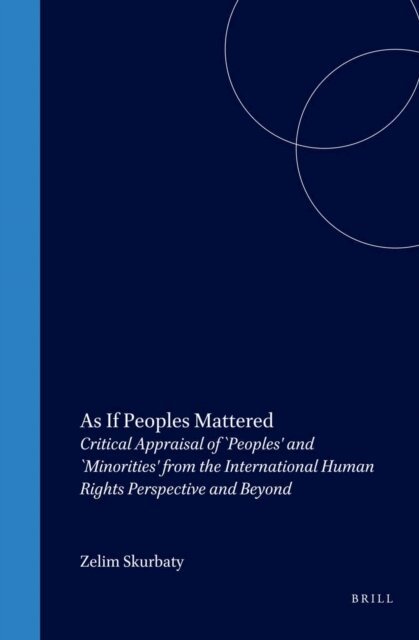
E-bok
PDF, Engelska, 20214 818 kr
Läs direkt efter köp
Ours is an era of decline for the nation state and one of world-wide concern for the problems surrounding sub-state groups: minorities, peoples and indigenous populations. The often violent resurgence of conflicts between these groups and States in even the stable democracies poses a challenge to international law as well as to liberal political principles. In this volume, an expert in international minority rights provides not only significant clarification of the legal issues involved, but also trenchant insights taken from a wide range of humanitarian disciplines: from philosophy and systems theory to neuro-linguistic programming (NLP) and transactional analysis (TA). The result is a meticulously researched book exploring from a variety of perspectives the terms `peoples' and `minorities' in international law as well as relationships between minorities, peoples and indigenous rights, individuation and self-determination. Of special interest is the attempt of the author to explain the existence of double standards in international minority rights (dubbing them `games') with the help of transactional analysis, and to redefine and reframe the basic terms such as `international law', `sovereignty', `self- determination', etc. The straightforward claim of the author is that the proposed theories can help both members of minorities and those in executive positions to gain insights on the cognitive level and make more congruent, community-oriented decisions on the practical level. The book will hold particular appeal for all those interested in the international law of human rights, politics and philosophy, as well as students seeking a multi-disciplinary perspective on these much-debated areas.
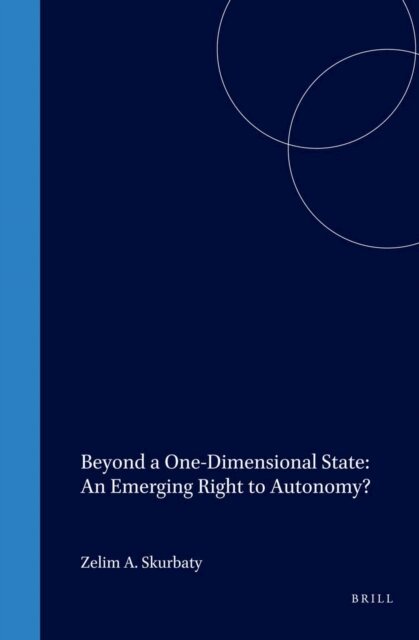
E-bok
PDF, Engelska, 20055 199 kr
Läs direkt efter köp
The beginning of the 21st century is characterized by global structural changes and worldwide concern for the problems surrounding the relationships between states and minority groups. Autonomy has become a code word for an all-purpose means of inclusion of sub-state groups in the three major functions that make for the essence of international law: the allocation of competence, the furtherance of common interest and the maintenance of international peace. Since to be autonomous is to be a law to oneself, and autonomous agents are self-governing agents, the authors of this present volume try give an answer - each from a particular professional perspective- to one overriding question: what conditions must be met in order to ensure that the autonomous agents govern themselves, and govern effectively. With a scholarly attention to analytical precision, factual accuracy, and scrupulous objectivity the authors of the present volume - coming from such diverse fields as international law, philosophy, ethics, economics, political science, - detail and explore the protean character of autonomy as both a concept (autonomy's subtypes, autonomy vs. other arrangements for the diffusion of power within heterogeneous societies, new definitions of the concept, etc.) and a practice (the potential of autonomy in the peaceful resolution of ethnic conflicts; comparative case studies, ranging from Greenland to Eritrea, from the Baltic States to South Asia).For all their differences in background and style, the authors share the common belief that autonomy, if properly understood and applied, holds considerable potential for ensuring an effective and harmonious co-existence for diverse groups within modern states. As such this book will hold particular appeal for all those (students, academics, policymakers, practitioners) who are on a quest for empowering insights vis-a-vis state-minority modus vivendi and ways to mitigate inter-group tensions by compromise.