Zoltán S. Schwáb – författare
Visar alla böcker från författaren Zoltán S. Schwáb. Handla med fri frakt och snabb leverans.
3 produkter
3 produkter
Inbunden, Engelska, 2026
443 kr
Kommande
In the story of the Garden of Eden, God thought it would be a bad idea for Adam and Eve to eat the fruit of the knowledge of good and evil. But they could not resist. Was eating the fruit a good idea? Their newfound knowledge sparked amazing technological and cultural inventions. However, it also enhanced their capacity for deception, betrayal, and violence. Humans became like gods, YHWH declared--but all too often they act like the most capricious and destructive deities ever imagined. It is as if they (we!) were lacking the wisdom necessary for using their divine knowledge well.Another part of the Bible, the Book of Proverbs, likens wisdom to a Tree of Life. The Tree of Life was, of course, the other enchanted tree in the Garden, the one our biblical ancestors did not taste. This volume offers a "Proverbian" interpretation of the Eden story, suggesting that while the Tree of Life represents wisdom, the art of humble dependence, the Tree of the Knowledge of Good and Evil stands for something similar yet distinct: a form of rationality, the power to set goals, solve problems, and claim independence. While the latter is a wonderful ability, without wisdom it becomes a loaded weapon in the hands of humans playing god.Today, our eyes are fixed again on a fruit that promises rational powers of divine proportions: artificial superintelligence. Should we reach out and take it? The ancient story of Eden may teach us a thing or two about our modern-day dilemmas.
Del 7 - Journal of Theological Interpretation Supplements
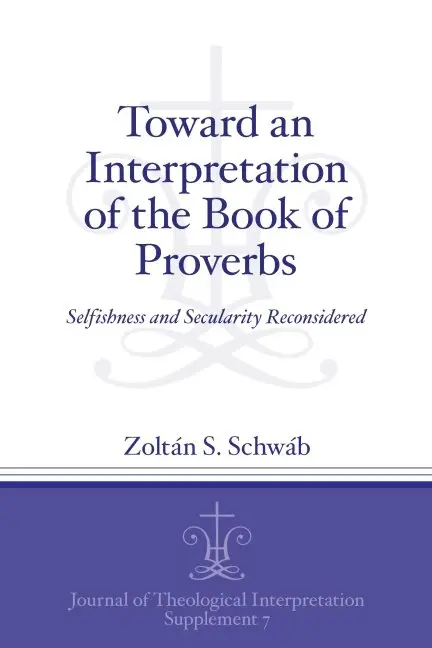
Toward an Interpretation of the Book of Proverbs
Selfishness and Secularity Reconsidered
Häftad, Engelska, 2013
621 kr
Skickas inom 5-8 vardagar
Major religious themes of the Bible, such as election and covenant, are not mentioned in the book of Proverbs. Furthermore, self-interest underlies its motivational system (“you shall behave well, because it will be good for you”). These “selfish” and “secular” features have posed serious ethical and theological challenges for some interpreters, while others have claimed that their presence is only in the eyes of the beholder.After a thorough investigation of the history of Proverbs’ interpretation in the nineteenth and twentieth centuries, Zoltán Schwáb argues that its self-interested and secular nature should not be simply affirmed or dismissed. The question is not whether Proverbs is selfish and secular but in what ways it is selfish and secular and within what conceptual framework one is supposed to interpret these characteristics. In order to construct a proper framework, Schwáb uses such diverse sources as Thomas Aquinas’ theological ethics, modern secularization theories, ancient Near Eastern temple ideology, and the theological tradition of God’s incomprehensibility. The result is a reading that simultaneously reflects on the ancient context of the text and the concerns of its readers in a secular world.
Häftad, Engelska, 2014
179 kr
Skickas inom 5-8 vardagar