Deborah Blincoe – illustratör
Upptäck titlar med illustrationer av Deborah Blincoe.
3 produkter
3 produkter
368 kr
Skickas inom 10-15 vardagar
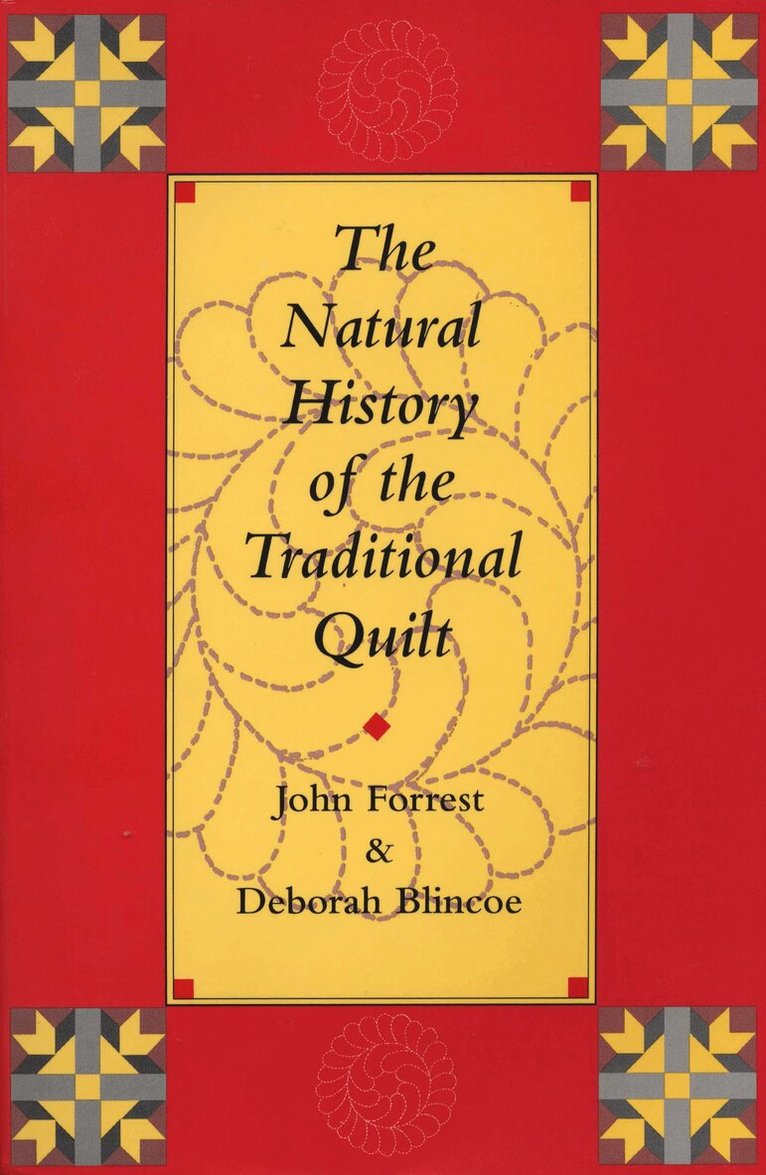
Traditional quilts serve many purposes over the course of a useful life. Beginning as a beautiful bed covering, a quilt may later function as a ground cover at picnics until years of wear relegate it to someone's ragbag for scrap uses.Observing this life cycle led authors John Forrest and Deborah Blincoe to the idea that quilts, like living things, have a natural history that can be studied scientifically. They explore that natural history through an examination of the taxonomy, morphology, behavior, and ecology of quilts in their native environment-the homes of humans who make, use, keep, and bestow them.The taxonomy proposed by Forrest and Blincoe is rooted in the mechanics of replicating quilts so that it can be used to understand evolutionary and genetic relationships between quilt types. The morphology section anatomizes normal and abnormal physical features of quilts, while the section on conception and birth in the life cycle discusses how the underlying processes of replication intersect with environmental factors to produce tangible objects.This methodology is applicable to many kinds of crafts and will be of wide interest to students of folklore, anthropology, and art history. Case studies of traditional quilts and their makers in the Catskills and Appalachia add a warm, human dimension to the book.

635 kr
Skickas inom 10-15 vardagar
Lord I'm Coming Home focuses on a small, white, rural fishing community on the southern reaches of the Great Dismal Swamp in North Carolina. By means of a new kind of anthropological fieldwork, John Forrest seeks to document the entire aesthetic experience of a group of people, showing the aesthetic to be an "everyday experience and not some rarefied and pure behavior reserved for an artistic elite."The opening chapter of the book is a vivid fictional narrative of a typical day in "Tidewater," presented from the perspective of one fisherman. In the following two chapters the author sets forth the philosophical and anthropological foundations of his book, paying particular attention to problems of defining "aesthetic," to methodological concerns, and to the natural landscape of his field site. Reviewing his own experience as both participant and observer, he then describes in scrupulous detail the aesthetic forms in four areas of Tidewater life: home, work, church, and leisure. People use these forms, Forrest shows, to establish personal and group identities, facilitate certain kinds of interactions while inhibiting others, and cue appropriate behavior. His concluding chapter deals with the different life cycles of men and women, insider-outsider relations, secular and sacred domains, the image and metaphor of "home," and the essential role that aesthetics plays in these spheres. The first ethnography to evoke the full aesthetic life of a community, Lord I'm Coming Home will be important reading not only for anthropologists but also for scholars and students in the fields of American studies, art, folklore, and sociology.
261 kr
Skickas inom 10-15 vardagar
Lord I'm Coming Home focuses on a small, white, rural fishing community on the southern reaches of the Great Dismal Swamp in North Carolina. By means of a new kind of anthropological fieldwork, John Forrest seeks to document the entire aesthetic experience of a group of people, showing the aesthetic to be an "everyday experience and not some rarefied and pure behavior reserved for an artistic elite."The opening chapter of the book is a vivid fictional narrative of a typical day in "Tidewater," presented from the perspective of one fisherman. In the following two chapters the author sets forth the philosophical and anthropological foundations of his book, paying particular attention to problems of defining "aesthetic," to methodological concerns, and to the natural landscape of his field site. Reviewing his own experience as both participant and observer, he then describes in scrupulous detail the aesthetic forms in four areas of Tidewater life: home, work, church, and leisure. People use these forms, Forrest shows, to establish personal and group identities, facilitate certain kinds of interactions while inhibiting others, and cue appropriate behavior. His concluding chapter deals with the different life cycles of men and women, insider-outsider relations, secular and sacred domains, the image and metaphor of "home," and the essential role that aesthetics plays in these spheres. The first ethnography to evoke the full aesthetic life of a community, Lord I'm Coming Home will be important reading not only for anthropologists but also for scholars and students in the fields of American studies, art, folklore, and sociology.