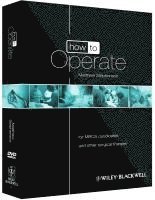
How to Operate
for MRCS candidates and other surgical trainees, includes 3 DVDs
1 178 kr
Tillfälligt slut
Beskrivning
Produktinformation
- Märke:John Wiley and Sons Ltd
- Utgivningsdatum:2011-08-19
- Höjd:140 x 196 x 33 mm
- Vikt:499 g
- Språk:Engelska
- Serie:How to Perform
- Antal sidor:288
- Förlag:John Wiley and Sons Ltd
- EAN:9780470657447
Utforska kategorier
Mer om författaren
Matthew Stephenson is Senior Surgical Registrar within the South East Thames Rotation
Recensioner i media
How to operate for MRCS candidates and other surgical trainees is an exciting addition to the market for the junior surgical trainee. Uniquely combining a DVD and handbook companion, it provides a step by step guide to more than 40 common operations likely to be encountered during core surgical training. The handbook is aided by intra-operative images highlighting the salient anatomy and surgical points. Whilst notionally aimed as a helpful addition to those studying for the Intercollegiate Membership of the Royal College of Surgeons examination this compilation has much more scope than that. With the time constraints on training with the European Working Time Directive (EWTD) the opportunities to have seen, in vivo, a wide range of procedures has become more limited. Therefore, the desire to be fully prepared when attending operating lists has heightened. How to operate provides a solution to this conundrum. Its step by step approach allows the trainee to be, at least, familiar with the techniques surrounding the operation prior to setting foot into theatre.The DVD provides a comprehensively narrated guide to operative practice. With 10 hours of footage and practical advice to the common pitfalls that may be encountered in the operating theatre. Unlike DVDs aimed at Higher Surgical Trainees, How to operate does not profess to show operations without challenges. Rather, it tackles the realities of the situation that one is likely to encounter.This compendium is firmly based at the Core Surgical Trainee. It covers a breath of surgical procedures likely to be covered during the 2 year rotation. These are namely; general, vascular, urology, orthopaedics, upper gastrointestinal, breast, and colorecatal, along with appendices covering basic surgical skills and theatre etiquette.There are inevitably some admissions, for example the lack of neurosurgical or cardiothoracic procedures. Furthermore, certain specialties fare better than others with orthopaedics and ENT covered somewhat more scantily than the general and urology sections of the DVD and book.It is surprising that a similar compilation is not already on the market. Those battling with their surgical exams have utilised Acland’s Anatomy for many years, and whilst their value cannot be negated they are a little dated. Furthermore, How to operate has the added benefit of demonstrating the surgical anatomy as it will be seen in the operating theatre. It will never replace comprehensive operative bibles in the mould of Farquharson’s Textbook of Operative General Surgery but nor does it purport to be. Rather it provides the junior surgical trainee with a firm grounding. On this note, How to operate will have limited benefit for the higher surgical trainee as they will be familiar with the procedures covered in their parent specialty. However, it opens the possibility of further additions to the series focussing on individual surgical specialties aimed at Registrar level trainees. (Captain Neil Shastri-Hurst RAMC MRCS, Queen Elizabeth Hospital, Birmingham) “This is a unique and useful addition to the bookshelves (and DVD players) of those progressing through basic surgical training. Detailed step-by-step videos of common operations are each accompanied by a chapter in the book detailing the procedural steps, coupled with operative pictures, radiographs and anatomical diagrams to illustrate the important learning points.The videos provide a clearly narrated guide to operative practice, pitched for the junior trainee starting out in the operating theatre. The narration tackles the realities of operations and their difficulties with useful tips and a common sense, occasionally humorous approach not found in more senior and specialist titles that often seem to present a more polished version of reality than one encounters in your own operating theatre. The procedures videoed cover the breadth of a typical core surgical training rotation, including general, vascular, urological, orthopaedic, upper gastrointestinal, ENT, breast, and colorectal procedures. For example, within upper gastrointestinal surgery the videos feature gastrectomy, splenectomy, gastrojejunostomy, open cholecystectomy, and thoracotomy. It is perhaps surprising that no-one has already put such a training package together. Many have used Acland’s anatomy DVDs for MRCS revision, and although sub-specialist operative training DVDs do exist these are limited in scope and are prohibitively expensive.It must surely have been a labour of love to assemble and edit these training videos all together, and the author and production team are to be congratulated on bringing this to life as well as they have. In the modern multimedia age this could well become as essential as Kirk’s seminal text on basic surgical techniques was to previous generations climbing the slippery surgical ladder.Given the broad coverage of disparate specialties, from orthopaedics to urology, the package will perhaps have limited interest to more senior trainees and one wonders whether dedicated editions featuring each of the nine surgical specialties will be forthcoming in future. Certainly there would be demand for this. Similarly, the level of the accompanying book is no replacement for operative surgery bibles such as Farquharson's or Kirk’s, but neither does it set out to be.Overall, many surgical trainees at the core/senior house office/resident level will find [this] greatly beneficial to their training." (Ed Fitzgerald MRCS, Specialist Registrar, General Surgery, The Royal Marsden Hospital, London)
Innehållsförteckning
- List of Contributors Foreword by John Black, President of the Royal College of SurgeonsPrefaceGeneral1 Inguinal Hernia Repair2 Split Skin Graft3 Femoral Hernia Repair4 Incision and Drainage of Abscess5 Wedge Resection for Ingrown Toenail6 Paraumbilical and Umbilical Hernia Repair7 Appendicectomy8 Establishing a Pneumoperitoneum9 LaparotomyVascular10 Long Saphenous Vein Stripping11 Short Saphenous Vein Ligation12 Abdominal Aortic Aneurysm Repair13 Below Knee Amputation14 Carotid Endarterectomy15 Temporal Artery Biopsy16 Femorodistal Bypass17 Brachiocephalic FistulaUrology18 Scrotal Exploration19 Vasectomy20 Circumcision21 NephrectomyOrthopaedics22 Dynamic Hip Screw23 Hip Hemiarthroplasty24 Carpal Tunnel DecompressionUpper Gastrointestinal25 Gastrectomy26 Splenectomy27 Gastrojejunostomy28 Open Cholecystectomy29 ThoracotomyBreast30 Mastectomy,31 Wide Local Excision32 Axillary Node Clearance33 FibroadenomaEar, Nose and Throat34 Thyroidectomy35 TracheostomyColorectal36 Haemorrhoidectomy37 Colostomy and Other Stomas38 Small Bowel Resection and Anastomosis39 Excision of Pilonidal Sinus40 Right HemicolectomyAppendices41 Surgical Instruments42 Sutures43 Patient Safety and the WHO Surgical Checklist44 Theatre Etiquette45 How to Write the Operation Note46 ConsentIndex
Mer från samma serie
How to Perform Operative Procedures in Obstetrics and Gynaecology
Wai Yoong, Abha Govind, Wasim Lodhi
705 kr
How to Perform Operative Procedures in Breast Surgery
Dhananjay Kulkarni, Kenneth J. Elder, Cameron Raine, J. Michael Dixon
Häftad, 2026
750 kr
Du kanske också är intresserad av
How to Perform Operative Procedures in Obstetrics and Gynaecology
Wai Yoong, Abha Govind, Wasim Lodhi
705 kr
How to Perform Operative Procedures in Breast Surgery
Dhananjay Kulkarni, Kenneth J. Elder, Cameron Raine, J. Michael Dixon
Häftad, 2026
750 kr