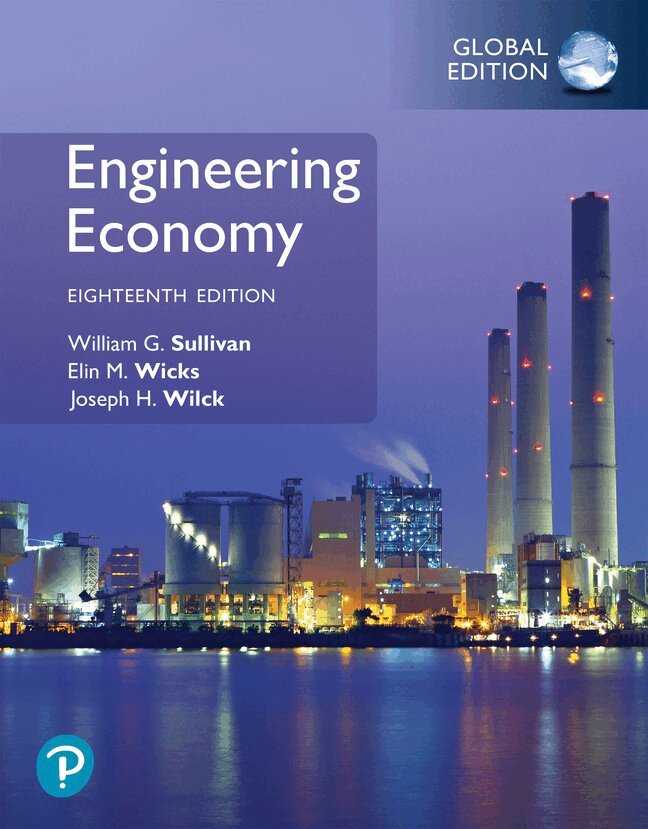
Engineering Economy, Global Edition -- MyLab Engineering with Pearson eText Access Code
845 kr
Beställningsvara. Skickas inom 7-10 vardagar. Fri frakt över 249 kr.
Produktinformation
- Utgivningsdatum:2025-08-22
- Höjd:126 x 165 x 1 mm
- Vikt:7 g
- Språk:Engelska
- Antal sidor:4
- Upplaga:18
- Förlag:Pearson Education
- EAN:9781292725871
Utforska kategorier
Mer om författaren
About our authors Dr. William G. Sullivan earned his PhD from the Georgia Institute of Technology in Industrial and Systems Engineering. In his more than 40 years of service to industry and the academy, he made enduring contributions to engineering economy education. A tireless lecturer, he taught engineering economy to more than 10,000 students at 5 major universities (Georgia Tech, University of Tennessee, North Carolina State University, Arizona State University and Virginia Tech). He also had extensive consulting experience with 25 firms in the US. Dr. Sullivan's 5 textbooks in the field, including Engineering Economy, continue to contribute to the education of thousands of students.Elin M. Wicks is the owner of Abacus Accounting LLC, an accounting and bookkeeping company focused on empowering small business owners to achieve financial success. She earned a BS and MS in Industrial Engineering from Rutgers University, where her masters research focused on a method of quantifying non-economic factors in monetary terms. During this time, she also developed software tools to assist Cosmair Inc. in improving scheduling and labor recording practices. She went on to earn her PhD in Industrial and Systems Engineering from Virginia Tech, focusing on the design of cellular manufacturing systems. She then joined the faculty of the University of Missouri, Columbia in the Industrial and Manufacturing Systems Department. After taking some time off to raise her children, she supplemented her education in the field of accounting and became the Senior Accountant of Glenn B. Cohen, CPA, an accounting and financial management firm. She has been an author of Engineering Economy since the publication of the 10th edition. Joseph Wilck is an analytics and operations faculty member at Bucknell University. Dr. Wilck received his PhD in Industrial Engineering and Operations Research from Pennsylvania State University, and an MS and BS in Industrial and Systems Engineering from Virginia Tech. He conducts research in applied optimization, data science, and analytics. Prior to joining Bucknell University, he was on faculty at William & Mary, United States Air Force Academy, East Carolina University, and the University of Tennessee. Dr. Wilck is a Program Evaluator for ABET and a licensed Professional Engineer in North Carolina. Dr. Wilck is an active member and Fellow of the American Society for Engineering Management and an active member of the Institute of Industrial and Systems Engineers, the Institute for Operations Research and the Management Sciences, and the American Society for Engineering Education.
Innehållsförteckning
- 1. Introduction to Engineering Economy 1.1 Introduction1.2 The Principles of Engineering Economy1.3 Engineering Economy and the Design Process1.4 Using Spreadsheets in Engineering Economy1.5 Try Your Skills1.6 Summary2. Cost Concepts and Design Economics 2.1 Cost Terminology2.2 The General Economic Environment2.3 Cost-Driven Design Optimization2.4 Present Economy Studies2.5 Case Study: The Economics of Daytime Running Lights2.6 Value Engineering2.7 In-Class Exercise2.8 Try Your Skills2.9 Summary3. Cost-Estimation Techniques 3.1 Introduction3.2 An Integrated Approach3.3 Selected Estimating Techniques (Models)3.4 Parametric Cost Estimating3.5 Case Study: Electric Vehicle Battery Recovery3.6 Electronic Spreadsheet Modeling: Learning Curve3.7 In-Class Exercise3.8 Try Your Skills3.9 Summary4. The Time Value of Money 4.1 Introduction4.2 Simple Interest4.3 Compound Interest4.4 The Concept of Equivalence4.5 Notation and Cash-Flow Diagrams and Tables4.6 Relating Present and Future Equivalent Values of Single Cash Flows4.7 Relating a Uniform Series (Annuity) to Its Present and Future Equivalent Values4.8 Summary of Interest Formulas and Relationships for Discrete Compounding4.9 Deferred Annuities (Uniform Series)4.10 Equivalence Calculations Involving Multiple Interest Formulas4.11 Uniform (Arithmetic) Gradient of Cash Flows4.12 Geometric Sequences of Cash Flows4.13 Interest Rates that Vary with Time4.14 Nominal and Effective Interest Rates4.15 Compounding More Often than Once per Year4.16 Interest Formulas for Continuous Compounding and Discrete Cash Flows4.17 Case Study: Understanding Economic Equivalence4.18 In-Class Exercise4.19 Try Your Skills4.20 Summary5. Evaluating a Single Project 5.1 Introduction5.2 Determining the Minimum Attractive Rate of Return (MARR)5.3 The Present Worth Method5.4 The Future Worth Method5.5 The Annual Worth Method5.6 The Internal Rate of Return Method5.7 The External Rate of Return Method5.8 The Payback (Payout) Period Method5.9 Case Study: Data Center Establishment Project5.10 Electronic Spreadsheet Modeling: Payback Period Method5.11 In-Class Exercise5.12 Try Your Skills5.13 SummaryAppendix 5-A The Multiple Rate of Return Problem with the IRR Method6. Comparison and Selection among Alternatives 6.1 Introduction6.2 Basic Concepts for Comparing Alternatives6.3 The Study (Analysis) Period6.4 Useful Lives Are Equal to the Study Period6.5 Useful Lives Are Unequal among the Alternatives6.6 Personal Finances6.7 Case Study: Ned and Larry’s Ice Cream Company6.8 Postevaluation of Results6.9 Project Postevaluation Spreadsheet Approach6.10 In-Class Exercise6.11 Try Your Skills6.12 Summary7. Depreciation and Income Taxes 7.1 Introduction7.2 Depreciation Concepts and Terminology7.3 The Classical (Historical) Depreciation Methods7.4 The Modified Accelerated Cost Recovery System7.5 A Comprehensive Depreciation Example7.6 Introduction to Income Taxes7.7 The Effective Corporate Income Tax Rate7.8 Gain (Loss) on the Disposal of an Asset7.9 General Procedure for Making After-Tax Economic Analyses7.10 Illustration of Computations of ATCFs7.11 Economic Value Added7.12 In-Class Exercise7.13 Try Your Skills7.14 Summary8. Price Changes and Exchange Rates 8.1 Introduction8.2 Terminology and Basic Concepts8.3 Fixed and Responsive Annuities8.4 Differential Price Changes8.5 Spreadsheet Application8.6 Global Exchange Rates and Purchasing Power Concepts8.7 Case Study: Selecting Electric Motors to Power an Assembly Line8.8 In-Class Exercise8.9 Try Your Skills8.10 Summary9. Replacement Analysis 9.1 Introduction9.2 Reasons for Replacement Analysis9.3 Factors that Must Be Considered in Replacement Studies9.4 Typical Replacement Problems9.5 Determining the Economic Life of a New Asset (Challenger)9.6 Determining the Economic Life of a Defender9.7 Comparisons in Which the Defender’s Useful Life Differs from that of the Challenger9.8 Retirement without Replacement (Abandonment)9.9 After-Tax Replacement Studies9.10 Case Study: Replacement of a Hospital’s Emergency Electrical Supply System9.11 In-Class Exercise9.12 Try Your Skills9.13 Summary10. Evaluating Projects with the Benefit−Cost Ratio Method 10.1 Introduction10.2 Perspective and Terminology for Analyzing Public Projects10.3 Self-Liquidating Projects10.4 Multiple-Purpose Projects10.5 Difficulties in Evaluating Public-Sector Projects10.6 What Interest Rate Should Be Used for Public Projects?10.7 The Benefit−Cost Ratio Method10.8 Evaluating Independent Projects by B−C Ratios10.9 Comparison of Mutually Exclusive Projects by B−C Ratios10.10 Case Study: Rural Broadband Internet Expansion10.11 Try Your Skills10.12 Summary11. Breakeven and Sensitivity Analysis 11.1 Introduction11.2 Breakeven Analysis11.3 Sensitivity Analysis11.4 Multiple Factor Sensitivity Analysis11.5 CASE STUDY: If You Build It, They Will Come11.6 Try Your Skills11.7 Summary12. Probabilistic Risk Analysis 12.1 Introduction12.2 Sources of Uncertainty12.3 The Distribution of Random Variables12.4 Evaluation of Projects with Discrete Random Variables12.5 Evaluation of Projects with Continuous Random Variables12.6 Evaluation of Risk and Uncertainty by Monte Carlo Simulation12.7 Performing Monte Carlo Simulation with a Computer12.8 Decision Trees12.9 Real Options Analysis12.10 CASE STUDY: Retirement Balance12.11 Summary13. The Capital Budgeting Process 13.1 Introduction13.2 Debt Capital13.3 Equity Capital13.4 The Weighted Average Cost of Capital (WACC)13.5 Project Selection13.6 Postmortem Review13.7 Budgeting of Capital Investments and Management Perspective13.8 Leasing Decisions13.9 Capital Allocation13.10 Summary14. Decision Making Considering Multiattributes 14.1 Introduction14.2 Examples of Multiattribute Decisions14.3 Choice of Attributes14.4 Selection of a Measurement Scale14.5 Dimensionality of the Problem14.6 Noncompensatory Models14.7 Compensatory Models14.8 SummaryAppendices A. Accounting FundamentalsB. Abbreviations and NotationC. Interest and Annuity Tables for Discrete CompoundingD. Interest and Annuity Tables for Continuous CompoundingE. Standard Normal DistributionF. Selected ReferencesG. Solutions to Try Your SkillsH. Answers to Selected ProblemsIndex
Mer från samma författare
Address to the Members of the Bar of Suffolk, Mass. at Their Stated Meeting on the First Tuesday of March, 1824.
William Sullivan
213 kr
Address to the Members of the Bar of Suffolk, Mass. at Their Stated Meeting on the First Tuesday of March, 1824.
William Sullivan
238 kr
Oration Delivered Before the Washington Benevolent Society of Massachusetts on the Thirtieth Day of April, 1812
William Sullivan
212 kr
Discourse, Delivered Before the Massachusetts Society for the Suppression of Intemperance, May 23, 1832.
William Sullivan
238 kr
Du kanske också är intresserad av
Engineering Economy, Global Edition -- MyLab Engineering with Pearson eText (ACC)
William Sullivan, Elin Wicks, C Koelling
819 kr
Engineering Economy, Global Edition plus Pearson MyLab Engineering with Pearson eText (Package)
William Sullivan, Elin Wicks, C Koelling
1 275 kr
A Discourse Delivered Before The Pilgrim Society, At Plymouth, On December, 22, 1829 (1830)
William Sullivan
361 kr
Familiar Letters on Public Characters, and Public Events: From the Peace of 1783, to the Peace of 1815.
William Sullivan
413 kr
Oration Delivered Before the Washington Benevolent Society of Massachusetts on the Thirtieth Day of April, 1812
William Sullivan
212 kr