
Visar resultat för..."Blå november"
Sökningen "Blå november Carl Mangård" gav inga träffar.6 produkter
6 produkter
Inbunden, Engelska, 2026
2 156 kr
Skickas inom 10-15 vardagar
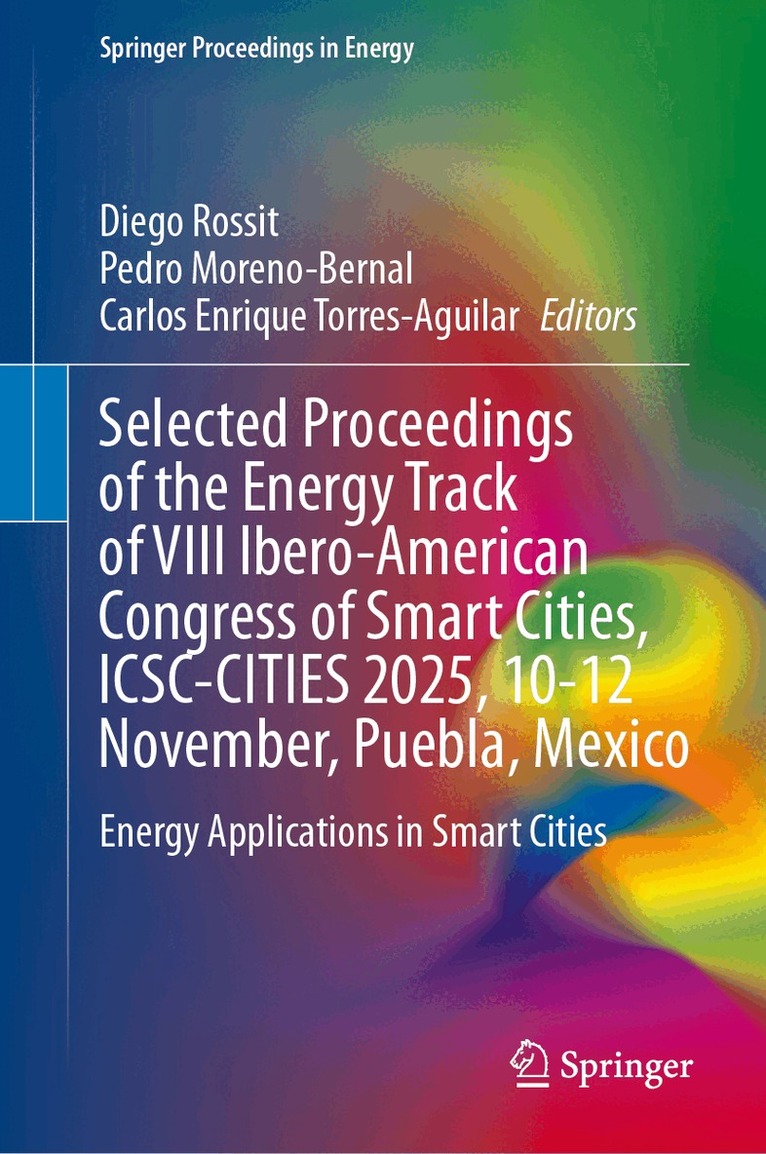
This book compiles high-quality selected papers from the VIII Ibero-American Congress of Smart Cities (ICSC-CITIES 2025), a leading event in the field of smart urban development. Smart cities are a response to the increasingly urgent need to reorient our lives towards sustainability. In an era of rapid urbanization and growing environmental challenges, these cities are designed to optimize resources, reduce environmental impact, and enhance the overall quality of life for their citizens. By leveraging advanced infrastructure, innovative solutions, and cutting-edge technology, smart cities aim to create more efficient, resilient, and livable urban environments. Within this framework, energy plays a pivotal role in enhancing the sustainability and functionality of our cities. The papers explore a wide range of topics, including smart grids, electric systems, energy efficiency, urban mobility, environmental monitoring, and other areas critical to the development of sustainable cities. The insights and research presented in this book contribute to the ongoing dialogue on how cities can better serve their populations while addressing the challenges of climate change, resource management, and technological integration. ICSC-CITIES 2025 takes place on November 10–12, 2025, in the vibrant city of Puebla, Mexico. As the eighth edition of the Ibero-American Congress of Smart Cities, this conference continues to be a key platform for academics, professionals, and policymakers to share knowledge, exchange ideas, and collaborate on the future of urban living. Authors invite the academic community and industry experts to engage in discussions and contribute to shaping the energy-related aspects and overall development of the cities of tomorrow.

2 840 kr
Läs direkt efter köp
This book compiles high-quality selected papers from the VIII Ibero-American Congress of Smart Cities (ICSC-CITIES 2025), a leading event in the field of smart urban development. Smart cities are a response to the increasingly urgent need to reorient our lives towards sustainability. In an era of rapid urbanization and growing environmental challenges, these cities are designed to optimize resources, reduce environmental impact, and enhance the overall quality of life for their citizens. By leveraging advanced infrastructure, innovative solutions, and cutting-edge technology, smart cities aim to create more efficient, resilient, and livable urban environments. Within this framework, energy plays a pivotal role in enhancing the sustainability and functionality of our cities. The papers explore a wide range of topics, including smart grids, electric systems, energy efficiency, urban mobility, environmental monitoring, and other areas critical to the development of sustainable cities. The insights and research presented in this book contribute to the ongoing dialogue on how cities can better serve their populations while addressing the challenges of climate change, resource management, and technological integration. ICSC-CITIES 2025 takes place on November 10–12, 2025, in the vibrant city of Puebla, Mexico. As the eighth edition of the Ibero-American Congress of Smart Cities, this conference continues to be a key platform for academics, professionals, and policymakers to share knowledge, exchange ideas, and collaborate on the future of urban living. Authors invite the academic community and industry experts to engage in discussions and contribute to shaping the energy-related aspects and overall development of the cities of tomorrow.
Inbunden, Engelska, 2011
2 257 kr
Skickas inom 10-15 vardagar
This book examines the crime-terror nexus in South Asia, focusing in particular on the activities of non-state actors that operate out of Pakistan, and challenges the conventional wisdom that the Pakistan Taleban (TTP) and Al-Qaeda are Pakistan’s most serious security threats.Much research has focused on the policies of India and Pakistan towards Kashmir. But surprisingly little attention has been paid to several notable Pakistan-based non-state actors who are increasingly operating on their own, and who have the potential to greatly inhibit, if not derail, the peace process there. These groups blur the line between terrorism and organized crime with serious implications for policy in the region. India and Pakistan can engage in confidence-building measures, but if criminal actors such as Lashkar-i-Taiba (LeT) and D-Company cannot effectively be controlled, a lack of trust between both sides will remain. Although the role of regular military forces is not to be discounted, many of the non-state actors in Indian-Held Kashmir, such as LeT, are not confined by the same restraints as state forces, thus allowing them engage in more violent actions without fear of reprisal. In order for lawmakers, security personnel, and others to develop sound, comprehensive policies, these forces and their potential to undermine political initiatives must be fully appreciated. This book explores the dynamics of the relationship between Pakistan, D-Company, and LeT and how it affects strategic thought, decision-making, and security interests in the region and explains the triangular relationships between states, terrorist groups, and organized criminal syndicates in general, and in India and Pakistan in particular. This book will of much interest to students of South Asian politics, terrorism, organised crime, war and conflict studies, and Security Studies in general.
Häftad, Engelska, 2013
696 kr
Skickas inom 10-15 vardagar
This book examines the crime-terror nexus in South Asia, focusing in particular on the activities of non-state actors that operate out of Pakistan, and challenges the conventional wisdom that the Pakistan Taleban (TTP) and Al-Qaeda are Pakistan’s most serious security threats.Much research has focused on the policies of India and Pakistan towards Kashmir. But surprisingly little attention has been paid to several notable Pakistan-based non-state actors who are increasingly operating on their own, and who have the potential to greatly inhibit, if not derail, the peace process there. These groups blur the line between terrorism and organized crime with serious implications for policy in the region. India and Pakistan can engage in confidence-building measures, but if criminal actors such as Lashkar-i-Taiba (LeT) and D-Company cannot effectively be controlled, a lack of trust between both sides will remain. Although the role of regular military forces is not to be discounted, many of the non-state actors in Indian-Held Kashmir, such as LeT, are not confined by the same restraints as state forces, thus allowing them engage in more violent actions without fear of reprisal. In order for lawmakers, security personnel, and others to develop sound, comprehensive policies, these forces and their potential to undermine political initiatives must be fully appreciated. This book explores the dynamics of the relationship between Pakistan, D-Company, and LeT and how it affects strategic thought, decision-making, and security interests in the region and explains the triangular relationships between states, terrorist groups, and organized criminal syndicates in general, and in India and Pakistan in particular. This book will of much interest to students of South Asian politics, terrorism, organised crime, war and conflict studies, and Security Studies in general.
E-bok
Engelska, 2011774 kr
Läs direkt efter köp
This book examines the crime-terror nexus in South Asia, focusing in particular on the activities of non-state actors that operate out of Pakistan, and challenges the conventional wisdom that the Pakistan Taleban (TTP) and Al-Qaeda are Pakistan’s most serious security threats.Much research has focused on the policies of India and Pakistan towards Kashmir. But surprisingly little attention has been paid to several notable Pakistan-based non-state actors who are increasingly operating on their own, and who have the potential to greatly inhibit, if not derail, the peace process there. These groups blur the line between terrorism and organized crime with serious implications for policy in the region. India and Pakistan can engage in confidence-building measures, but if criminal actors such as Lashkar-i-Taiba (LeT) and D-Company cannot effectively be controlled, a lack of trust between both sides will remain. Although the role of regular military forces is not to be discounted, many of the non-state actors in Indian-Held Kashmir, such as LeT, are not confined by the same restraints as state forces, thus allowing them engage in more violent actions without fear of reprisal. In order for lawmakers, security personnel, and others to develop sound, comprehensive policies, these forces and their potential to undermine political initiatives must be fully appreciated. This book explores the dynamics of the relationship between Pakistan, D-Company, and LeT and how it affects strategic thought, decision-making, and security interests in the region and explains the triangular relationships between states, terrorist groups, and organized criminal syndicates in general, and in India and Pakistan in particular. This book will of much interest to students of South Asian politics, terrorism, organised crime, war and conflict studies, and Security Studies in general.
E-bok
PDF, Engelska, 2011774 kr
Läs direkt efter köp
This book examines the crime-terror nexus in South Asia, focusing in particular on the activities of non-state actors that operate out of Pakistan, and challenges the conventional wisdom that the Pakistan Taleban (TTP) and Al-Qaeda are Pakistan’s most serious security threats.Much research has focused on the policies of India and Pakistan towards Kashmir. But surprisingly little attention has been paid to several notable Pakistan-based non-state actors who are increasingly operating on their own, and who have the potential to greatly inhibit, if not derail, the peace process there. These groups blur the line between terrorism and organized crime with serious implications for policy in the region. India and Pakistan can engage in confidence-building measures, but if criminal actors such as Lashkar-i-Taiba (LeT) and D-Company cannot effectively be controlled, a lack of trust between both sides will remain. Although the role of regular military forces is not to be discounted, many of the non-state actors in Indian-Held Kashmir, such as LeT, are not confined by the same restraints as state forces, thus allowing them engage in more violent actions without fear of reprisal. In order for lawmakers, security personnel, and others to develop sound, comprehensive policies, these forces and their potential to undermine political initiatives must be fully appreciated. This book explores the dynamics of the relationship between Pakistan, D-Company, and LeT and how it affects strategic thought, decision-making, and security interests in the region and explains the triangular relationships between states, terrorist groups, and organized criminal syndicates in general, and in India and Pakistan in particular. This book will of much interest to students of South Asian politics, terrorism, organised crime, war and conflict studies, and Security Studies in general.