American Institutions and Society – serie
Visar alla böcker i serien American Institutions and Society. Handla med fri frakt och snabb leverans.
11 produkter
11 produkter
Inbunden, Engelska, 2010
609 kr
Skickas inom 10-15 vardagar
From 1963 to 1965 roughly 6,000 families moved into Rochdale Village, at the time the world's largest housing cooperative, in southeastern Queens County. The moderate-income cooperative attracted families from a diverse background, white and black, to what was a predominantly black neighborhood. In its early years, Rochdale was widely hailed as one of the few successful large-scale efforts to create an integrated community in New York City or, for that matter, anywhere in the United States. Rochdale was built by the United Housing Foundation. Its president, Abraham Kazan, had been the major builder of low-cost cooperative housing in New York City for decades. His partner in many of these ventures was Robert Moses. Their work together was a marriage of opposites: Kazan's utopian-anarchist strain of social idealism with its roots in the early twentieth century Jewish labor movement combined with Moses's hardheaded, no-nonsense pragmatism. Peter Eisenstadt recounts the history of Rochdale Village's first years, from the controversies over its planning, to the civil rights demonstrations at its construction site in 1963, through the late 1970s, tracing the rise and fall of integration in the cooperative. (Today, although Rochdale is no longer integrated, it remains a successful and vibrant cooperative that is a testament to the ideals of its founders and the hard work of its residents.) Rochdale's problems were a microcosm of those of the city as a whole—troubled schools, rising levels of crime, fallout from the disastrous teachers' strike of 1968, and generally heightened racial tensions. By the end of the 1970s few white families remained. Drawing on exhaustive archival research, extensive interviews with the planners and residents, and his own childhood experiences growing up in Rochdale Village, Eisenstadt offers an insightful and engaging look at what it was like to live in Rochdale and explores the community's place in the postwar history of America's cities and in the still unfinished quests for racial equality and affordable urban housing.
Inbunden, Engelska, 2013
494 kr
Skickas inom 10-15 vardagar
During the height of the wars in Iraq and Afghanistan, the Pentagon launched a controversial counterinsurgency program called the Human Terrain System. The program embedded social scientists within military units to provide commanders with information about the cultures and grievances of local populations. Yet the controversy it inspired was not new. Decades earlier, similar national security concerns brought the Department of Defense and American social scientists together in the search for intellectual weapons that could combat the spread of communism during the Cold War. In Armed with Expertise, Joy Rohde traces the optimistic rise, anguished fall, and surprising rebirth of Cold War–era military-sponsored social research. Seeking expert knowledge that would enable the United States to contain communism, the Pentagon turned to social scientists. Beginning in the 1950s, political scientists, social psychologists, and anthropologists optimistically applied their expertise to military problems, convinced that their work would enhance democracy around the world. As Rohde shows, by the late 1960s, a growing number of scholars and activists condemned Pentagon-funded social scientists as handmaidens of a technocratic warfare state and sought to eliminate military-sponsored research from American intellectual life. But the Pentagon's social research projects had remarkable institutional momentum and intellectual flexibility. Instead of severing their ties to the military, the Pentagon's experts relocated to a burgeoning network of private consulting agencies and for-profit research offices. Now shielded from public scrutiny, they continued to influence national security affairs. They also diversified their portfolios to include the study of domestic problems, including urban violence and racial conflict. In examining the controversies over Cold War social science, Rohde reveals the persistent militarization of American political and intellectual life, a phenomenon that continues to raise grave questions about the relationship between expert knowledge and American democracy.
Inbunden, Engelska, 2018
682 kr
Skickas inom 10-15 vardagar
In the critically acclaimed La Fin de la Pauverté?, Romain D. Huret identifies a network of experts who were dedicated to the post-World War II battle against poverty in the United States. John Angell's translation of Huret's work brings to light for an English-speaking audience this critical set of intellectuals working in federal government, academic institutions, and think tanks. Their efforts to create a policy bureaucracy to support federal socio-economic action spanned from the last days of the New Deal to the late 1960s when President Richard M. Nixon implemented the Family Assistance Plan. Often toiling in obscurity, this cadre of experts waged their own war not only on poverty but on the American political establishment. Their policy recommendations, as Huret clearly shows, often militated against the unscientific prejudices and electoral calculations that ruled Washington D.C. politics.The Experts' War on Poverty highlights the metrics, research, and economic and social facts these social scientists employed in their work, and thereby reveals the unstable institutional foundation of successive executive efforts to grapple with gross social and economic disparities in the United States. Huret argues that this internal war, coming at a time of great disruption due to the Cold War, undermined and fractured the institutional system officially directed at ending poverty. The official War on Poverty, which arguably reached its peak under President Lyndon B. Johnson, was thus fomented and maintained by a group of experts determined to fight poverty in radical ways that outstripped both the operational capacity of the federal government and the political will of a succession of presidents.
Inbunden, Engelska, 2013
369 kr
Skickas inom 10-15 vardagar
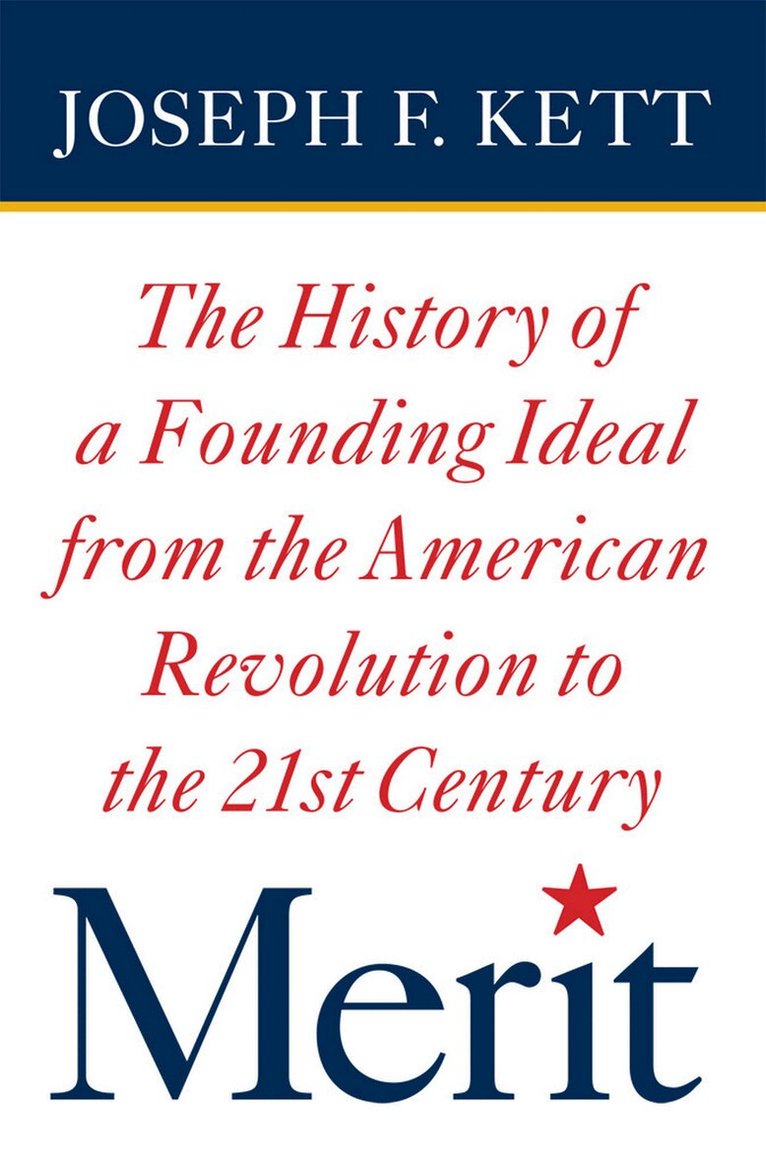
The idea that citizens' advancement should depend exclusively on merit, on qualities that deserve reward rather than on bloodlines or wire-pulling, was among the Founding ideals of the American republic, Joseph F. Kett argues in this provocative and engaging book. Merit's history, he contends, is best understood within the context of its often conflicting interaction with the other ideals of the Founding, equal rights and government by consent. Merit implies difference; equality suggests sameness. By sanctioning selection of those lower down by those higher up, merit potentially conflicts with the republican ideal that citizens consent to the decisions that affect their lives. In Merit, which traces the history of its subject over three centuries, Kett asserts that Americans have reconciled merit with other principles of the Founding in ways that have shaped their distinctive approach to the grading of public schools, report cards, the forging of workplace hierarchies, employee rating forms, merit systems in government, the selection of officers for the armed forces, and standardized testing for intelligence, character, and vocational interests. Today, the concept of merit is most commonly associated with measures by which it is quantified. Viewing their merit as an element of their selfhood—essential merit—members of the Founding generation showed no interest in quantitative measurements. Rather, they equated merit with an inner quality that accounted for their achievements and that was best measured by their reputations among their peers. In a republic based on equal rights and consent of the people, however, it became important to establish that merit-based rewards were within the grasp of ordinary Americans. In response, Americans embraced institutional merit in the form of procedures focused on drawing small distinctions among average people. They also developed a penchant for increasing the number of winners in competitions—what Kett calls "selection in" rather than "selection out"—in order to satisfy popular aspirations. Merit argues that values rooted in the Founding of the republic continue to influence Americans' approach to controversies, including those surrounding affirmative action, which involve the ideal of merit.
Inbunden, Engelska, 2017
380 kr
Skickas inom 3-6 vardagar
Are colleges and universities in a period of unprecedented disruption? Is a bachelor's degree still worth the investment? Are the humanities coming to an end? What, exactly, is higher education good for?In For the Common Good, Charles Dorn challenges the rhetoric of America's so-called crisis in higher education by investigating two centuries of college and university history. From the community college to the elite research university—in states from California to Maine—Dorn engages a fundamental question confronted by higher education institutions ever since the nation's founding: Do colleges and universities contribute to the common good?Tracking changes in the prevailing social ethos between the late eighteenth and early twenty-first centuries, Dorn illustrates the ways in which civic-mindedness, practicality, commercialism, and affluence influenced higher education's dedication to the public good. Each ethos, long a part of American history and tradition, came to predominate over the others during one of the four chronological periods examined in the book, informing the character of institutional debates and telling the definitive story of its time. For the Common Good demonstrates how two hundred years of political, economic, and social change prompted transformation among colleges and universities—including the establishment of entirely new kinds of institutions—and refashioned higher education in the United States over time in essential and often vibrant ways.
Häftad, Engelska, 2014
269 kr
Skickas inom 10-15 vardagar
Since the early 1990s, the federal role in education—exemplified by the controversial No Child Left Behind Act (NCLB)—has expanded dramatically. Yet states and localities have retained a central role in education policy, leading to a growing struggle for control over the direction of the nation's schools. In An Education in Politics, Jesse H. Rhodes explains the uneven development of federal involvement in education. While supporters of expanded federal involvement enjoyed some success in bringing new ideas to the federal policy agenda, Rhodes argues, they also encountered stiff resistance from proponents of local control. Built atop existing decentralized policies, new federal reforms raised difficult questions about which level of government bore ultimate responsibility for improving schools.Rhodes's argument focuses on the role played by civil rights activists, business leaders, and education experts in promoting the reforms that would be enacted with federal policies such as NCLB. It also underscores the constraints on federal involvement imposed by existing education policies, hostile interest groups, and, above all, the nation's federal system. Indeed, the federal system, which left specific policy formation and implementation to the states and localities, repeatedly frustrated efforts to effect changes: national reforms lost their force as policies passed through iterations at the state, county, and municipal levels. Ironically, state and local resistance only encouraged civil rights activists, business leaders, and their political allies to advocate even more stringent reforms that imposed heavier burdens on state and local governments. Through it all, the nation's education system made only incremental steps toward the goal of providing a quality education for every child.
Inbunden, Engelska, 2016
549 kr
Skickas inom 10-15 vardagar
Throughout the twentieth century, local control of school districts was one of the most contentious issues in American politics. As state and federal regulation attempted to standardize public schools, conservatives defended local prerogative as a bulwark of democratic values. Yet their commitment to those values was shifting and selective. In The Fight for Local Control, Campbell F. Scribner demonstrates how, in the decades after World War II, suburban communities appropriated legacies of rural education to assert their political autonomy and in the process radically changed educational law. Scribner's account unfolds on the metropolitan fringe, where rapid suburbanization overlapped with the consolidation of thousands of small rural schools. Rural residents initially clashed with their new neighbors, but by the 1960s the groups had rallied to resist government oversight. What began as residual opposition to school consolidation would transform into campaigns against race-based busing, unionized teachers, tax equalization, and secular curriculum. In case after case, suburban conservatives carved out new rights for local autonomy, stifling equal educational opportunity.Yet Scribner also provides insight into why many conservatives have since abandoned localism for policies that stress school choice and federal accountability. In the 1970s, as new battles arose over unions, textbooks, and taxes, districts on the rural-suburban fringe became the first to assert individual choice in the form of school vouchers, religious exemptions, and a marketplace model of education. At the same time, they began to embrace tax limitation and standardized testing, policies that checked educational bureaucracy but bypassed local school boards. The effect, Scribner concludes, has been to reinforce inequalities between districts while weakening participatory government within them, keeping the worst aspects of local control in place while forfeiting its virtues.
Inbunden, Engelska, 2016
664 kr
Skickas inom 10-15 vardagar
In A New Moral Vision, Andrea L. Turpin explores how the entrance of women into U.S. colleges and universities shaped changing ideas about the moral and religious purposes of higher education in unexpected ways, and in turn profoundly shaped American culture. In the decades before the Civil War, evangelical Protestantism provided the main impetus for opening the highest levels of American education to women. Between the Civil War and World War I, however, shifting theological beliefs, a growing cultural pluralism, and a new emphasis on university research led educators to reevaluate how colleges should inculcate an ethical outlook in students—just as the proportion of female collegians swelled. In this environment, Turpin argues, educational leaders articulated a new moral vision for their institutions by positioning them within the new landscape of competing men's, women's, and coeducational colleges and universities. In place of fostering evangelical conversion, religiously liberal educators sought to foster in students a surprisingly more gendered ideal of character and service than had earlier evangelical educators. Because of this moral reorientation, the widespread entrance of women into higher education did not shift the social order in as egalitarian a direction as we might expect. Instead, college graduates—who formed a disproportionate number of the leaders and reformers of the Progressive Era—contributed to the creation of separate male and female cultures within Progressive Era public life and beyond. Drawing on extensive archival research at ten trend-setting men's, women's, and coeducational colleges and universities, A New Moral Vision illuminates the historical intersection of gender ideals, religious beliefs, educational theories, and social change in ways that offer insight into the nature—and cultural consequences—of the moral messages communicated by institutions of higher education today.
Inbunden, Engelska, 2017
380 kr
Skickas inom 3-6 vardagar
Two Weeks Every Summer, which is based on extensive oral history interviews with former guests, hosts, and administrators in Fresh Air programs, opens a new chapter in the history of race in the United States by showing how the actions of hundreds of thousands of rural and suburban residents who hosted children from the city perpetuated racial inequity rather than overturned it. Since 1877 and to this day, Fresh Air programs from Maine to Montana have brought inner-city children to rural and suburban homes for two-week summer vacations. Tobin Miller Shearer brings to the forefront of his history of the Fresh Air program the voices of the children themselves through letters that they wrote, pictures that they took, and their testimonials. Shearer offers a careful social and cultural history of the Fresh Air programs, giving readers a good sense of the summer experiences for both hosts and the visiting children. By covering the racially transformative years between 1939 and 1979, Shearer shows how the rhetoric of innocence employed by Fresh Air boosters largely served the interests of religiously minded white hosts and did little to offer more than a vacation for African American and Latino urban youth. In what could have been a new arena for the civil rights movement, white adults often overpowered the courageous actions of children of color. By giving white suburbanites and rural residents a safe race relations project that did not require adjustments to their investment portfolios, real estate holdings, or political affiliations, the programs perpetuated an economic order that marginalized African Americans and Latinos by suggesting that solutions to poverty lay in one-on-one acts of charity.
Häftad, Engelska, 2018
342 kr
Skickas inom 10-15 vardagar
During the height of the wars in Iraq and Afghanistan, the Pentagon launched a controversial counterinsurgency program called the Human Terrain System. The program embedded social scientists within military units to provide commanders with information about the cultures and grievances of local populations. Yet the controversy it inspired was not new. Decades earlier, similar national security concerns brought the Department of Defense and American social scientists together in the search for intellectual weapons that could combat the spread of communism during the Cold War. In Armed with Expertise, Joy Rohde traces the optimistic rise, anguished fall, and surprising rebirth of Cold War–era military-sponsored social research. Seeking expert knowledge that would enable the United States to contain communism, the Pentagon turned to social scientists. Beginning in the 1950s, political scientists, social psychologists, and anthropologists optimistically applied their expertise to military problems, convinced that their work would enhance democracy around the world. As Rohde shows, by the late 1960s, a growing number of scholars and activists condemned Pentagon-funded social scientists as handmaidens of a technocratic warfare state and sought to eliminate military-sponsored research from American intellectual life. But the Pentagon's social research projects had remarkable institutional momentum and intellectual flexibility. Instead of severing their ties to the military, the Pentagon's experts relocated to a burgeoning network of private consulting agencies and for-profit research offices. Now shielded from public scrutiny, they continued to influence national security affairs. They also diversified their portfolios to include the study of domestic problems, including urban violence and racial conflict. In examining the controversies over Cold War social science, Rohde reveals the persistent militarization of American political and intellectual life, a phenomenon that continues to raise grave questions about the relationship between expert knowledge and American democracy.
Häftad, Engelska, 2022
342 kr
Skickas inom 10-15 vardagar
Are colleges and universities in a period of unprecedented disruption? Is a bachelor's degree still worth the investment? Are the humanities coming to an end? What, exactly, is higher education good for?In For the Common Good, Charles Dorn challenges the rhetoric of America's so-called crisis in higher education by investigating two centuries of college and university history. From the community college to the elite research university—in states from California to Maine—Dorn engages a fundamental question confronted by higher education institutions ever since the nation's founding: Do colleges and universities contribute to the common good?Tracking changes in the prevailing social ethos between the late eighteenth and early twenty-first centuries, Dorn illustrates the ways in which civic-mindedness, practicality, commercialism, and affluence influenced higher education's dedication to the public good. Each ethos, long a part of American history and tradition, came to predominate over the others during one of the four chronological periods examined in the book, informing the character of institutional debates and telling the definitive story of its time. For the Common Good demonstrates how two hundred years of political, economic, and social change prompted transformation among colleges and universities—including the establishment of entirely new kinds of institutions—and refashioned higher education in the United States over time in essential and often vibrant ways.