Conflict, Culture, Communication – serie
Visar alla böcker i serien Conflict, Culture, Communication. Handla med fri frakt och snabb leverans.
2 produkter
2 produkter
Inbunden, Engelska, 2026
1 548 kr
Kommande
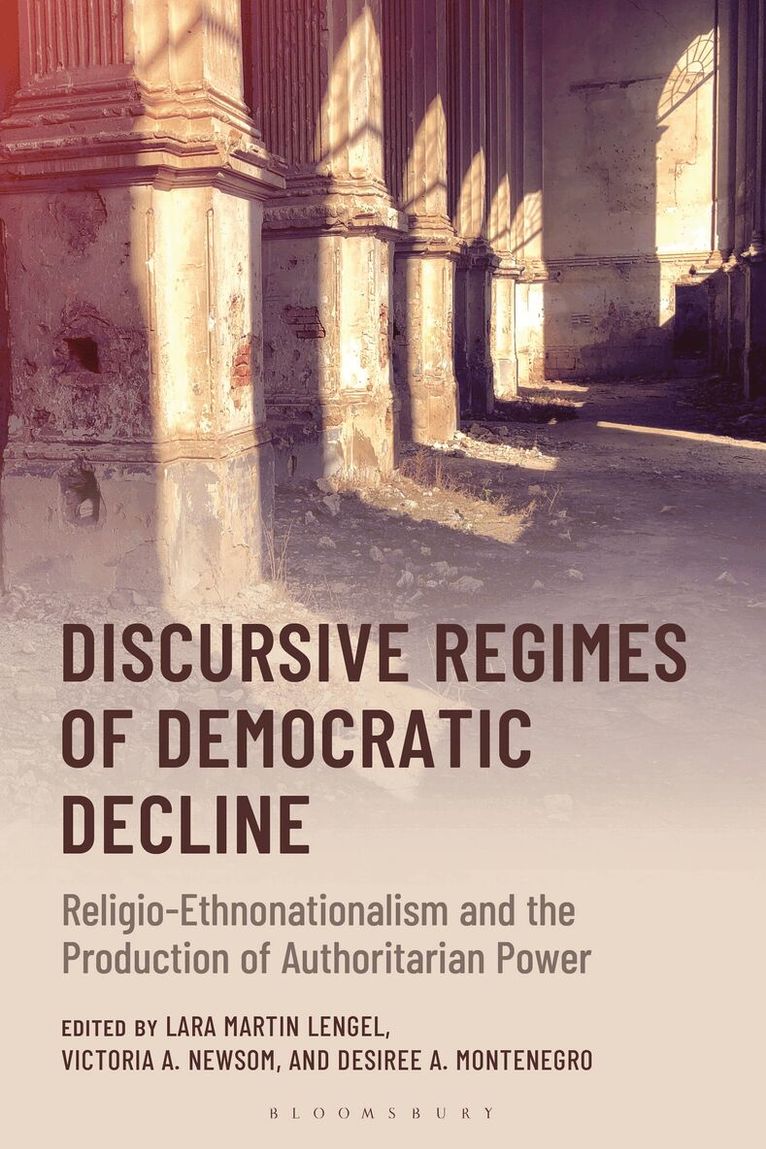
This edited collection brings together esteemed international scholars to examine how religio-ethnonationalist power is produced, normalized, and resisted through discourse. Rather than treating democratic decline as a purely institutional or electoral phenomenon, the book foregrounds communicative processes through which exclusionary identities, historical narratives, moral claims, and affective appeals are mobilized to legitimate authoritarian power. As the first book in communication studies to systematically theorize religio-ethnonationalism as a central analytic framework, Democratic Decline advances understanding of how religion, nationalism, and media power intersect in struggles over democracy. Contributors from Ghana, Great Britain, India, Iran, Malaysia, Nigeria, North Macedonia, and the U.S. analyze how discourse functions simultaneously as a mechanism of domination and a site of contestation, shaping memory, identity, citizenship, and political belonging through processes of discursive amnesia, discursive amnesty, discursive cleansing, and discursive resistance.The book engages a wide range of interdisciplinary conversations, including peace, war, and conflict resolution, legal and policy analysis, colonial and post-colonial inquiry, ethnic and minority rights, post-structuralist discourse theory, civil society, and environmental injustice. Across these intersecting domains, contributors demonstrate how religio-ethnonationalist projects rely on structured forgetting, moralized narratives, and affective polarization to sustain hierarchies of power and exclusion, while also revealing uneven conditions under which resistance emerges.By centering communication as a site of democratic struggle, Democratic Decline offers readers conceptual tools for identifying how democratic backsliding is communicatively produced and challenged, while foregrounding the ethical and political stakes of memory, identity, power, and resistance in shaping the future of democracy.
Inbunden, Engelska, 2027
1 459 kr
Kommande
This edited volume examines discourse and the construction of violence to investigate how language is weaponized to construct violence-priming and endorse discourses that enable terrorism, war, and other forms of conflict. Contributors examine a variety of cases, including discourses rooted in anti-Semitism, Islamophobia, white nationalism, and other ideological extremisms, to demonstrate how the ultimate aim of these discourses is to dehumanize groups and consolidate power. To offer an interdisciplinary perspective, contributors use approaches from a variety of fields, including communication and rhetoric, sociology, critical and cultural studies, political science, peace and conflict studies, and linguistics. The collection is split into three distinct aspects of weaponized language -- dehumanization and othering; justification of violence; and language as resistance.