Granary Books – serie
Visar alla böcker i serien Granary Books. Handla med fri frakt och snabb leverans.
3 produkter
3 produkter
Häftad, Engelska, 2001
180 kr
Skickas inom 5-8 vardagar
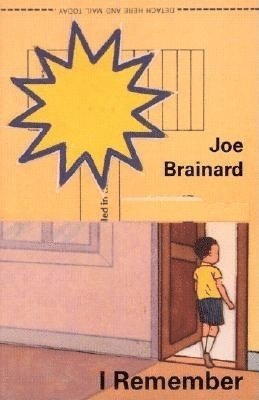
The American artist's much-imitated memoir, described by Paul Auster as "one of the few totally original books I have ever read.”Joe Brainard's I Remember is a literary and artistic cult classic, praised and admired by writers from Paul Auster to John Ashery and Edmund White. As autobiography, Brainard's method was brilliantly simple: to set down specific memories as they rose to the surface of his consciousness, each prefaced by the refrain "I remember": "I remember when I thought that if you did anything bad, policemen would put you in jail." Brainard's enduring gem of a book has been issued in various forms over the past thirty years. In 1970, Angel Hair books published the first edition of I Remember, which quickly sold out; he wrote two subsequent volumes for Angel Hair, More I Remember (1972) and More I Remember More (1973), both of which proved as popular as the original. In 1973, the Museum of Modern Art in New York published Brainard's I Remember Christmas, a new text for which he also contributed a cover design and four drawings. Excerpts from the Angel Hair editions appeared in Interview, Gay Sunshine, The World and the New York Herald. Then in 1975, Full Court Press issued a revised version collecting all three of the Angel Hair volumes and added new material, using the original title I Remember. This complete edition is prefaced by poet and translator Ron Padgett.
Häftad, Engelska, 2004
318 kr
Skickas inom 5-8 vardagar
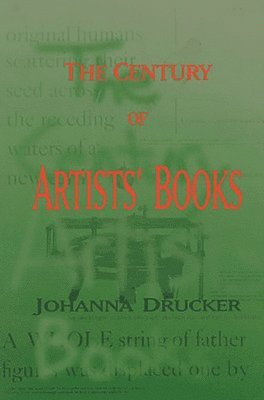
"From codex to document, from performance to self-image, the world of artists' books is made available to student and teacher, collector and connoisseur.” –Paula Frosch, Metropolitan Museum of Art Library, Library JournalNow Back in Print! Johanna Drucker's The Century of Artists' Books is the seminal full-length study of the development of artists' books as a twentieth-century art form. By situating artists' books within the context of mainstream developments in the visual arts, Drucker raises critical and theoretical issues as well as providing a historical overview of the medium. Within its pages, she explores more than two hundred individual books in relation to their structure, form, and conceptualization. This latest edition of the book features a new preface by Drucker and includes an introduction by New York Times senior art critic Holland Cotter.Prior praise for Johanna Drucker's The Century of Artists' Books:“[Drucker] locates the artists' book, in all of its multitudinous aspects, within every significant modern movement and draws on an extensive bibliography of scholarly references to reveal the philosophical and artistic connections among the several emerging avant-garde movements of the early twentieth century.... The book vastly expands our understanding of the interdependence of structure and meaning in artists' books.”--Buzz Spector, Art Journal“A folded fan, a set of blocks, words embedded in lucite: artists' books are a singular form of imaginative expression. With the insight of the artist and the discernment of the art historian, Drucker details over 200 of these works, relating them to the variety of art movements of the last century and tracing their development in form and concept. This work, one of the first full-length studies available of artists' books, provides both a critical analysis of the structures themselves and a basis for further reflection on the philosophical and conceptual roles they play. From codex to document, from performance to self-image, the world of artists' books is made available to student and teacher, collector and connoisseur. A useful work for all art collections, both public and academic.” Paula Frosch, Metropolitan Museum of Art Library, Library Journal
Häftad, Engelska, 2008
217 kr
Skickas inom 5-8 vardagar
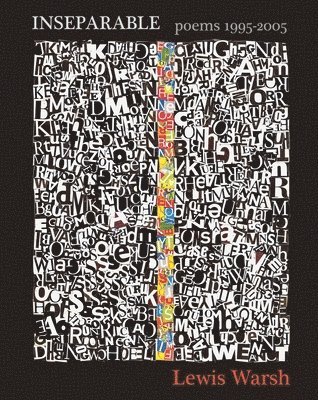
Inseparable collects poems written between 1995 and 2005 by the New York poet, editor and novelist Lewis Warsh. Strongly identified with New York since the 1960s, when he co-founded Angel Hair magazine with Anne Waldman, Warsh makes poems from the city’s linguistic fabric, interwoven with a bemused real-time interiority. The 35 poems of this collection are pitted with reminiscences made approachable to the reader by their lack of self-absorption; it is the momentum of the will to persist by means of language--“moving, word by word”--against the incipient flickerings of mortality, that is their real logic. This act of self-propulsion may be subject to doubt (“Can we spend our lives feeding/off simple endurance?”), but it is humbly pursued: Warsh resists the inflated rhetoric such preoccupations usually attract and sticks instead with (in the words of his colleague Clark Coolidge) “confusion, in strict order.”