Nuffield European Studies - Böcker
Visar alla böcker i serien Nuffield European Studies. Handla med fri frakt och snabb leverans.
5 produkter
5 produkter
1 275 kr
Skickas inom 3-6 vardagar
Nuffield European StudiesSeries editors: Joachim Jens Hesse and Vincent WrightThis series provides students and teachers in the social sciences and related disciplines with interdisciplinary and comparative works dealing with significant political, economic, legal, and social problems confronting European nation-states and the European Community. It will comprise both research monographs and the edited proceedings of conferences organized by the Centre for European Studies at Nuffield College, Oxford.The role of interest groups in the formulation of EC policy is a central aspect of the development of the European Community. This book is unique in providing both an academic analysis of the system and an insider's view of how lobbying actually works.The first part examines the consequences of the increasing transference of power to Brussels in terms of the EC policy process, the activities of the Commission of the EC as an `adolescent' bureaucracy, and the behaviour of interest associations at national and European level. Subsequent chapters look in detail at the wide range of interest groups involved in lobbying, including business, industry, the financial sector, and voluntary organizations.The combination of contributions from academic specialists and practitioners, including Commission officials and interest group leaders, will make this book uniquely interesting as a study of a key area of the evolving European policy process.Contributors: Lynn Collie, Martin Donnelly, Dick Eberlie, Wyn Grant, Brian Harvey, Robert Hull, Grant Jordan, Jeffrey Knight, Andrew McLaughlin, James Mitchell, Jean-Pierre Peckstadt, Jane Sargent
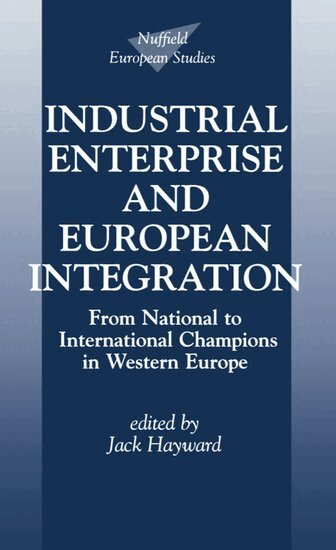
Industrial Enterprise and European Integration
From National to International Champions in Western Europe
Inbunden, Engelska, 1995
2 933 kr
Skickas inom 5-8 vardagar
For centuries states have attempted to increase their national wealth and power by protecting and promoting certain privileged enterprises. Since the 1960s this phenomena has accelerated with the emergence of 'national champions' - firms socially selected and promoted by governments to carry the national flag into the internationally competitive arena.This volume focuses on how European national champions have fared in an increasingly globalized industrial context. After setting the four national policy contexts of France, Germany, Britain, and Italy, it considers four major industrial sectors comparatively: electricity, aerospace, air transport, and telecommunications. It goes on to examine the binational collaboration involved in the Channel Tunnel project.It concludes with an assessment of the increasing impact of the European Union on Europe's national champions as they lose their national identity and monopoly status and become Europeanized, globalized, and hybridized.
862 kr
Skickas inom 7-10 vardagar
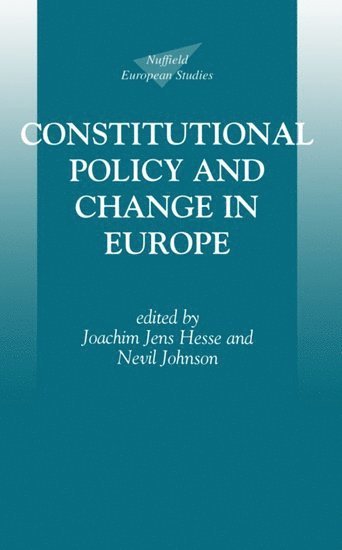
During recent years, constitutional issues have claimed increasing attention in many European countries. The social and political transformations in Central and Eastern Europe have thrust constitutional debates to the fore. This book looks at the needs and claims of constitutional adaption and reconstruction in contemporary Europe. The range and complexity of the constitutional challenge in Europe, which differs markedly form one country to another, is fully explored. The contributions to this book illustrate certain aspects of this challenge as it is perceived in various European countries and of the different responses to it. The problems discussed are approached from the constitutional legal aspects, in others from those of political science.The different tasks facing Western, and East and Central Europe are considered in some detail. In Western Europe, constitutional debate has assumed greater prominence on account of closer economic and political integration within the European Community and internal changes within particular countries. In the East, far-reaching constitutional reconstruction has been an imperative, a task which has had to be tackled in the difficult and uncertain conditions of radical, social and economic transformation.The book also address some of the issues of political theory presented by the notion of liberal constitutionalism itself and throws light on the direction of future change.
Federalizing Europe?
The Costs, Benefits, and Preconditions of Federal Political Systems
Inbunden, Engelska, 1996
1 303 kr
Skickas inom 3-6 vardagar
This constitutional and institutional development of the European Community, and federalism in particular, are widely and intensely debated. The issue of federalism has proved to be divisive and misunderstood. This book provides a critical reappraisal of the political, economic, and socio-cultural potential of current federal political-institutional arrangements. It includes both an analysis of their necessary preconditions as well as evaluation of their advantages and disadvantages compared with other forms of state organisation.The authors examine the issue at the level of the Community, the member states, and the states of Central and Eastern Europe reflecting the increasing interdependence and interplay of these three levels; nation states in all parts of Europe influencing only one another and the Community, and being influenced by it. The book concludes with an overall assessment of the federalizing processes at work in Europe, both at the Community and nation state level, and pints out the problems, paradoxes and likely outcomes of these processes.
2 977 kr
Skickas inom 5-8 vardagar
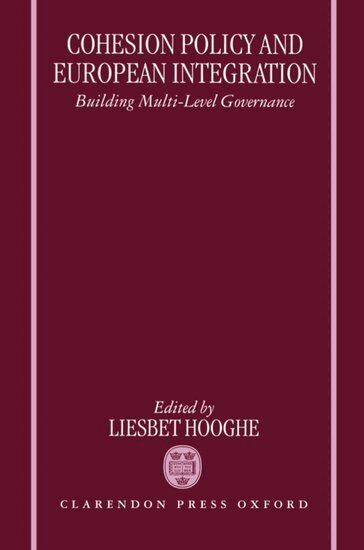
How can one convince potent nation-states to put their sovereignty at risk in common European policies? EU cohesion policy, now one-third of the EU budget, provides such a puzzle. Until 1988 the European Commission shared out money to national governments with few strings attached. Since the reform of 1988, national governments are required to negotiate with the Commission and regional authorities on how to use the money. Has this European-wide policy eroded national sovereignty in favour of a stronger role for the Commission and more power for Europe's regions?The first part of this book probes into the policy dynamics at the European level. In the second part, eight country studies evaluate the impact of uniform EU policy on territorial relations by comparing policy making before and after reform. The concluding section explains persistent variation in EU cohesion decision making and implementation.